
Background
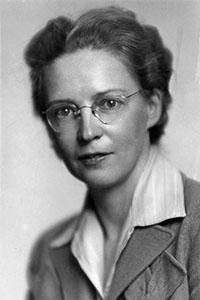
America may have had the fictional "Rosie the Riveter" – made famous during the Second World War – but Canada had its own female role model in a real person.
Elsie MacGill was known as "Queen of the Hurricanes," and is remembered for leading the production of the Hawker Hurricane, a plane specifically adapted to fly in cold weather. She also designed the Maple Leaf trainer, which may still be the only plane completely designed by a woman.
The Hawker Hurricane
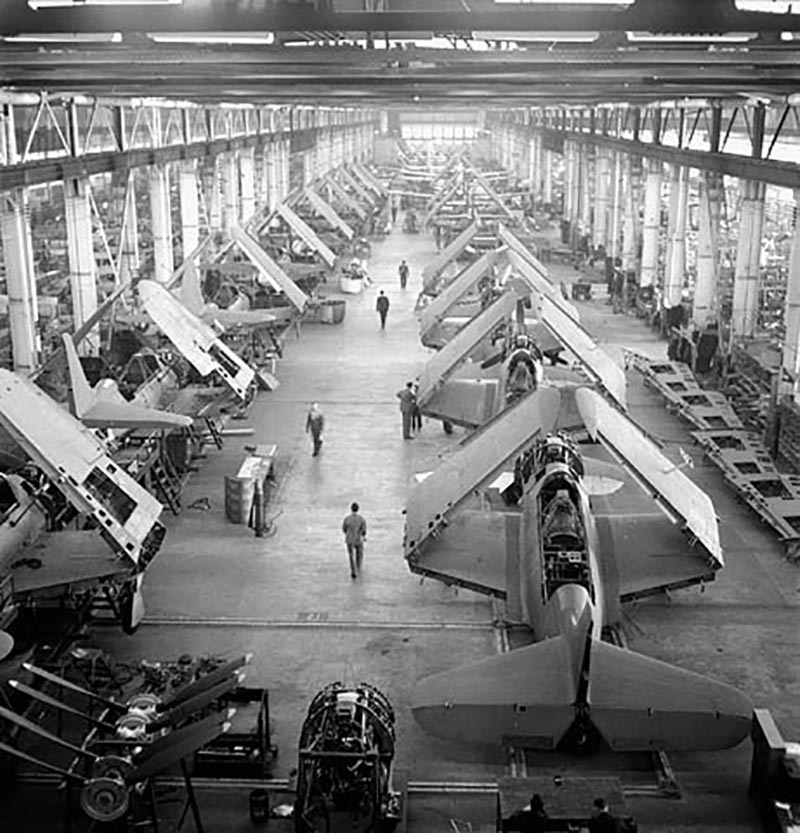
As a 35-year-old aeronautical engineer she supervised the production of Hawker Hurricane fighter planes at the Canadian Car and Foundry Company.
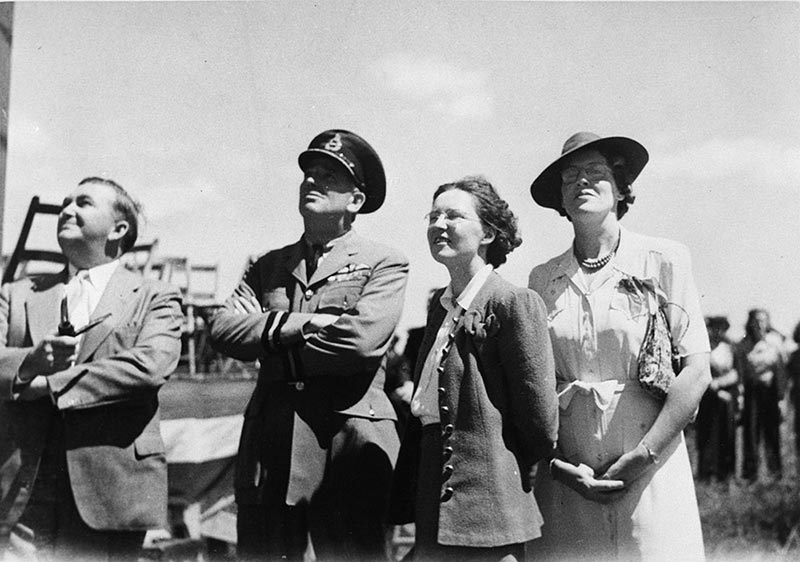
David Boyd, Brian Sheaver, Elsie MacGill and Mary Boyd watching flight of Hurricane aircraft at Canadian Car and Foundry Co. flying field. Library and Archives – 3222815.
A few weeks after the beginning of World War II in 1939, she was informed that the plant would be involved with large-scale production of military aircraft.
She was put in charge of all engineering work related to the Canadian production of the British-designed Hawker Hurricane fighter. Within a year the old railway car plant was producing three fighters a day with a staff of 4,500.
A total of 1,450 Hurricanes were produced in just two years. When this contract was completed, MacGill was made responsible for the production of 835 Curtiss Hell Divers for the U.S. Navy.
David Boyd, Brian Sheaver, Elsie MacGill and Mary Boyd watching flight of Hurricane aircraft at Canadian Car and Foundry Co. flying field. Library and Archives – 3222815.
Legacy
MacGill became a symbol of Canada's miraculous economic wartime transformation. She was even the subject of a comic book called "Queen of the Hurricanes" that was devoted to her achievements.
In addition to her aeronautical pursuits, she had a concern for the legal rights and status of women, became active in women's organizations throughout Canada, and was highly respected for her thoughtful and constructive views. In 1967 she was one of the seven appointees to the Royal Commission on the Status of Women. Just prior to her death she had accepted an appointment to the Canadian Organizing Committee for the 1981 International Year of the Disabled. She died in a car accident at Cambridge, Massachusetts, U.S.A., on November 4, 1980, before she could participate on this committee.
Learn more about Elsie MacGill
- Heritage Minutes: Elsie MacGill – Historica Canada
- New $1 coin features engineer and “Queen of the Hurricanes,” Elsie MacGill
- 1984 – inducted into Canada’s Aviation Hall of Fame
- Elsie MacGill – The Canadian Encyclopedia
- Queen of the Hurricanes – The Elsie MacGill Story
- National Historic Person: Elizabeth Muriel Gregory “Elsie” MacGill