
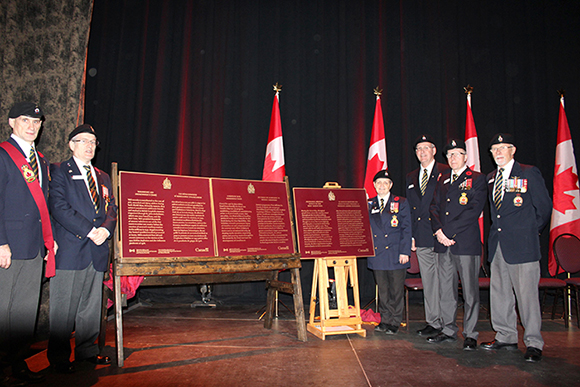
Le 2 mars 2017, le personnel du ministère de la Défense nationale (MDN) a appuyé Parcs Canada et la Commission des lieux et monuments historiques du Canada (CLMHC) lors d’un événement commémoratif sur la signification historique des Détachements d’aide volontaire. Ils ont fait défiler les drapeaux durant l’événement qui s’est déroulé dans le théâtre Barney-Danson au Musée canadien de la guerre. Se sont joints au maître de cérémonie M. Brian Alway, PhD, de la Commission des lieux et monuments historiques du Canada, lors du dévoilement de trois plaques, l’honorable Catherine McKenna (ministre de l’Environnement et du Changement climatique et ministre responsable de Parcs Canada), le conseiller Ron Bernard de la Première nation des Algonquins de Pikwakanagan, Mme Laura Brandon, PhD (ancienne historienne, Art et guerre du Musée canadien de la guerre) et Dave Mowat, membre de la Première Nation d’Alderville, des Mississaugas.
Plaque du Fonds de souvenirs de guerre canadiens
Ottawa, Ontario
Avis :
L’inventaire national des monuments commémoratifs militaires canadiens est un registre public alimenté par la contribution citoyenne qui permet aux Canadiens et aux Canadiennes de découvrir les monuments commémoratifs dans leur collectivité. La présence dans l’inventaire ne confère aucun droit de propriété ni pouvoir décisionnel à ACC. La responsabilité de l’entretien, de la gestion et de toute modification d’un monument incombe à l’organisme propriétaire ou gestionnaire.
Inscription
The Canadian War Memorials Fund
The Canadian War Memorials Fund (CWMF) was a charity initiated by Sir William Maxwell Aitken (subsequently Lord Beaverbrook) in November 1916. It was Canada’s first war art program and established the ongoing tradition of using artists to depict Canada at war.
The Fund was an outgrowth of the Canadian War Records Office (CWRO), an organ of the Canadian government founded in February 1916 and directed by Beaverbrook to document the conflict from a Canadian perspective in film, photography and print. The material he collected for the CWRO included official daily reports, maps, photographs and war diaries among other types of documents.
Beaverbrook’s new project of commissioning and collecting original works of war art was prompted in part by a lack of official war photographs, especially after the Second Battle of Ypres and the battles of Festubert, St. Eloi and Givenchy, which went largely unrecorded, at least visually. Post-battle paintings that reconstructed the events were criticized for lacking conviction. Worse, fake photographs and films purporting to depict elements of the battles began to be produced. Beaverbrook also believed that photographs had a maximum lifespan of 25 years. Only paintings, he believed, would survive long enough to convey a message about Canadian activity during the First World War for posterity.
Although Beaverbrook had formidable obstacles to overcome in trying to provide access to the front for artists and reporters, he eventually succeeded in moving artists into the theatre of war. These artists received military commissions and, as employees of the Canadian War Memorials Fund, compensation for materials, studio space and their completed works. In general, Beaverbrook and his partner the art critic P.G. Konody, commissioned oversized works in the tradition of historic battle paintings, with some smaller, more documentary works. Beaverbrook and Konody emphasized fieldwork and insisted that artists spend time on the battlefield making sketches that could later be transformed into canvases.
Nearly 1,000 paintings, photographs, drawings and films by over 100 artists, one-third of them Canadians, were commissioned. The Fund thus contributed to the artistic development of a number of important Canadian artists by providing them with salaries, commissions, supplies and media attention at a time when art production was little valued. The Fund paved the way for the growth of a young Canadian art scene by bringing together artists, curators, archivists, patrons and art institutions.
The hundreds of paintings, drawings, photographs and films produced for the Canadian War Memorials Fund were exhibited in London just after the war, as well as through the 1920s and 1930s, usually to warm public and critical acclaim. The collection was ultimately placed in the National Gallery of Canada. In 1971, most of the works were transferred to the Canadian War Museum, where they remain. The collection of the CWMF illustrates, commemorates and illuminates the Canadian experience of the First World War through the expression of Canadian artists.
Informations pour les visiteurs
Plaque du Fonds de souvenirs de guerre canadiens
1, place Vimy
Ottawa
Ontario
Lat. 45.4165562
Long. -75.7169158