
La plaque explicative des femmes en uniforme a été inaugurée le 4 septembre 2021, en présence d’une troupe de gardes du drapeau en marche de la filiale 340 (Southampton) de la Légion et de la filiale 155 (Port Elgin). Une foule d’environ 100 personnes y a assisté, y compris des membres de la famille et des descendants des femmes qui ont servi pendant les Première et Seconde Guerres mondiales. Bill Streeter a fait des recherches sur chacune des 19 femmes figurant sur la plaque.
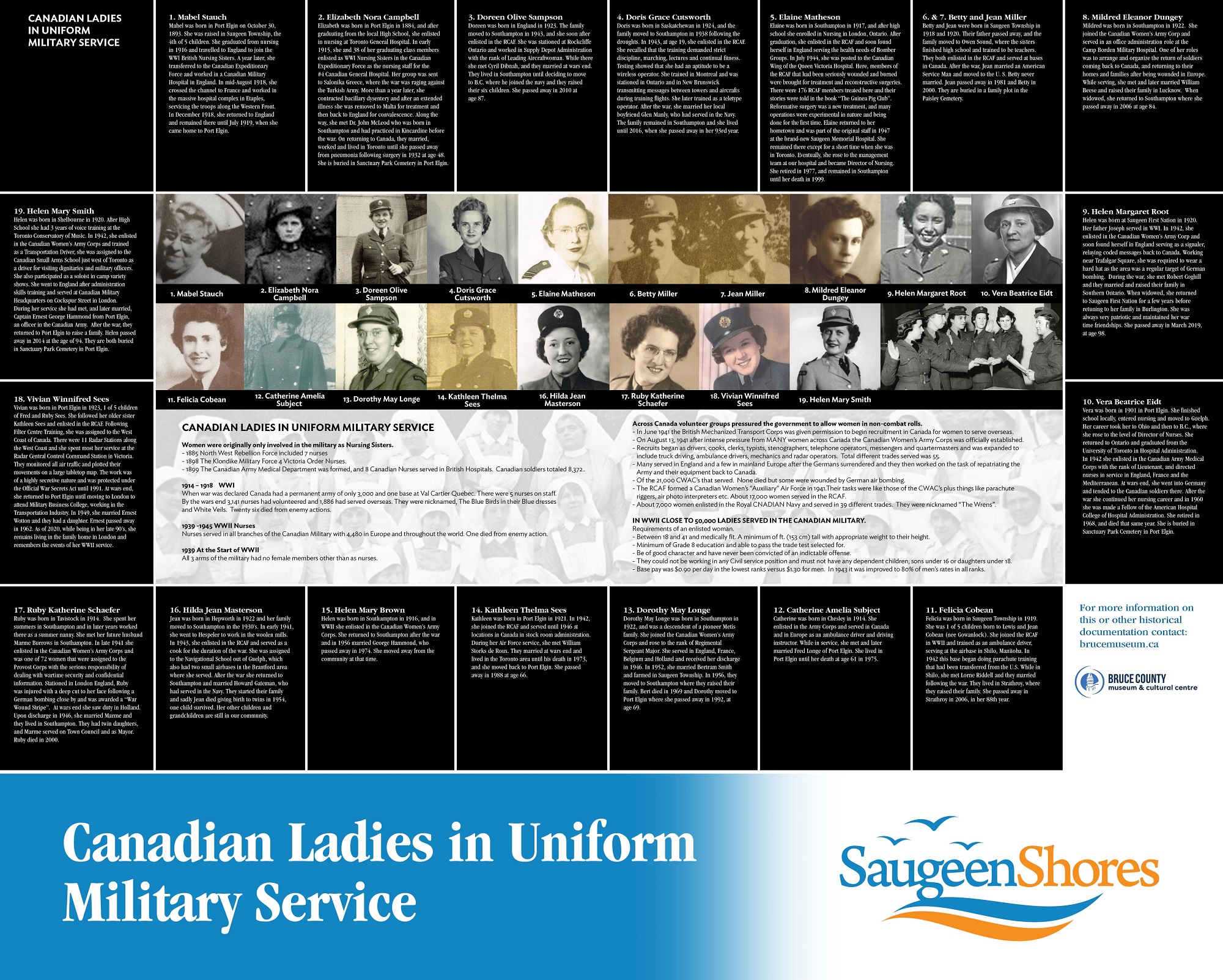
Ladies in Uniform Interpretive Plaque
Bill Streeter1
sur
2
images

Bill Streeter and Veteran Vivian Wotton at unveiling.
Bill Streeter1
sur
2
images
Type
Plaque explicative des femmes en uniforme
Port Elgin, Ontario
Avis :
L’inventaire national des monuments commémoratifs militaires canadiens est un registre public alimenté par la contribution citoyenne qui permet aux Canadiens et aux Canadiennes de découvrir les monuments commémoratifs dans leur collectivité. La présence dans l’inventaire ne confère aucun droit de propriété ni pouvoir décisionnel à ACC. La responsabilité de l’entretien, de la gestion et de toute modification d’un monument incombe à l’organisme propriétaire ou gestionnaire.
Inscription
CANADIAN LADIES IN UNIFORM MILITARY SERVICE
1. Mabel Stauch
Mabel was born in Port Elgin on October 30, 1893. She was raised in Saugeen Township, the 4th of 5 children. She graduated from nursing in 1916 and travelled to England to join the WW1 British Nursing Sisters. A year later, she transferred to the Canadian Expeditionary Force and worked in a Canadian Military hospital in England. In mid-August 1918, she crossed the channel to France and worked in the massive hospital complex in Etaples, servicing the troops along the Western Front. In December 1918, she returned to England and remained there until July 1919, when she came here to Port Elgin.
2. Elizabeth Nora Campbell
Elizabeth was born in Port Elgin in 1884, and after graduating from the local high school, she enlisted in nursing at Toronto General Hospital. In early 1915, she and 38 of her graduating class members enlisted as WWI Nursing Sisters in the Canadian Expeditionary Force as the nursing staff for the #1 Canadian General Hospital. Her group was sent to Salonika, Greece, where the war was raging against the Turkish Army. More than a year later, she contracted bacillary dysentery and after an extended illness she was removed to Malta for treatment and then back to England for convalescence. Along the way, she met Dr. John McLeod who was born in Southampton and had practiced in Kincardine before the war. On returning to Canada, they married, worked and lived in Toronto until she passed away from pneumonia following surgery in 1932 at age 48. She is buried in Sanctuary Park Cemetery in Port Elgin.
3. Doreen Olive Sampson
Doreen was born in England in 1923. The family moved to Southampton in 1913, and she soon after enlisted in the RCAF. She was stationed at Rockcliffe, Ontario and worked in Supply Depot Administration with the rank of Leading Aircraftwoman. While there she Cyril Dibnah, and they married at wars end. They lived in Southampton until deciding to move to B.C. where he joined the navy and they raised their six children. She passed away in 2010 at age 87.
4. Doris Grace Cutsforth
Doris was born in Saskatchewan in 1924, and the family moved to Southampton in 1938 following the droughts. In 1943, at the age of 19, Doris enlisted in the RCAF. She recalled that the training demanded strict discipline, marching, lectures and continual fitness. Testing showed that she had an aptitude to be a wireless operator. She trained in Montreal and was stationed in Ontario and in New Brunswick transmitting messages between towers and aircrafts during training flights. She later trained as a teletype operator. After the war, she married Glen Manly, who had served in the Navy. The family remained in Southampton and she lived until 2016, when she passed away in her 93rd year.
5. Elaine Matheson
Elaine was born in Southampton in 1917, and after high school she enrolled in Nursing in London, Ontario. After graduation, she enlisted in the RCAF and soon found herself in England serving the health needs of Bomber Groups. In July 1944, she was posted to the Canadian Wing of the Queen Victoria Hospital. Here members of the RCAF that had been seriously wounded and burned were brought for treatment and reconstructive surgeries. There were 176 RCAF members treated here and their stories were told in the book “The Guinea Pig Club”. Reformative surgery was a new treatment, and many operations were experimental in nature and being done for the first time. Elaine returned to her hometown and was part of the original staff in 1947 at the brand-new Saugeen Memorial Hospital. She remained there except for a short time when she was in Toronto. Eventually, she rose to the management team at our hospital and became Director of Nursing. She retired in 1977, and remained in Southampton until her death in 1999.
6. & 7. Betty and Jean Miller
Betty and Jean were born in Saugeen Township in 1918 and 1920. Their father passed away, and the family moved to Owen Sound, where the sisters finished high school and trained to be teachers. They both enlisted in the RCAF and served at bases in Canada. After the war, Jean married an American Service Man and moved to the U.S. Betty never married. Jean passed away in 1981 and Betty in 2000. They are buried in a family plot in the Paisley Cemetery.
8. Mildred Eleanor Dungey
Mildred was born in Southampton in 1922. She joined the Canadian Women's Army Corp and served in an office administration role at the Camp Borden Military Hospital. One of her roles was to arrange and organize the return of soldiers coming back to Canada, and returning to their homes and families after being wounded in Europe. While serving, she met and later married Wiliam Beese and raised their family in Lucknow. When widowed, she returned to Southampton where she passed away in 2006 at age 84.
9. Helen Margaret Root
Helen was born at Saugeen First Nation in 1920. Her father Joseph served in WWI. In 1942, she enlisted in the Canadian Women's Army Corp and soon found herself in England serving as a signaler, relaying coded messages back to Canada. Working near Trafalgar Square, she was required to wear a hard hat as the area was a regular target of German bombing. During the war, she met Robert Coghill and they married and raised their family in Southern Ontario. When widowed, she returned to Saugeen First Nation for a few years before returning to her family in Burlington. She was always very patriotic and maintained he war time friendships. She passed away in March 2019, at age 98.
10. Vera Beatrice Eidt
Vera was born in 1901 in Port Eglin. She finished school locally, entered nursing and moved to Guelph. Her career took her to Ohio and then to B.C., where she rose to the level of Director of Nurses. She returned to Ontario and graduated from the University of Toronto in Hospital Administration. In 1942 she enlisted in the Canadian Army Medical Corps with the rank of Lieutenant, and directed nurses in service in England, France and the Mediterranean. At wars end, she went into Germany and tended to the Canadian soldiers there. After the war she continued her nursing career and in 1960 she was made a Fellow of the American Hospital College of Hospital Administration. She retired in 1968, and died that same year. She is buried in Sanctuary Park Cemetery in Port Elgin.
11. Felicia Cobean
Felicia was born in Saugeen Township in 1919. She was 1 of 5 children born to Lewis and Jean Cobean (nee Gowanlock). She joined the RCAF in WWII and trained as an ambulance driver, serving at the airbase in Shilo, Manitoba. In 1942 this base began doing parachute training that had been transferred from the U.S. While in Shilo, she met Lorne Riddell and they married following the war. They lived in Strathroy, where they raised their family. She passed away in Strathroy in 2006, in her 88th year.
12. Catherine Amelia Subject
Catherine was born in Chesley in 1914. She enlisted in the Army Corps and served in Canada and in Europe as an ambulance driver and driving instructor. While in service, she met and later married Fred Longe of Port Elgin. She lived in Port Elgin until her death at age 61 in 1975.
13. Dorothy May Longe
Dorothy May Longe was born in Southampton in 1922, and was a descendent of a pioneer Metis family, She joined the Canadian Women's Army Corps and rose to the rank of Regimental Sergeant Major. She served in England, France, Belgium and Holland and received her discharge in 1946. In 1952, she married Bertram Smith and farmed in Saugeen Township. In 1956, they moved to Southampton where they raised their family. Bert died in 1969 and Dorothy moved to Port Elgin where she passed away in 1992, at age 69.
14. Kathleen Thelma Sees
Kathleen was born in Port Elgin in 1921. In 1942, she joined the RCAF and served until 1946 at locations in Canada in stock room administration. During her Air Force service, she met William Storks de Roux. They married at wars end and lived in the Toronto area until his death in 1973, and she moved back to Port Elgin. She passed away in 1988 at age 66.
15. Helen Mary Brown
Helen was born in Southampton in 1916, and in WWII she enlisted in the Canadian Women's Army Corps. She returned to Southampton after the war and in 1956 married George Hammond, who passed away in 1974. She moved away from the community at that time.
16. Hilda Jean Masterson
Jean was born in Hepworth in 1922 and her family moved to Southampton in the 1930's. In early 1941, she went to Hespeler to work in the woolen mills. In 1945, she enlisted in the RCAF and served as a cook for the duration of the war. She was assigned to the Navigational School out of Guelph, which also had two small airbases in the Brantford area where she served. After the war she returned to Southampton and married Howard Gateman, who had served in the Navy. They started their family and sadly Jean died giving birth to twins in 1954, one child survived. Her other children and grandchildren are still in our community.
17. Ruby Katherine Schaefer
Ruby was born in Tavistock in 1914. She spent he summers in Southampton and in later years worked there as a summer nanny. She met her future husband Marme Burrows in Southampton. In late 1941 she enlisted in the Canadian Women's Army Corps and was one of 72 women that were assigned to the Provost Corps with the serious responsibility of dealing with wartime security and confidential information. Stationed in London England, Ruby was injured with a deep cut to her face following a German bombing close by and was awarded a "War Wound Stripe". At wars end she saw duty in Holland. Upon discharge in 1946, she married Marme and they lived in Southampton. They had twin daughters, and Marme served on Town Council as Mayor. Ruby died in 2000.
18. Vivian Winnifred Sees
Vivian was born in Port Elgin in 1923, 1 of 5 children of Fred and Ruby Sees. She followed her older sister Kathleen Sees and enlisted in the RCAF. Following Filter Centre Training, she was assigned to the West Coast of Canada. There were 11 Radar Stations along the West Coast and she spent most of her service at the Radar Central Control Command Station in Victoria. They monitored all air traffic and plotted their movements on a large tabletop map. The work was of a highly secretive nature and was protected under the Official War Secrets Act until 1991. At wars end, she returned to Port Elgin until moving to London to attend Military Business College, working in the Transportation Industry. In 1949, she married Ernest Wotton and they had a daughter. Ernest passed away in 1962. As of 2020, while being in her late 90's, she remains living in the family home in London and remembers the events of her WWII service.
19. Helen Mary Smith
Helen was born in Shelbourne in 1920. After High School she had 3 years of voice training at the Toronto Conservatory of Music. In 1942, she enlisted in the Canadian Women's Army Corps and trained as a Transportation Driver, she was assigned to the Canadian Small Arms School just west of Toronto as a driver for visiting dignitaries and military officers. She also participated as a soloist in camp variety shows. She went to England after administration skills training and served at Canadian Military Headquarters on Cockspur Street in London. During her service she had met, and later married, Captain Ernest George Hammond from Port Eglin, an officer in the Canadian Army. After the war, they returned to Port Eglin to raise a family. Helen passed away in 2014 at the age of 94. They are both buried in Sanctuary Park Cemetery in Port Eglin.
CANADIAN LADIES IN UNIFORM MILITARY SERVICE
Women were originally only involved in the military as Nursing Sisters.
- 1885 North West Rebellion Force included 7 nurses.
- 1898 The Klondike Military Force 4 Victoria Order Nurses.
- 1899 The Canadian Army Medical Department was formed, and 8 Canadian Nurses served in British Hospitals. Canadian soldiers totaled 8,372...
1914 - 1918 WWI
When war was declared Canada had a permanent army of only 3,000 and one base at Val Cartier Quebec. There were 5 nurses on staff. By the wars end 3, 141 nurses had volunteered and 1,886 had served overseas. They were nicknamed, The Blue Birds in the Blue dresses and White Veils. Twenty six died from enemy actions.
1938 - 1945 WWII Nurses
Nurses served in all branches of the Canadian Military with 4,480 in Europe and throughout the world. One died from enemy action.
1939 At the Start of WWII
All 3 arms of the military had no female members other than as nurses.
Across Canada volunteer groups pressured the government to allow women in non-combat rolls.
- In June 1941 the British Mechanized Transport Corps was given permission to begin recruitment in Canada for women to serve overseas.
- On August 13, 1941 after intense pressure from MANY women across Canada the Canadian Women’s Army Corps was officially established.
- Recruits began as drivers, cooks, clerks, typists, stenographers, telephone operators, messengers and quartermasters and was expanded to include truck driving, ambulance drivers, mechanics and radar operators. Total different trades served was 55.
- Many served in England and a few in mainland Europe after the Germans surrendered and they then worked on the task of repatriating the Army and their equipment back to Canada.
- Of the 21,000 CWAC’s that served, None died but some were wounded by German air bombing.
- The RCAF formed a Canadian Women’s “Auxiliary” Air Force in 1941. Their tasks were like those of the CWAC’s plus things like parachute riggers, air photo interpreters etc. About 17,000 women served in the RCAF.
- About 7,000 women enlisted in the Royal CANADIAN Navy and served in 39 different trades. They were nicknamed “The WRENS”.
IN WWII CLOSE TO 50,000 LADIES SERVED IN THE CANADIAN MILITARY.
Requirements of an enlisted woman.
- Between 18 and 41 and medically fit. A minimum of ft. (153) tall with appropriate weight to their height.
- Minimum of Grade 8 and able to pass the trades test selected for.
- Be of good character and have never been convicted of an indictable offense.
- They could not be working in any Civil Service position and must not have dependent children, sons under 16 or daughters under 18.
- Base pay was $0.90 per day in the lowest ranks versus $1.30 for men. In 1943 it was improved to 80% of men's rates in all ranks.
Informations pour les visiteurs
Location
Plaque explicative des femmes en uniforme
600, rue Tomlinson
Port Elgin
Ontario
Plaque explicative des femmes en uniforme
600, rue Tomlinson
Port Elgin
Ontario
Coordonnées GPS
Lat. 44.4501277
Long. -81.3753147
Lat. 44.4501277
Long. -81.3753147