
« Un chemin vers la paix »

Vancouver, Colombie-Britannique
Type
Autre

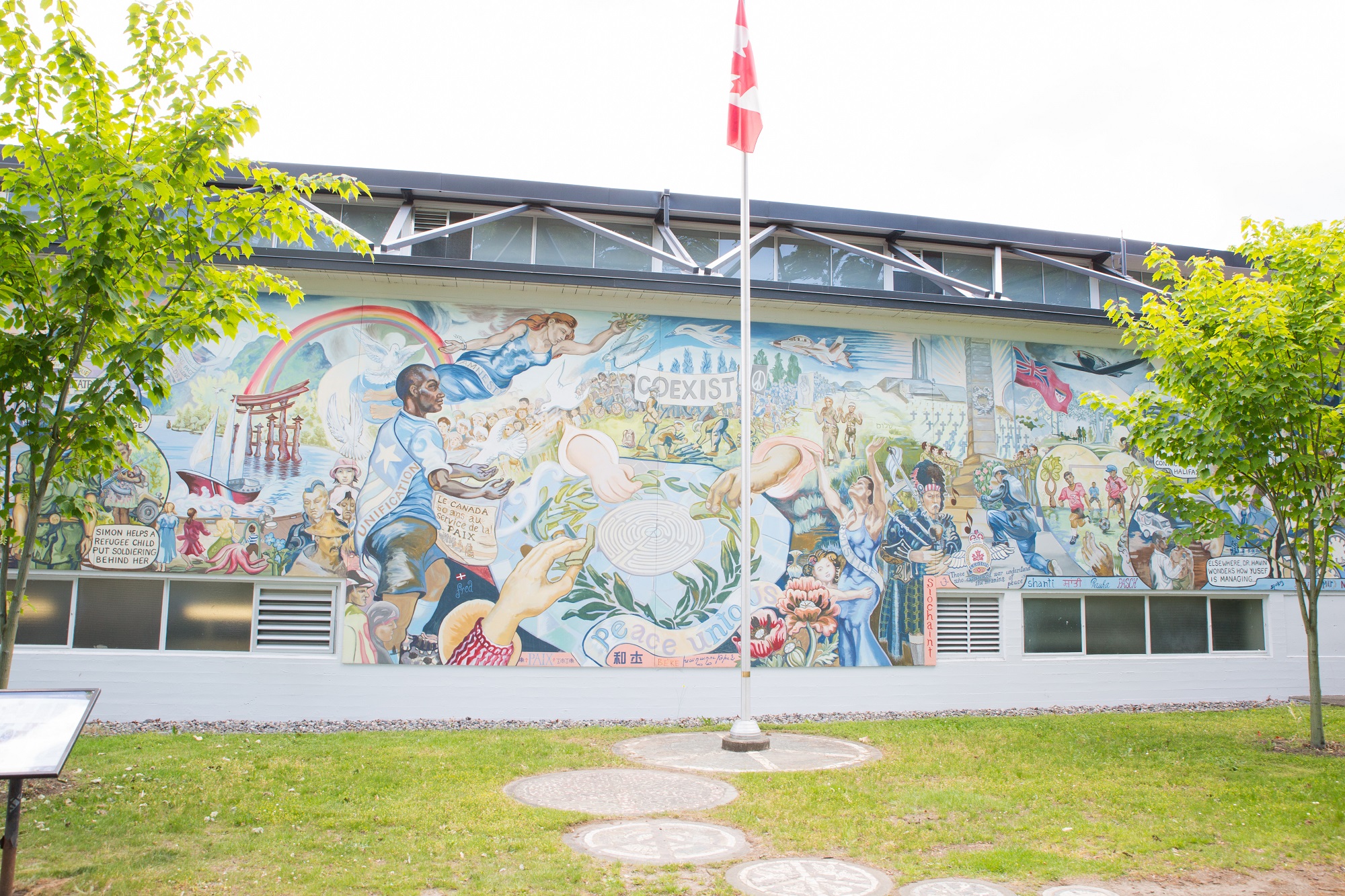
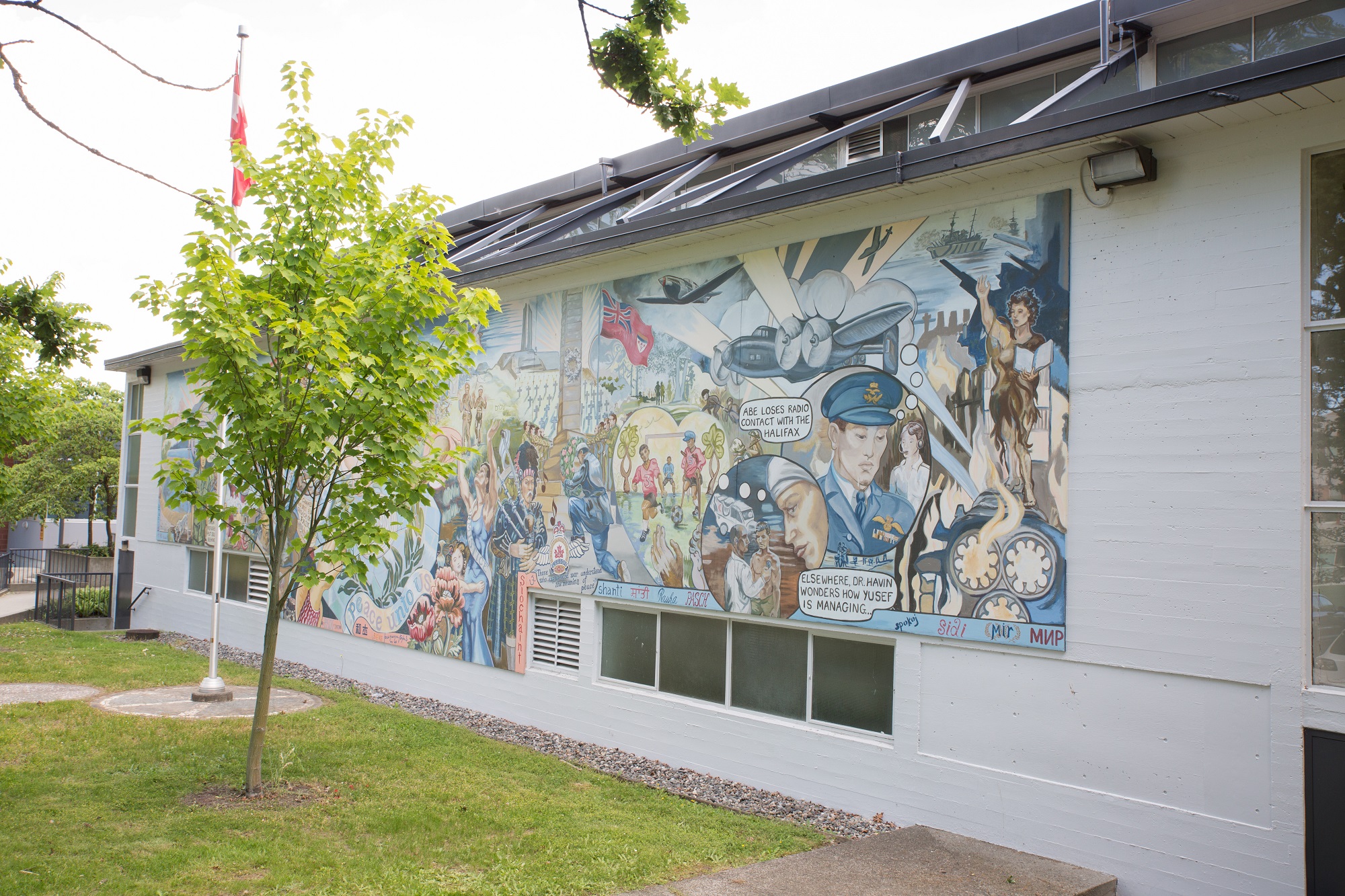
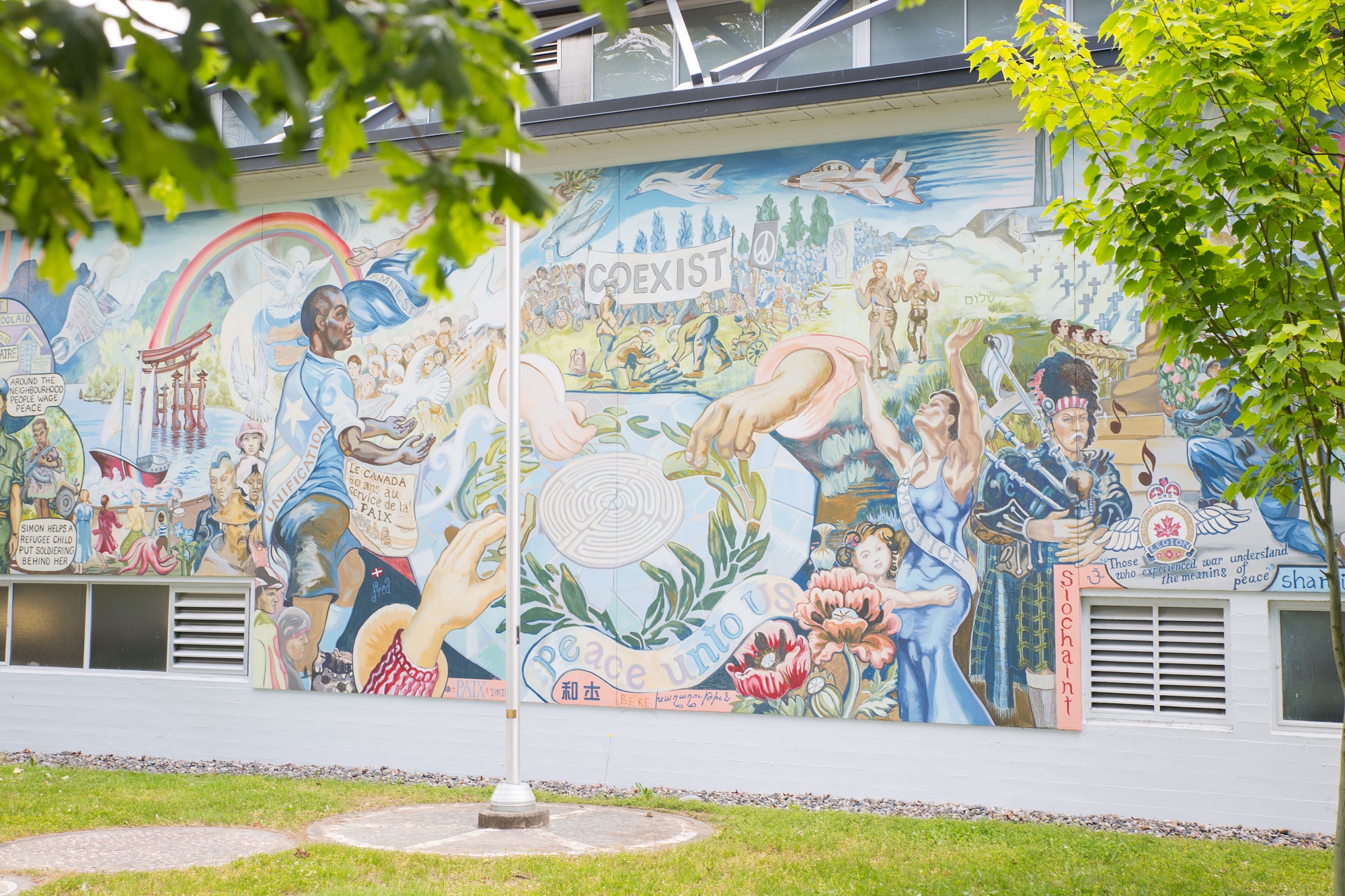
« Un chemin vers la paix » (A Path to Peace) a été érigé par Ruth Jones et des bénévoles de la communauté de Kitsilano au cours de l’été 2003. La murale illustre de nombreuses images et symboles, mettant l’accent sur le Kitsilano War Memorial Community Centre en tant que site commémoratif de guerre et sur la communauté de Kitsilano en tant que centre d’activisme pour la paix. Elle a été conçue par l’artiste en résidence Ruth Jones et peinte par trente membres de la communauté sous la tutelle de Ruth.

La conception s’inspire d’un journal de souvenirs réalisé par des membres de la communauté en collaboration avec les artistes communautaires Dorothy Wolf et Lizanne Fisher, des mosaïques de la paix réalisées par l’artiste Dan Hill et les groupes communautaires du KCC, ainsi que des échanges entre Ruth et les habitants de Kitsilano qui lui ont fait part de leurs souvenirs, de leurs croyances et de leurs espoirs.

Les images illustrées dans la murale sont les suivantes :

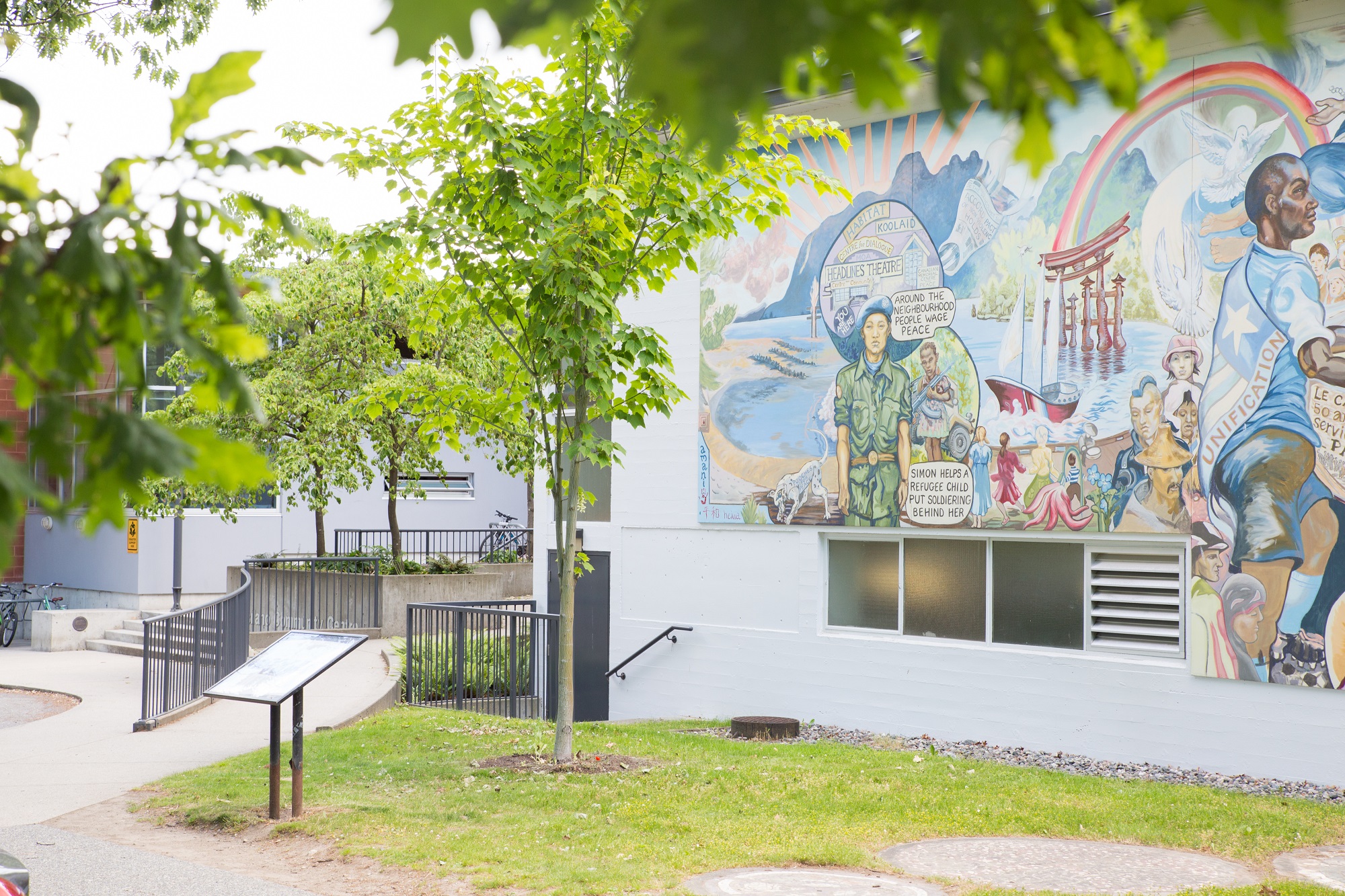
  • L’eau, le ciel et les plages de Kitsilano nous rappellent que, dans un monde où règne la paix, la nature appartient à tous et à personne. La terre est un miracle en soi qui ne doit pas faire l’objet de disputes fondées sur la cupidité.
  • Une balise de navigation sur Spanish Bank devient une bougie d’espoir pour nous guider.
  • Images de bâtiments de Kitsilano, où de nombreuses sociétés dédiées à l’établissement de la paix et à la résolution des conflits ont vu le jour.
  • Un soldat de la paix portant l’uniforme original des années 1950 nous rappelle la longue histoire de l’instauration d’une paix durable. Il s’appelle Simon, et son identité individuelle nous rappelle la contribution personnelle de tous les soldats de la paix.
  • Derrière Simon se trouve une petite fille qui a été entraînée à utiliser un fusil d’assaut. C’est l’un des milliers de scénarios auxquels sont confrontés les soldats de la paix, en l’occurrence des enfants soldats qui ont été formés à un mode de vie guerrier.
  • Un journal local qui souffle un titre : « Accord : maintien du pacte de non-violence ».
  • Une enfant d’âge préscolaire, Miaoli, a inspiré l’image des enfants sur la digue de mer pour symboliser la paix.
  • Le Mémorial de la Paix au Japon : son mystère et sa beauté inspirent des pensées de paix aux personnes de toutes les nations. Une passerelle vers les valeurs spirituelles.
  • L’arc-en-ciel est un ancien symbole de paix dans de nombreuses cultures.
  • Une marche pour la paix à Kitsilano, près de la plage, point de ralliement d’anciennes marches pour la paix. Les marcheurs, habillés pour faire face au vent et aux intempéries, regardent les mains qui construisent la mosaïque de l’Unité.
  • Le joueur de soccer préconise la paix par le sport. Il est drapé d’un drapeau de la paix. Son étoile unique suggère l’unité entre les nations et les États, une communauté mondiale où règne l’empathie, et ses couleurs sont celles des Nations Unies.
  • Une personne représente l’Amnistie, qui se veut le pardon personnifié. Elle tient devant elle une branche d’olivier, symbole du temps de paix, et laisse tomber derrière elle les chaînes de l’emprisonnement.
  • Les bombardiers se transforment en colombes alors que le ciel passe de la nuit, à droite, au jour à gauche. Il s’agit d’une représentation mythique de la façon dont la pensée humaine se transforme pour saisir une nouvelle harmonie mondiale.
  • Une marche pour la paix serpente à travers la murale centrale. Elle représente les marches incessantes de nos communautés pour la paix au cours de nombreuses décennies et nous relie aux marches et aux veillées pour la paix dans le monde entier. Elle signifie aussi que la majorité des personnes sont à la recherche d’une nouvelle façon d’échanger entre les nations. Comme le chante le musicien Ben Harper : « If the people lead, the leaders will have to follow » (Si les gens montrent la voie, les dirigeants devront la suivre).
  • Au centre de la fresque, le thème passe de la guerre et de ses conséquences à la résolution des conflits et à la recherche d’une nouvelle façon de dialoguer entre les nations. On y voit deux soldats déposer leurs armes avec de bonnes intentions, en espérant, l’un comme l’autre, qu’ils ne seront pas dans une embuscade... Une métaphore pour deux peuples, quels qu’ils soient, qui tentent de se réconcilier.
  • En 2002, la communauté a créé une mosaïque autour du mât. Le processus participatif, qui permet à de nombreuses personnes de réaliser ensemble une œuvre d’art, symbolise les efforts de chaque personne en faveur de la paix, menant ainsi à l’objectif plus vaste de la paix mondiale.
  • Les coquelicots sont les fleurs du Souvenir.
  • Le F18 est le bombardier contemporain du Canada. Il ouvre la voie aérienne lors de missions militaires.
  • Une danseuse a inspiré le personnage allégorique « Armistice » : une paix négociée et signée par des parties opposées. Les troupes qui se rendent sont entre ses bras tendus. Il faut beaucoup de courage pour se rendre, car il faut faire confiance à l’ennemi.
  • Des croix gravissent la colline, symbole des pertes du Canada lors d’une mission militaire, jusqu’au Mémorial national du Canada à Vimy. Le drapeau rouge (notre drapeau d’origine) rappelle l’histoire du Canada et son évolution en tant que nation, grâce à la bravoure des personnes qui se sont battues pour qu’aujourd’hui nous puissions vivre dans la liberté et la paix.
  • Les symboles se combinent de manière à souligner les pertes et les souvenirs précieux. Un joueur de cornemuse représente solennité et rituel. Le dépôt d’une couronne est un geste commun à tous les cortèges funèbres et aux cérémonies marquant l’anniversaire d’un décès. Le cénotaphe rend hommage aux personnes décédées dans le cadre de conflits dans le monde entier. Les quatre soldats commémorent les troupes récemment perdues au combat en Afghanistan. La présence de quatre autres soldats, faisant face à leurs frères disparus, souligne que lorsque les vivants honorent les morts, leur souvenir vit à travers eux.
  • Un médecin de terrain, dans un avant-poste médical près d’une zone de guerre, s’inquiète de l’état de santé d’une victime d’une mine antipersonnel. Une infirmière imagine le meilleur pour un jeune survivant qui, bien qu’en attente d’une jambe artificielle, est encore capable de jouer dans le match de soccer.
  • Les Kittyhawk étaient les « petits copains » des gros bombardiers comme le Halifax. Ils les accompagnaient dans leurs missions et tentaient d’abattre les avions de chasse qui les attaquaient.
  • Un officier supérieur, en uniforme, responsable de soldats dans le cadre d’un combat aérien, s’inquiète de la perte de communication avec un avion sous son commandement.
  • Une femme se tient debout, en haillons, sur un bâtiment bombardé et chante avec défi, symbolisant ainsi la force inébranlable de l’esprit humain dans l’adversité. Elle joue le rôle de la conteuse d’histoires, désignant de son bras tendu le chemin qui, en temps de guerre, mène à la paix. Au-dessus apparaît une bataille navale, pour commémorer les troupes canadiennes qui ont servi dans la Marine royale.

Inscription

[mural/murale]

HABITAT
KOOLAID
CENTRE for DIALOGUE
HEADLINES THEATRE

YOU
ARE
HERE

AROUND THE
NEIGHBOURHOOD
PEOPLE WAGE
PEACE

SIMON HELPS A
REFUGEE CHILD
PUT SOLDIERING
BEHIND HER

COEXIST

AMNESTY

UNIFICATION

LE CANADA
50 and au
service de la
PAIX

peace unto us

ARMISTICE

"Those
who survived war understand
the meaning of
peace"

ABE LOSES RADIO
CONTACT WITH THE
HALIFAX

ELSEWHERE, DR. HAVIN
WONDERS HOW YUSSEF
IS MANAGING

[storyboard/scénarimage]

A Path To Peace
COMMUNITY MURAL PROJECT

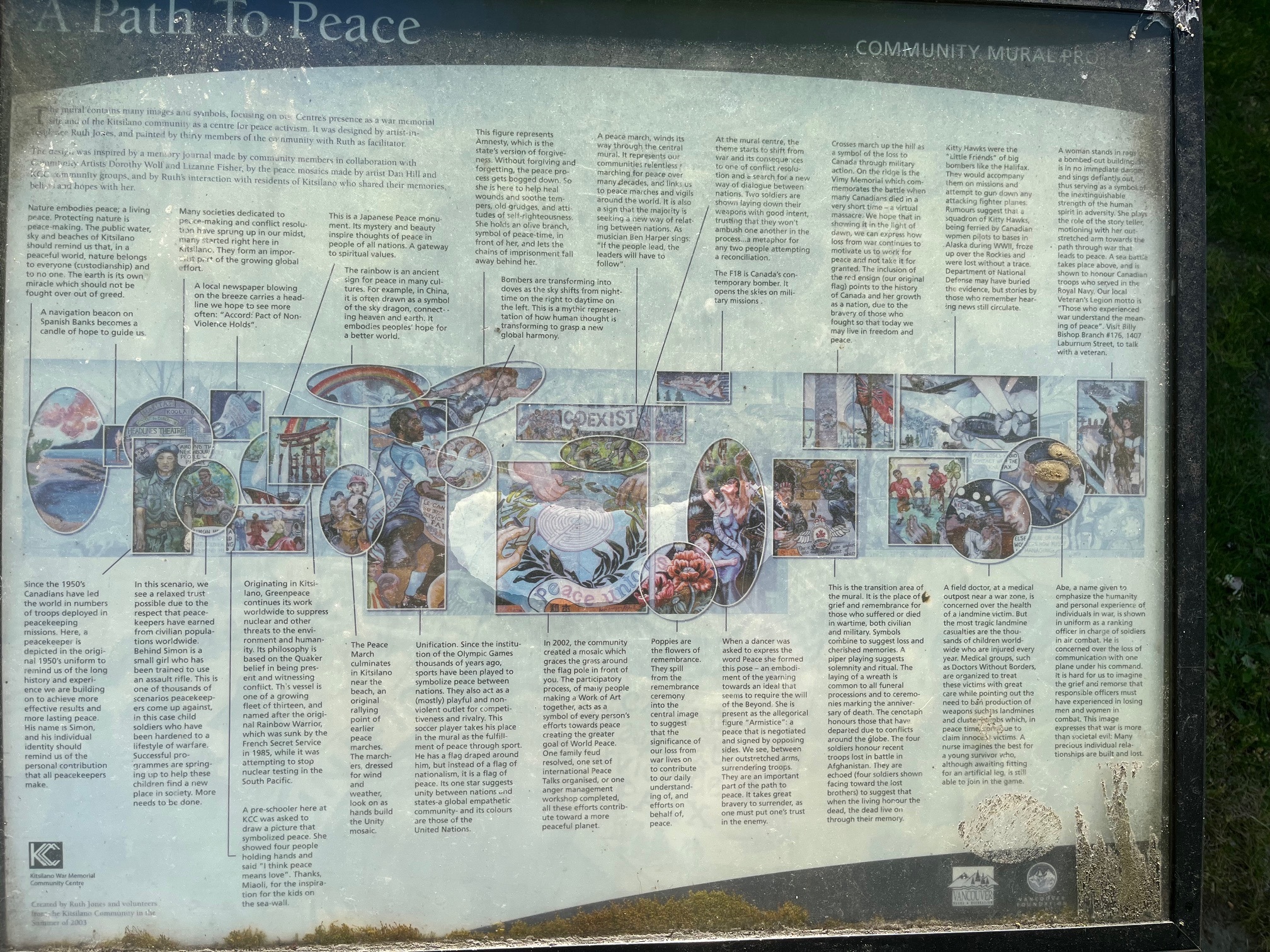
The mural contains many images and symbols, focusing on our Centre's presence as a war memorial site and of the Kitsilano community as a centre for peace activism. It was designed by artist-in-residence Ruth Jones, and painted by thirty members of the community with Ruth as facilitator.

The design was inspired by a memory journal made by community members in collaboration with Community Artists Dorothy Wolf and Lizanne Fisher, by the peace mosaics made by artist Dan Hill and KCC community groups, and by Ruth's interaction with residents of Kitsilano who shared their memories, beliefs and hopes with her.

Nature embodies peace; a living peace. Protecting nature is peace-making. The public water, sky and beaches of Kitsilano should remind us that, in a peaceful world, nature belongs to everyone (custodianship) and to no one. The earth is its own miracle which should not be fought over out of greed.

A navigation beacon on Spanish Banks becomes a candle of hope to guide us.

Many societies dedicated to peace-making and conflict resolution have sprung up in our midst, many started right here in Kitsilano. They form an important part of growing global effort.

A local newspaper blowing on breeze carries a headline we hope to see more often: "Accord: Pact of Non-Violence Holds".

This is a Japanese Peace monument. Its mystery and beauty inspire thoughts of peace in people of all nations. A gateway to spiritual values.

The rainbow is an ancient sign for peace in many cultures. For example, in China, it is often drawn as a symbol of the sky dragon, connecting heaven and earth. It embodies peoples' hope for a better world.

This figure represents Amnesty, which is the state's version of forgiveness. Without forgiving and forgetting, the peace process gets bogged down. So she is here to help heal wounds and soothe tempers, old grudges, and attitudes of self-righteousness. She holds an olive branch, symbol of peace-time, in front of her, and lets the chains of imprisonment fall away behind her.

Bombers are transforming into doves as the sky shifts from night time on the right to daytime on the left. This is a mythic representation of how human thought is transforming to grasp a new global harmony.

A peace march, winds its way through the central mural. It represents our communities relentless marching for peace over many decades, and links us to peace marches and vigils around the world. It is also a sign that the majority is seeking a new way of relating between nations. As musician Ben Harper sings: "If the people lead, the leaders will have to follow".

At the mural centre, the theme starts to shift from war and it consequences to one of conflict resolution and a search for a new way of dialogue between nations. Two soldiers are shown laying down their weapons with good intent, trusting that they won't ambush one another in the process... a metaphor for any two people attempting a reconciliation.

The F18 is Canada's contemporary bomber. It opens the skies on military missions.

Crosses march up the hill as a symbol of the loss of Canada through military action. On the ridge is the Vimy Memorial which commemorates the battles when many Canadian dies in a very short time - a virtual massacre. We hope that in showing it in the light of dawn, we can express how loss from war continues to motivate us to work for peace and no take it for granted. The inclusion of the red ensign (our original flag) points to the history of Canada and her growth as a nation, due to the bravery of those who fought so that today we may live in freedom and peace.

Kitty Hawks were the "Little Friends" of big bombers like the Halifax. They would accompany them on missions and attempt to gun down any attacking fighter planes. Rumours suggest that a squadron of Kitty Hawks, being ferried by Canadian women pilots to bases in Alaska during WWII, froze up over the Rockies and were lost without a trace. Department of National Defense may have buried the evidence, but stories by those who remember hearing news still circulate.

A woman stands in rags on a bombed-out building, she is in no immediate danger and sings defiantly out, thus serving as a symbol of the inextinguishable strength of the human spirit in adversity. She plays the role of the story teller, motioning with her outstretched arm towards the path through war that leads to peace. A sea battle takes place above, and is shown to honour Canadian troops who served in the Royal Navy. Our local Veteran's Legion motto is "Those who experienced war understand the meaning of peace". Visit Billy Bishop Branch #176, 1407 Laburnum Street, to talk with a veteran.

Since the 1950's Canadians have led the world in numbers of troops deployed in peacekeeping missions. Here, a peacekeeper is depicted in the original 1950's uniform to remind us of the long history and experience we are building on to achieve more effective results and more lasting peace. His name is Simon, and his individual identity should remind us of the personal contribution that all peacekeepers make.

In this scenario, we see a relaxed trust possible due to the respect that peacekeepers have earned from civilian populations worldwide. Behind Simon is a small girl who has been trained to use an assault rifle. This is one of thousands of scenarios peacekeepers come up against, in this case child soldiers who have been hardened to a lifestyle of warfare. Successful programmers are springing up to help these children find a new place in society. More needs to be done.

Originating in Kitsilano, Greenpeace continues its work worldwide to suppress nuclear and other threats to the environment and humanity. Its philosophy is based on the Quaker belief in being present and witnessing conflict. This vessel is one of a growing fleet of thirteen, and named after the original Rainbow Warrior, which was sunk by the French Secret Service in 1985, while it was attempting to stop nuclear testing in the South Pacific.

A pre-schooler here at KCC was asked to draw a picture that symbolized peace. She showed four people holding hands and said "I think peace means love". Thanks, Miaoli, for the inspiration for the kids on the sea-wall.

The Peace March culminates in Kitsilano near the beach, an original rallying point of earlier peace marches. The marchers, dressed for wind and weather, look on as hands build the Unity mosaic.

Unification. Since the institution of the Olympic Games thousands of years ago, sports have been played to symbolize peace between nations. They also act as a (mostly) playful and nonviolent outlet for competitiveness and rivalry. This soccer player takes his place in the mural as the fulfillment of peace through sport. He has a flag draped around him, but instead of a flag of nationalism, it is a flag of peace. Its one star suggests unity between nations and states — a global empathetic community — and its colours are those of the United Nations.

In 2002, the community created a mosaic which graces the grass around the flag pole in front of you. The participatory process, of many people making a Work of Art together, acts as a symbol of every person's efforts towards peace creating the greater goal of World Peace. One family feud resolved, one set of international Peace Talks organised, or one anger management workshop completed, all these efforts contribute toward a more peaceful planet.

Poppies are the flowers of remembrance. They spill from the remembrance ceremony into the central image to suggest that the significance of our loss from war lives on to contribute to our daily understanding of, and efforts on behalf of, peace.

When a dancer was asked to express the word Peace she formed this pose - an embodiment of the yearning towards an ideal that seems to require the will of the Beyond. She is present as the allegorical figure "Armistice": a peace that is negotiated and signed by opposing sides. We see, between her outstretched arms, surrendering troops. They are an important part of the path to peace. It takes great bravery to surrender, as one must put one's trust in the enemy.

This is the transition area of the mural. It is the place of grief and remembrance for those who suffered or died in wartime, both civilian and military. Symbols combine to suggest loss and cherished memories. A piper playing suggest solemnity and ritual. The laying of a wreath is common to all funeral processions and to ceremonies marking the anniversary of death. The cenotaph honours those that have departed due to conflicts around the globe. The four soldiers honour recent troops lost in battle in Afghanistan. They are echoed (four soldiers shown facing toward the lost brothers) to suggest that when the living honour the dead, the dead live on through their memory.

A field doctor, at a medical outpost near a war zone, is concerned over the health of a landmine victim. But the most tragic landmine casualties are the thousands of children worldwide who are injured every year. Medical groups, such as Doctors Without Borders, are organized to treat these victims with great care while pointing out the need to ban production of weapons such as landmines and cluster bombs which, in peace time ? to claim innocent victims. A nurse imagines the best for a young survivor who, although awaiting fitting for an artificial leg, is still able to join in the game.

Abe, a name given to emphasize the humanity and personal experience of individuals in war, is shown in uniform as a ranking officer in charge of soldiers in air combat. He is concerned over the loss of communication with one plane under his command. It is hard for us to imagine the grief and remorse that responsible officers must have experienced in losing men and women in combat. This image expresses that war is more than societal evil. Many precious individuals relationships are built and lost.

needs further research/recherche incomplète

Location
« Un chemin vers la paix »

2690, rue Larch
Vancouver
Colombie-Britannique
Coordonnées GPS
Lat. 49.2615535
Long. -123.1625269

A Path to Peace storyboard

1 sur 5 images

A Path to Peace

1 sur 5 images

A Path to Peace

1 sur 5 images

A Path to Peace

1 sur 5 images

A Path to Peace

1 sur 5 images
Table des matières