Attention!
Cette vidéo est disponible en anglais seulement.
Description
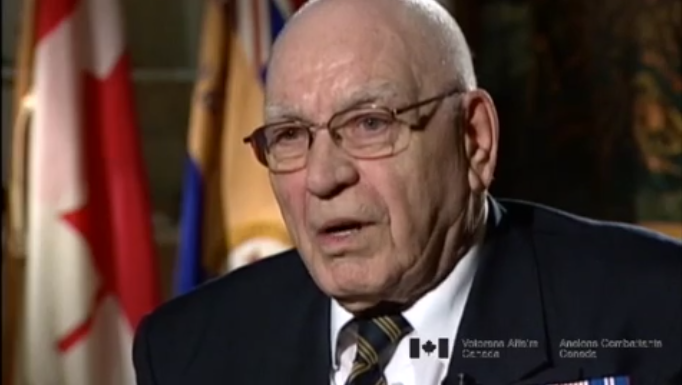
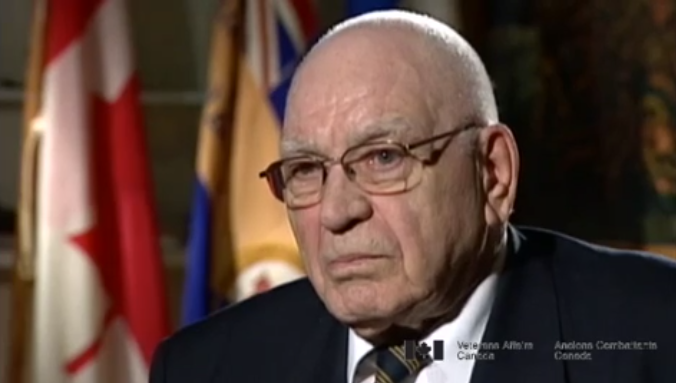
Mr. Downey recalls his participation in the historic Battle of Vimy Ridge on Easter Monday, April 9, 1917.
Philip Downey
Philip Downey est né le 28 janvier 1891 à Shemogue (Nouveau-Brunswick). Son père était constructeur de voitures et fermier. Lorsque la Première Guerre mondiale a éclaté, monsieur Downey travaillait dans une usine d’automobiles à Amherst (Nouvelle-Écosse). À l’automne 1914, il s’est enrôlé dans le 26e bataillon du Corps expéditionnaire canadien. Suite à un entraînement de base à Saint John (Nouveau-Brunswick), il s’est embarqué pour l’Angleterre afin d’y recevoir un entraînement plus poussé. À la fin de l’automne 1915, il a rejoint les troupes canadiennes en France, attaché à la 5e Brigade. Monsieur Downey avait 105 ans au moment de son entrevue en 1996.
Transcription
We didn't know what they were doing. (No.) What they were preparing for.Interviewer: But you knew something was up. (Oh Yeah). Something big.Oh yeah. Till Easter morningInterviewer: Can you tell me about it? Pouring raining. You could see why we trying, the boys are climbing on their hands and knees. (Yes) white/grey stones, slippery.Interviewer: Now you're showing me an article or you're referring to an article that has a picture and your, and you believe that's a picture of your machine gun group.I was NCO of the machine gun. (Yes.) Trench machine gun (Yes sir.) Light machine gun, that's what we called them and, and I had been warned by my officer to watch for a counter attack (Yes.) and I got it and I got right stern with, I got on, on, on the Germans coming. (Okay.) Whole platoon of them.Interviewer: So this, this attack then that you beat off was after you'd taken Vimy Ridge was it? The what? Interviewer: Vimy Ridge had already been taking Mr. Downey and? Oh they were, oh yeah, my boys were, they brought up 6, 7 machine guns. The Germans had in there and the rest of it were just like a living quarter for officers. (Okay.) You talk about French furniture and every, liquor but we did not touch it. They might poison it, see. And soon, our fellows got up on that ladder we got, fired a few bombs in there. That was it.Interviewer: Well, tell me about how the attack began. You said it started off, it was raining? They sneaked up on them (inaudible) and they couldn't and once, once they got there see they had rabbit holes. They got the rabbit holes alot I suppose for ventilation in there. (Yes.) They got so they could fire them good aim right now and put it (inaudible) machine gun and let her go. Oh Christ, they were practically all dead. (Okay.) We got a few live one but. (Okay.) And then after, after we tore the top, big hole on the top of that so we could get down and see what they had in there and sort them out. The dead ones check them over to them to the other side and the live ones, chuck them outside, prisoners.Interviewer: Okay. And did you take many prisoners that day? Not very many out of that. (No.) There was a few officers, I think right the first bomb that dropped a few officers come out (inaudible) one of their vent holes, and over the top hollered something to us. Said the commanding officer leading the attack "Put your hands up" and then when we got down there, we found a few. A few alive, most them were dead. Suffocate from the smoke from and one of those hand grenades if it was thrown in to a place like that it would kill 7 or 8 men. (Yes.) It blows up in little squares. See the bomb itself is all corrugated everywhere. When it goes off it all breaks up in pieces. (Yes.) Each piece will kill a man.Interviewer: Do you remember what the reaction was at, at, at the time that the Canadians took the, the top of the heights? When they secured the position? The reaction, the reaction was they took a few hours to get them sorted out and get them cleaned out of there. And take the prisoners back, we had a bunch detailed take the prisoners back and the dead ones we fired over on their side and we cleaned the place up and we stayed there. We stayed there! That was our orders. And, and we used it as, all of what, the officers a lot of the officers it was used as sleeping quarters. It was a regular home. (Yes.) Dug out of the, that bank.Interviewer: Did you have any, any feeling at the time of how important a victory that was? Well it big talk. It was big talks about it when the French failed and then the British failed and lost so many men. We, we did go. We had hundreds, that's what we were, they were up to and we were (inaudible) loses and everything but we wasn't sure. And we said another, another ten, ten thousand our men gone, but we lost a lot of men but we took it and held it and they never tried to come back. Well, they couldn't. (No.) No, we were watching them all the time. (Yes.) But we, we took them by surprise.
Catégories
Battle of Vimy Ridge
Médium
Video
Propriétaire
Veterans Affairs Canada
Guerre ou mission
Première Guerre mondiale
Campagne
Bataille de la crête de Vimy
Personne interviewée
Philip Downey
Branche
Armée
Unité ou navire
26e Bataillon, Corps expéditionnaire canadien
Military Rank
Sous-officier
Durée
05:12