Attention!
Cette vidéo est disponible en anglais seulement.
Description
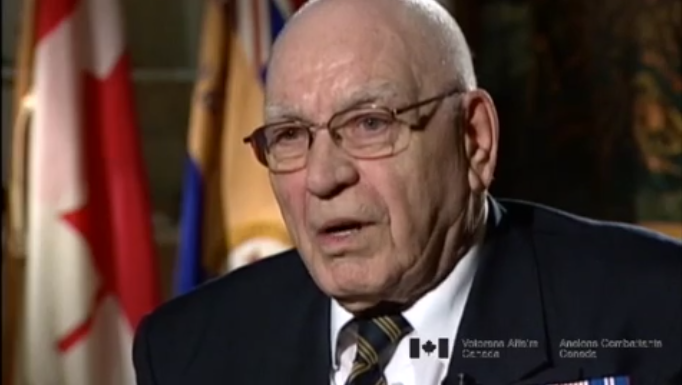
Mr. Downey recalls his further experiences during the Battle of the Somme in Belgium.
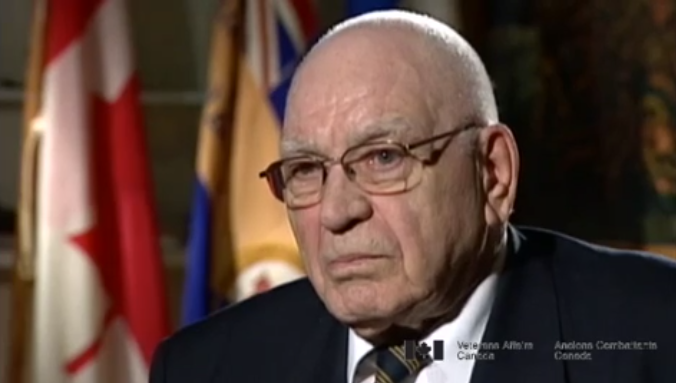
Philip Downey
Philip Downey est né le 28 janvier 1891 à Shemogue (Nouveau-Brunswick). Son père était constructeur de voitures et fermier. Lorsque la Première Guerre mondiale a éclaté, monsieur Downey travaillait dans une usine d’automobiles à Amherst (Nouvelle-Écosse). À l’automne 1914, il s’est enrôlé dans le 26e bataillon du Corps expéditionnaire canadien. Suite à un entraînement de base à Saint John (Nouveau-Brunswick), il s’est embarqué pour l’Angleterre afin d’y recevoir un entraînement plus poussé. À la fin de l’automne 1915, il a rejoint les troupes canadiennes en France, attaché à la 5e Brigade. Monsieur Downey avait 105 ans au moment de son entrevue en 1996.
Transcription
We're in Belgium front. They march us ten days, 20 miles a day and our scouts getting billets for us everyday. And when you take your boots off, your heels were bleeding. Those old army shoes. If you struck it lucky found a nice little wedow, window open French woman's. She come, especially if she could talk French and I can. (Yes.) Help me to bathe my feet and everything and fix you up. (Very good.) And get you good bed to sleep in, if you could talk French. (Okay.) You had to be, know that there was little French in you. My mother was French. My Father was Irish. And they'd get billets for you ahead of time and we did that for ten days and then at the end of ten days they'd put us in box cars. all going and horse manure in it and they put us in that and we drove one night till sometime next four doors. Then we'd march in again from, from where they took us out the, the box cars and we struck the front where they wanted us to be for, for the bombs attack. And this is where when one of the village was bombed. They had hit the, the statue on the church where there was a (inaudible) on it. And when it hit it, it tipped it her down and it tipped her down so when we marched through the streets underneath you'd swear she was our, with her hands like that. You'd swear she was there praying for us. And the government man here that's making that book, I started to tell him about that. Just a minute he said and he dug in his "Oh you were there alright." He had the picture of that. (Yes.) Right in his book. Yeah, that was one thing I remember real well.
Interviewer: So that was on your way to the Battle of the Somme?
On the way. We had a good rest the next day. The following day we went over the top.
Interviewer: And that was one of the worst days of the?
Well, no. That wasn't the worst. I think the worst battle they had was, was Passchendaele. I mean for the condition they had to go through and everything. Yeah, but it was a battle, it was a, it was quite a battle.
Interviewer: What do you remember specifically about, what do you remember about the Battle of the Somme yourself?
What do you remember? Well remember when you get ordered you get your ammunition if you're NCO. You, your, your commander and sergeant and company sergeant was there get your, if you're a platoon sergeant or if you're in charge of machine gun, you get your stuff all ready, piled up there and you got to lug it with you. Your belt's full of ammunition, bombs, sacks and everything and you go. (Inaudible) everybody watched the whole division, watched the whole time, the same time. When they holler, everybody goes.
Interviewer: What was the signal? Was it (Yeah, sure.) somebody shouting?
Well they had some signals yeah. Well from one battalion to another they just holler. Or no one place had a very loud bugler. And he, he blew, blew something in it on my left side I heard the bugle play. And the minute that bugle everybody moved (inaudible ) the battalion.
Interviewer: Now you'd all go forward?
All go forward. I don't think the German expected at all.
Interviewer: Was the artillery still (well we) going off in the distance?
When we got to the first of the German trenches, there wasn't anything left at all. All our artillery, our artillery was on each side where I was standing would be quarter of a mile long. And they opened that up on and the brigade out there and the machine gun behind them (inaudible)over and the heavy artillery. There was, there was nothing left. Everything flattened. Once in a while you, you might see a, a wounded man, we, we wouldn't stop. "Carry on. Don't stop." And, I forget how far back we pushed them quite a few miles back and there were places come over their trenches. They had a lot of.. so, it was their trenches you see. They'd retire from one. They were all flattened out.
Interviewer: So as far as you can remember you went by
Far as I can remember (inaudible) brought ‘em back. (Okay.) From where we had got orders to stop.
Interviewer: And were there many of your unit hurt or injured or killed?
Oh, well you wouldn't know because you weren't allowed to stop and help your, your buddy because he's wounded. You had to go. I'll never know. But our losses were quite heavy, but we, we took our objective what, what we were to do. It was a Canadian affair you see. Yep we took er'.
Interviewer: So that was on your way to the Battle of the Somme?
On the way. We had a good rest the next day. The following day we went over the top.
Interviewer: And that was one of the worst days of the?
Well, no. That wasn't the worst. I think the worst battle they had was, was Passchendaele. I mean for the condition they had to go through and everything. Yeah, but it was a battle, it was a, it was quite a battle.
Interviewer: What do you remember specifically about, what do you remember about the Battle of the Somme yourself?
What do you remember? Well remember when you get ordered you get your ammunition if you're NCO. You, your, your commander and sergeant and company sergeant was there get your, if you're a platoon sergeant or if you're in charge of machine gun, you get your stuff all ready, piled up there and you got to lug it with you. Your belt's full of ammunition, bombs, sacks and everything and you go. (Inaudible) everybody watched the whole division, watched the whole time, the same time. When they holler, everybody goes.
Interviewer: What was the signal? Was it (Yeah, sure.) somebody shouting?
Well they had some signals yeah. Well from one battalion to another they just holler. Or no one place had a very loud bugler. And he, he blew, blew something in it on my left side I heard the bugle play. And the minute that bugle everybody moved (inaudible ) the battalion.
Interviewer: Now you'd all go forward?
All go forward. I don't think the German expected at all.
Interviewer: Was the artillery still (well we) going off in the distance?
When we got to the first of the German trenches, there wasn't anything left at all. All our artillery, our artillery was on each side where I was standing would be quarter of a mile long. And they opened that up on and the brigade out there and the machine gun behind them (inaudible)over and the heavy artillery. There was, there was nothing left. Everything flattened. Once in a while you, you might see a, a wounded man, we, we wouldn't stop. "Carry on. Don't stop." And, I forget how far back we pushed them quite a few miles back and there were places come over their trenches. They had a lot of.. so, it was their trenches you see. They'd retire from one. They were all flattened out.
Interviewer: So as far as you can remember you went by
Far as I can remember (inaudible) brought ‘em back. (Okay.) From where we had got orders to stop.
Interviewer: And were there many of your unit hurt or injured or killed?
Oh, well you wouldn't know because you weren't allowed to stop and help your, your buddy because he's wounded. You had to go. I'll never know. But our losses were quite heavy, but we, we took our objective what, what we were to do. It was a Canadian affair you see. Yep we took er'.
Catégories
Battle of The Somme
Médium
Video
Propriétaire
Veterans Affairs Canada
Guerre ou mission
Première Guerre mondiale
Campagne
Bataille de la Somme
Personne interviewée
Philip Downey
Branche
Armée
Unité ou navire
26e Bataillon, Corps expéditionnaire canadien
Military Rank
Sous-officier
Durée
06:28