Attention!
Cette vidéo est disponible en anglais seulement.
Description
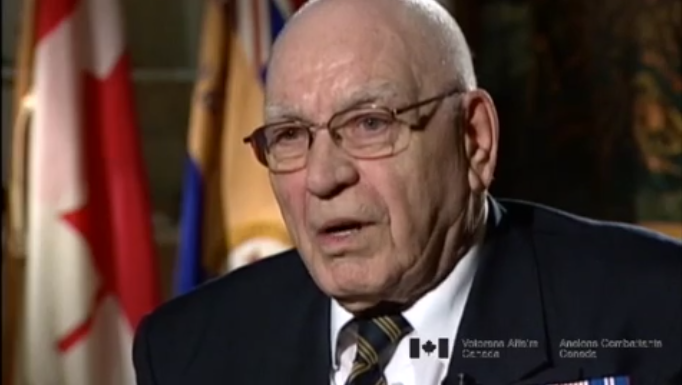
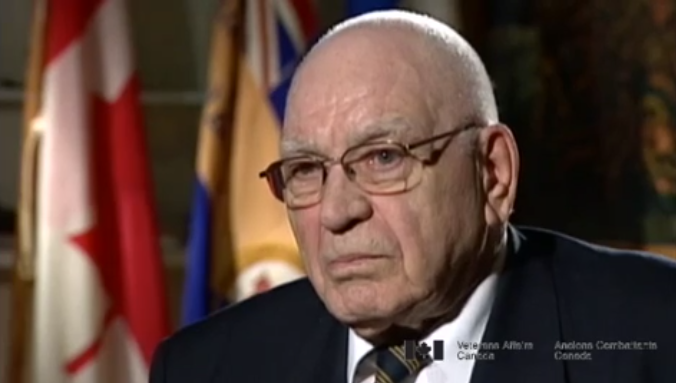
Alfred Mason
Alfred Mason est né à Tangier (Nouvelle-Écosse), le 4 janvier 1895. Une fois ses études terminées, il a travaillé dans les mines d'or de Tangier avant d'accepter un emploi dans la construction de wagons à Trenton (Nouvelle-Écosse), alors qu'il avait 17 ans. Il a aussi travaillé quelque temps à l'aciérie, puis dans les mines de charbon du nord de la Nouvelle-Écosse avant de se rendre à Halifax en 1915 pour s'enrôler. Il s'est joint au 66<sup>e</sup> bataillon, puis a été transféré au 40<sup>e</sup>. Il a reçu un entraînement de base au Québec, puis a été envoyé en Angleterre et, presque immédiatement en France, où il est arrivé au printemps de 1916 en renfort de la 3<sup>e</sup> Division de la 8<sup>e</sup> Brigade du 5<sup>e</sup> Bataillon canadien de fusiliers à cheval.
Transcription
I went across there expecting to be picked off. I expected that because they were on the other side, and, and I'm crossing the bridge with all of my men on, on these stringers and were on hands and knees and carrying a rifle. And we got across and there wasn't a god damn shot fired. Not a shot! I got, I got them all lined up. All along everywhere and finally the battalion (inaudible). They built, the engineers come in and, and built a bridge across, on the water, ya know one of those bridges they have and across. So we went up through the town, quite a big town. I seen one German, one German and he was running and hiding. Finally he wanted be taken prisoner and some of the boys were shooting at him ya know. But he was harmless ya know other then to say he wasn't, he wanted to be taken prisoner anyway.
I went on the other side looking for stuff, the other side of the coal mine. I went, we went along different places hunting for them and then couldn't find them, they'd go on way back. I come across a wagon full of ammunition and two horses, four horses dead, laying there dead. One of our shells hit it. And, and a, and a German foot cut off there it was laying down at the side of the wagon and it got him way. I overhauled a wagon and I hauled out some clothes was into a hole in that there. And opened it and there was a bottle of German schnapps, German whiskey in there. I never touched it. I, I, I took it but I'd never, never take a drink out of it. I never would. Some would try it. So we had brought, we had some prisoners and one fellow was wounded pretty bad so I took the top off and I said, oh he said, "Good, good." He took a drink and I said, "That's good, that's okay." So I put it in my pocket and that's all he got out of it. I'll never, never try that because they'd try all kinds of traps for ya, you see.
Interviewer: You should have shared that bottle of schnapps with the officer that sent you across.
The officer, no, no. So we were up we're on the other side. We were on the, we were on the run then we were, we were going (inaudible). Everyday we were in a new town mostly.
Interviewer: So the advance was a couple of miles a day? (Yeah. Oh yeah.) Was the artillery able to keep up?
Oh yes artillery, artillery was pretty good you know. They were mobile, they're pretty good. Some, some small ones were pulled by horses and some more went by tractor, stuff like that.
Interviewer: But after the stalemate for those many years in the trenches this must have been almost unheard of to be moving that fast?
Yeah. Yeah. That's right they were in for a long time. Holding the line, we called that was. It was just staying there. Yeah?
Interviewer: So did you feel then that the war was nearly over?
Yes. I knew it was over. I knew it was over, sure. And we just kept on coming for Mons so and we took Mons the day, the day she ended.
Interviewer: And when did you find out that the war had ended?
We found out right away. (How? ) The officer told us right away. He told us, he said that she's all over.
Interviewer: And what was the reaction?
Oh god. I (inaudible) fired my rifle away. Yeah it was, it was quite a, quite a, a thing yeah.
We went up as far as Belgium. When the war, we were at Belgium when the war ended, the capital of Belgium just outside. We started, I'll tell ya why. They wanted to take the 3rd and 4th Division, I was in the 3rd and let the 1st and 2nd go home first. So to take us up. So that's when we arrived up that far and then big speech come on, the big General come out and he said going through the trouble of getting us up that we'll send you home first and let the 2nd and the 1st and 2nd Division stay where they are in Germany and they were mad about that. Cause, because they were over first that ain't saying, that ain't saying they should have stayed home. But we went home first. I, I come home in the 20th, 20th of February 19, 19 (1919? ) 1919 yeah, yeah 1919.
Interviewer: Did you land in Halifax?
I land in Halifax. The 20, I landed in Halifax, I'll tell ya I coulda come back, I coulda landed in Montreal. I didn't come back with the Battalion. No quite a few of us belonged Nova Scotia in the Battalion and we paraded before the Colonel to see if we could stay and come back with an outfit that's coming to Halifax. So, they wasn't gonna stop off they were going to Montreal. So we'd have to go up to Montreal and parade up there and then come back and parade again and so we didn't want that. So they, they were, they were a week ahead of us, the battalion was. I know my father was saying the battalion's back where, where's Alf he's not home yet. Well however, and we come back the 20th, on the 20th we were in Halifax. I, I was wise enough, in fact I forget what time of day it was, it was about noon time or around that time. I knew 3 o'clock in the afternoon I was a free man, I had my discharge.
Interviewer: So within a few hours you were discharged?
I had my, yeah in another few hours. I had my discharge, but still a soldier for another week. They, they paid ya for the week, they paid ya for another week. They give you the chance to get a uniform ya see, a chance to get civilian clothes.
Interviewer: What, do you remember what they paid you for a week?
Yeah. A dollar ten a day. (So they) I got a dollar fifty being a Sergeant, that's all. Dollar ten a day that what you got for, you figure that out for a week.
Interviewer: So you didn't get wealthy during the war?
You're darn right you won't get wealthy, I'll tell you that.