Attention!
Cette vidéo est disponible en anglais seulement.
Description
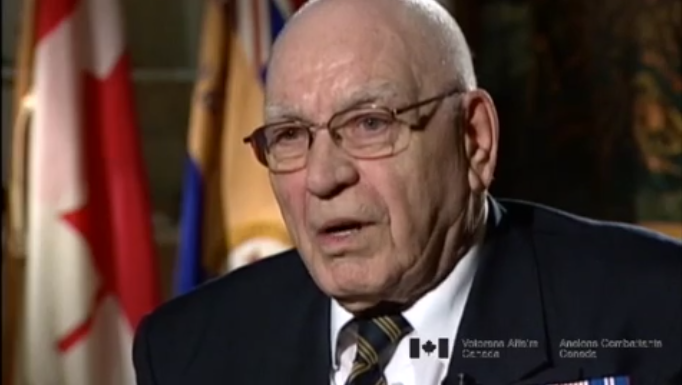
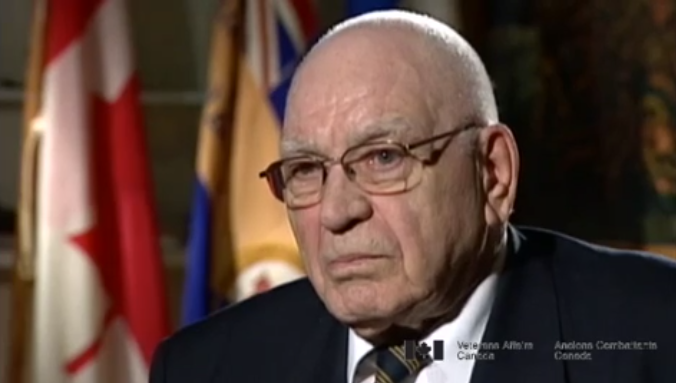
Mr. Welland describes a successful attack on a German submarine, and the attempted rescue of a crippled Royal Navy sloop.
Transcription
In the same ship, in the St. Laurent, we were again set offshore to meet a convoy. And we came across a submarine. At that time, in 1940, we didn’t have radar, so one spent a lot of time with binoculars to your face looking out for things. And I was on watch on the bridge when I saw a submarine on the surface, about a mile ahead of us. And the other people saw it about the same time. So we attacked the submarine. It dove before we could shoot at it. We attacked it for about seven hours with depths charges. We felt we’d destroyed it. It was analysed later that we had, in fact, sunk the submarine. But it took seven hours of firing off depth charges. I think we used all our depth charges, maybe about 20 tons of TNT, something like that. Sometimes sinking submarines is unsatisfactory business, because you never see the results of your work. Myself and the men who worked for me, we operated the submarine detection equipment. It was called the ASDIC, it’s now called sonar. It was the only way of holding the submarine. It sends out a sound beam and you have to, you get echoes off the submarine and have to figure out what to do next. Also, in the same ship, we were in a convoy and we were attacked by a half a dozen submarines. And one of the escorts was hit by a torpedo. It was a British sloop, a warship, and the crew were taken off by another ship and the sloop didn’t sink. My ship was told to - I was lieutenant - was told to go back and try and rescue this ship that had, this sloop that had not sunk. So we did that and I was the boarding officer. I took the crew over to put the wire, the towing wire, on the ship so our destroyer could tow it. So we were in a boat with a half a dozen sailors, a row boat I might say, and we got the line on the ship. She was towed for a while and then she started to sink and we managed to let the line go and the ship sank right beside us, like that. So, you know, I mean ... A couple of bodies drifted up from the ship, but I mean that was coincidental.
Catégories
You Never See the Results of Your Work.
Médium
Video
Propriétaire
Veterans Affairs Canada
Guerre ou mission
Seconde Guerre mondiale
Emplacement géographique
Océan Atlantique Nord
Campagne
Bataille de l'Atlantique
Personne interviewée
Robert Welland
Branche
Marine
Unité ou navire
HMCS <em>St-Laurent</em>
Military Rank
Lieutenant
Occupation
Anti-submarine officer
Durée
3:33