Attention!
Cette vidéo est disponible en anglais seulement.
Description
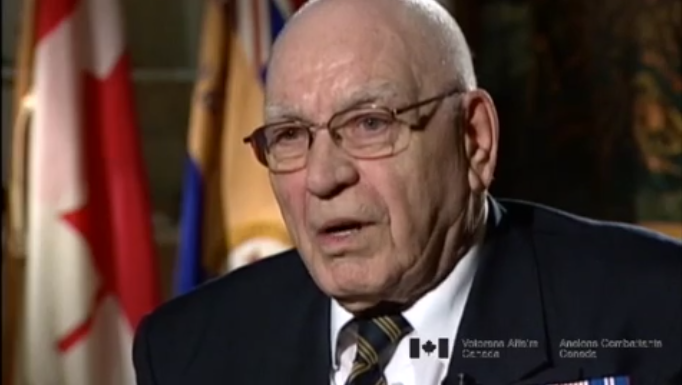
Mr. Pitcairn describes his role as layer in an 18-Pound artillery crew, the make up of the crew, and concludes by describing the wide variety and versatility of artillery pieces, both Commonwealth and German.
Transcription
I was a gunner and I was a, well, they were all gunners, but I was a layer. I’m the one that pulls the lever that fires the gun and I’m the one that sets the instruments. I was very good at it if I do say so myself. Officially there’s seven men, but actually we could run it with four men and we didn’t always use seven men, but officially it was seven. But when we trained more than, we always trained more than a double crew because you had replacements and you had to have somebody else coming and going. But we always trained, oh, there’d be at least fourteen men on each gun and there was also the NCO in charge of it. And then our, in the centre of the section was our officer, one officer to each section. When things are inactive, you’re not firing guns all the time. You’re just firing so many a day and one gun is ample. Now, our sniping gun, one in particular, we were in the same position for I’d say about three or four months, and the Germans never did find us in that position. We never had one casualty there, but the battery was further back. They never located us, you see. And the sniping gun did all the firing at night. That’s the firing they send in over the phone every night … that anything that’s spotted through the day or anything they want to do, we would fire, usually around twenty, twenty-five rounds, and it was left to us to set the gun and fire them. Well, you see, our field gun was a 3.3. It’s a light gun and the German field gun was a 4.1. This was a light gun. We called it a whiz gun. It wasn’t very effective. Our field gun was much, much, much more effective than the German one. But the German 5.9 was an old round gun. They used it for everything and it was a very, very good gun. I would say it was better than any of our guns. Now, in the trench warfare we had a six inch gun, we had a 4.1, we had 9 inch howitzers, we had 12 inch howitzers, we had trench mortars. The trench, they were down ahead of us, the trench guns, yes, the trench mortars. Now, the 9 and 12 inches, they were way back of us. They were part of the artillery, but they were way out of the line, and they were firing great distances. In the open warfare they were useless. I don’t know whatever happened to them, they just disappeared, I suppose. You see, then we had the 4.1 howitzers with the field gun, because of the trenches, you know. A howitzer goes up and they, of course, they were used during the open warfare a bit, not as much as the others. Our field guns had caused more casualties to the Germans than anything, more than machine guns or anything else. The artillery were the cause of more casualties. Now that’s not generally accepted, and I didn’t think that was true until I read it somewhere in some of the books that said that artillery caused the most casualties and it would be the field gunners that would cause most of it, to the Germans. But the German 5.9 was really a very good gun. Well, they had one or two big guns, of course. They had that big one that went 75 miles to, into Paris, but we never saw that. But they had one or two of these big train ones and every now and again we hear it go overhead, over us into the back country somewhere. They were probably trying to find something at the back. But we had the same thing. But those guns took a long time to mount and dismount, you see. And also, a howitzer took longer. We could mount and dismount in two minutes and be gone. We went into action and inside of a minute we could be firing.
Catégories
Artillery Arsenal
Médium
Video
Propriétaire
Veterans Affairs Canada
Guerre ou mission
Première Guerre mondiale
Emplacement géographique
France
Personne interviewée
James Pitcairn
Branche
Armée
Unité ou navire
50th Battery
Military Rank
Private
Occupation
Artilleur
Durée
4:20