Attention!
Cette vidéo est disponible en anglais seulement.
Description
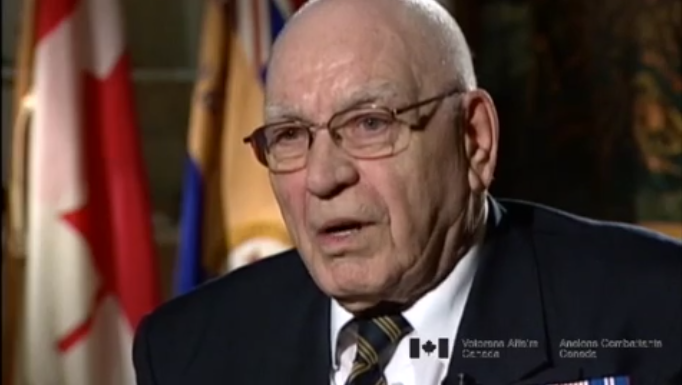
Mr. Candow describes how moving at night made each offensive position seem the same, and explains how duties and the main objective always remained the same.
Transcription
Interviewer: Okay so now we're in Italy and tell me about your first, when you first get into combat in Italy, where it was and what the scene was. Paint me a picture of that scene of your first combat in Italy.
Well, strange thing about scenery, panoramas held in the army, was that you move at night. You don't, you don't see, you know, and then take up a position, do your duty, communications, your wires things, make sure your wireless sets are working and find out where the cook house is, place the bed down, back to routine. Now there might be an orchard, you know, there might be a cornfield , very few animals. I don't know why, I guess probably the Germans had taken them or something, you know. And, and we were out in the country, we weren't in towns you know, we were right across the peninsula see. And there was, there was, you know there was a comparison in Italy and Africa but, not that much to give you a lasting impression, you know, I mean you're still doing your duty. You don't think about where you are, you know. What country you're in, I suppose that's the least of your worries, you're just doing what your supposed to be doing and so on. That's the way I found it.
Interviewer: So all those major battles in the Italian campaign; (inaudible)Cassino, Ortona all that, from the artillery perspective they were all the same?
Yeah, that's right. More or less. Different positions, different places, different surroundings but doing the same thing. Supporting infantry; blowing up targets for them. That was our job. Yep.
Well, strange thing about scenery, panoramas held in the army, was that you move at night. You don't, you don't see, you know, and then take up a position, do your duty, communications, your wires things, make sure your wireless sets are working and find out where the cook house is, place the bed down, back to routine. Now there might be an orchard, you know, there might be a cornfield , very few animals. I don't know why, I guess probably the Germans had taken them or something, you know. And, and we were out in the country, we weren't in towns you know, we were right across the peninsula see. And there was, there was, you know there was a comparison in Italy and Africa but, not that much to give you a lasting impression, you know, I mean you're still doing your duty. You don't think about where you are, you know. What country you're in, I suppose that's the least of your worries, you're just doing what your supposed to be doing and so on. That's the way I found it.
Interviewer: So all those major battles in the Italian campaign; (inaudible)Cassino, Ortona all that, from the artillery perspective they were all the same?
Yeah, that's right. More or less. Different positions, different places, different surroundings but doing the same thing. Supporting infantry; blowing up targets for them. That was our job. Yep.
Catégories
Same Job, No Matter the Location
Médium
Video
Propriétaire
Veterans Affairs Canada
Guerre ou mission
Seconde Guerre mondiale
Personne interviewée
Gordon Henry Candow
Branche
Armée
Unité ou navire
166<sup>e</sup> Régiment de campagne terre-neuvien
Military Rank
Gunner
Occupation
Communications Gunner
Durée
02:45