Attention!
Cette vidéo est disponible en anglais seulement.
Description
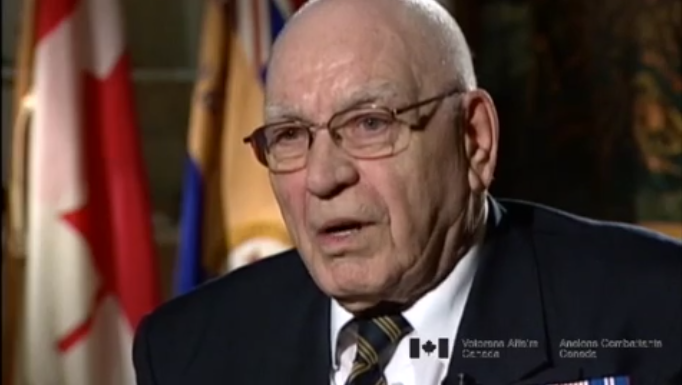
Mr. MacKenzie describes the four different aircraft used for training in Ontario and Quebec.
Transcription
It was tricky to fly a Tiger Moth, now. It was, it was a double-winged aircraft, and it had a lot of . . . Because it was, it was double, a bi-plane it had, it meant there was more control, so if you moved the stick a little bit, you went. And there was just enough torque in it to, on taking off, where you would go one way. And they were, they were tricky, a little tricky. And then, of course, most of them went from there into Harvards, which was fairly advanced. You were into about 650 horsepower aircraft. It was a good aircraft, but as I'm saying, there was so many changes, you know, that to take place where you had retra . . . retractable undercarriage, and you had variable pitch propellers. And it had a lot of steam, those things. They were, they were a good aircraft. But it's just a matter of, as I said, probably running out of fuel and getting lost. And if, if you did, if you got lost, well there weren't many. You didn't have long to get back on track, because you didn't have a lot of fuel. I would say that we picked up more Ansons, they were twin engine Ansons and Harvards than anything, yeah. Some of those old, the Ansons, were just . . .I don't know how they stayed up. Well, and there was a Mark 1, Mark 2, Mark 3, Mark 4, a Mark 5 Anson. That meant they were . . . the first Mark 1s were English. They had certain types of engines which weren't too bad, and . . .Then we got Mark 2s that were, had Jacobs. They were not good engines. And then 3 and 4 and Mark 5s, they put Pratt and Whitney's in them, the same as Harvards, and they were good engines. So you see, as things went along what happened. This was my feeling of it anyway. This is what I, I found. Somebody might disagree with me. I don't think so, cause Jacobs, they were, they were like that. Actually, the old Cheetahs that were in the old . . . they were actually pretty durable. And then they were always trying to improve things, and finally they did. These Mark 5s were pretty good aircraft, but there were five of those new ones that went down in that snowstorm. There were five of them, went up out of Malton, and it got caught in a terrible snowstorm. You know what they did? They jumped! The guys jumped and let those things go. I got pictures. One hit a wood pile, just before a farmer's house, where it could have taken his house and everything. He thought the world had come to an end. But that's what they did, they seem to, they saved the pilots, and the aircraft went, five new ones, you know? Things like that. There was an aircraft called a Yale and it was a counterpart of a Harvard. It was like a Harvard, except it had fixed undercarriage and it had a different engine in it. I think a Wright engine, Wright Whirlwind and it wasn't as powerful. And they used a, they used those a lot for training electron, radio people, and they were not really a good aircraft. But they, but they had, they, they... fortunately, there weren't that many of them. They were just used for what they had to be used for and there weren't really many of them. But no, I can't really think of any with any bad mechanical faults, I wouldn't say. Like, sure, some of them were maybe a little underpowered, but they, they kept changing engines as they went along. Put a little better engine in them, and . . . I mean, we didn't have very much to do with the, with of course, fighter aircraft. I mean, an odd one would come in there, but we were involved in this part of it, yeah. But a lot of the aircraft like Spitfires, Hurricanes, they were, they kept increasing the horsepower and changing engines and, and, as they went along. But we weren't involved in that.
Catégories
They got caught in a terrible snowstorm
Médium
Video
Propriétaire
Veterans Affairs Canada
Guerre ou mission
Seconde Guerre mondiale
Emplacement géographique
Canada
Personne interviewée
Grant MacKenzie
Branche
Aviation
Unité ou navire
6<sup>e</sup> Dépôt de réparation
Military Rank
Aviateur-chef
Occupation
Aero Engine Mechanic
Durée
04:29