Attention!
Cette vidéo est disponible en anglais seulement.
Description
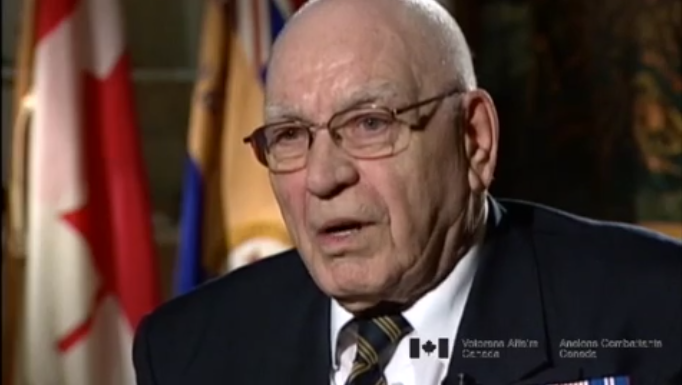
Mr. Castonguay describes life in the POW camp and the working conditions they encountered.
Bernard Castonguay
Bernard Castonguay est né à Montréal, au Québec, le 9 février 1921. Il était le quatrième d'une famille de 11 enfants. Son père était monteur de tuyaux à vapeur pour la Canadian Pacific Railway. M. Castonguay a quitté la maison à l'âge de 16 ans, à la recherche d'aventure. Il a travaillé comme bûcheron et à la construction des chemins de fer. En 1940, incapable de trouver du travail, M. Castonguay s'est rendu à Québec pour s'enrôler dans le Royal Rifles of Canada. Il fut envoyé à Gander, à Terre-Neuve, où il fut signaleur et sentinelle. On l'envoya ensuite à Saint John, au Nouveau-Brunswick. À Hong Kong, M. Castonguay fut fait prisonnier par les Japonais et envoyé au camp de prisonniers de guerre (Omeni) de Nagasaki, au Japon, pour travailler dans une mine de charbon. Après son service, M. Castonguay a travaillé pour l'Institut national canadien pour les aveugles (INCA). Il devint par la suite directeur régional de l'INCA. Il fut également bénévole pour le Conseil canadien des aveugles.

Transcription
And Shamshuipo that was our camp before the war. It was, it's a nice camp except that there was no windows, no doors, no nothing, see. So everything was changed. I mean everything was wide open. And the mosquitos over there well for Malaria it's dangerous. So we had no protection.
Interviewer: During that period of time, the men were expected to work. What do you remember about the work that you prisoners were expected?
Ya we were getting up in the morning at four, four thirty, every morning. And we had to walk through Kowloon to go to the ferry which is about two miles I think, to walk. And as we walk on the street every morning we saw corpses here and there. Chinese, die from lack of food. And we saw these trucks painted in green picking up the bodies and throwing them in like garbage. And we got on the ferry every morning to go to Kai Tak Airport. And we had to move a mountain to in the sea in order to enlarge the Kai Tak Airport. It was in the hot sun. We had a G-string, nothing on the head. And it happened a few times, too many times that we didn't have any breakfast or we didn't have any dinner. Imagine, and we didn't have enough to eat and yet they were not giving us our meal.
Interviewer: And during this time, the men were still sick from many of the diseases that you just talked about?
Worse than ever. Yes, some people were dying everyday. Sometimes six in a day from diphtheria especially. Yes there were all kinds of disease. Pneumonia and also of course electric feet and Beri-beri and all those things you know.