Attention!
Cette vidéo est disponible en anglais seulement.
Description
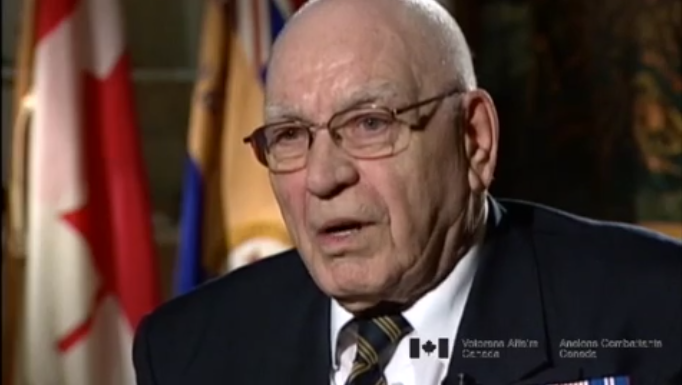
Hugh Victor Letendre
M. Letendre est né le 4 mars 1925 dans le petit village de Lac Ste-Anne (Alberta). Comme Métis, il a appris à parler cri, français et anglais. Il faisait partie d’une grande famille : il avait un frère et huit soeurs. Son père était trappeur et faisait une pêche commerciale importante. M. Letendre a appris à chasser et à pêcher de son père. <br><br> À l’âge de 11 ans, il est devenu concierge de l’école à classe unique où il était également élève. Il balayait les planchers, préparait le feu le matin et transportait l’eau et le charbon. Pour tous ses efforts, on le payait quatre dollars par mois, qu’il remettait à ses parents puisqu’ils avaient très peu d’argent à l’époque. <br><br> Il s’enrôla à l’âge de 18 ans et il servit pendant la Seconde Guerre mondiale comme carabinier dans les Calgary Highlanders. Pendant son déploiement outre-mer, il a servi dans la campagne de Normandie après le jour J. Après la guerre, il devint le chef de l’Association nationale des anciens combattants autochtones.
Transcription
Interviewer: What did you know about the Canadian Army when you enlisted?
Not too much, not too much. I knew they were a fighting force.
Interviewer: How old were you when you enlisted?
Eighteen, just about nineteen, I turned nineteen shortly after. I enlisted in February, I think it was the 14th, 1944 and I turned nineteen on March the 4th, 1944. Interviewer: Looking back on it now Mr. Letendre, why did you enlist?
I really don't know to be honest with you and I guess I maybe wanted some excitement, explore, you know travel, whatever you want to call it I guess. And most of all I think, I look back now on all the boys from my hometown - Metis boys, white boys all joined up. And Metis boys there were 17. And oddly enough only one got killed. So I guess it was my turn to join I guess and go. But we all went in the service, every one of us.
Interviewer: By then you knew that casualties were heavy, the fighting in Italy had been going on for over a year?
Yeah, I didn't really pay that much attention about how many casualties were, were happening or anything else. The boys that were in the service were still all alive and everything else you know so. I guess even when I was in the service I didn't worry about being a casualty.