Attention!
Cette vidéo est disponible en anglais seulement.
Description
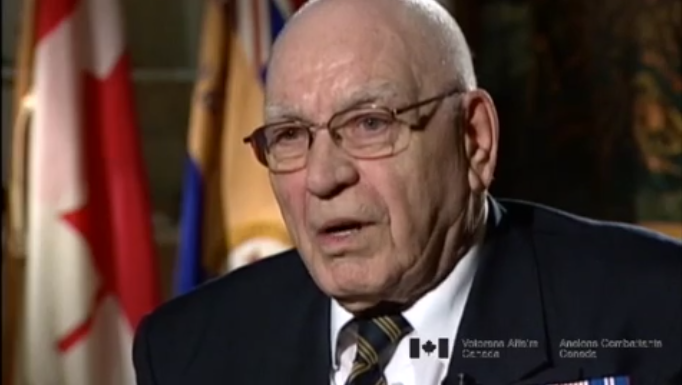
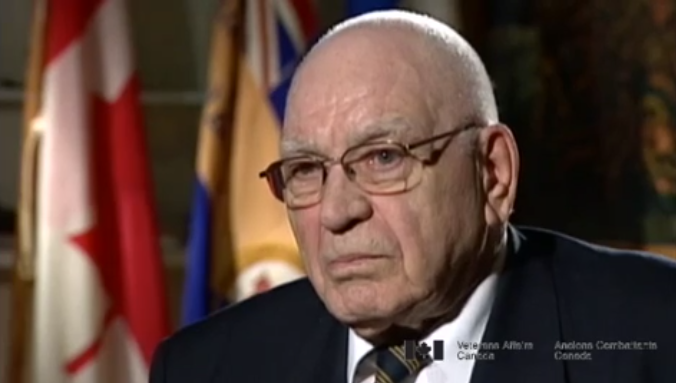
Mr. Chisholm speaks of his arrival in Britain and his first assignment overseas.
William Lawrence (Red) Chisholm
Le père de M. Chisholm était chef de gare à Berwick (Nouvelle-Écosse) pour le Dominion Atlantic Railway. Il a déménagé à la gare de Windsor (Nouvelle-Écosse), puis a quitté les chemins de fer pour s'acheter un magasin à Kentville (Nouvelle-Écosse). M. Chisholm a terminé ses études dans le système scolaire à Kentville. Après avoir obtenu son diplôme d'études secondaires, il a travaillé pendant une courte période pour son père, puis il est allé travailler comme serre-frein pour le Dominion Atlantic Railway. Après s'être enrôlé dans l'Aviation royale canadienne en 1940, il suit son premier entraînement à Toronto. Il fait ensuite partie des 500 membres environ qui sont envoyés aux premiers cours, d'une durée de deux mois, donnés à l'école de formation de Regina dans le cadre du Programme d'entraînement aérien du Commonwealth. On l'envoie ensuite à l'école d'aviation de London (Ontario). M. Chisholm devient par la suite un as pilote et reçoit la Croix du service distingué dans l'Aviation (DFC), avec barrette.
Transcription
Posted to Great Britain Interviewer: Where was it you were first stationed? Mr. Chisholm: I first went, this probably saved my life, because I was sent down to a bombing and gunnery school down in south Wales as a staff pilot and I towed targets up and down the Bristol Channel for a whole year, and then the, the bombers with, full of under- training air gunners would, would fire at our drogues and it was very boring, except once in a while one of the, I got stitched from one end of my Ferry Battle to the other one time by a gunner who gave way too much deflection. Didn’t know it till I got down on the ground and the ground crew came up and said, “My God sergeant, you’ve been hit.” And I said, “What do you mean? ” He said, “There’s four bullet holes right down the side of your airplane,” and he said there was a hole on this side and hole on that, I didn’t know this when your engine roaring and all that sort of stuff, a bullet had come in one side of my aircraft and passed about that far in front of my belly and out the other side. So I thought, “Am I going to last to get into actual fighting, or is somebody going to shoot me down out here in friendly fire? ” Interviewer: These targets that you would pull, how far behind, you said a Ferry Battle, so a Ferry Battle aircraft that you were flying, about how far back was the target? Mr. Chisholm: I would say probably two or three hundred feet. They were quite a ways back. Yeah. Interviewer: So this, this, this or a plane load of air gunners would come up along side you. Mr. Chisholm: Yep. Interviewer: And shoot at the target? Mr. Chisholm: That’s right. Interviewer: Now you said deflection shooting. Mr. Chisholm: Now they have to allow deflection, they have to aim over here when the aircraft is there. Well one of these young, they were all Polish lads, and he allowed too much deflection. Maybe somebody hadn’t told him, maybe he was firing and thought he was supposed to fire at the airplane, I don’t know. Shook me up a little. Interviewer: So you were there doing this type of work which could, from time to time, be both boring and dangerous. Mr. Chisholm: Yes, yes. Interviewer: You did that about a year? Mr. Chisholm: Did that about a year, yes. As I say, it probably saved my life because I became a pretty good pilot through that, all that extra flying. So many of these kids were sent into action with only a couple a hundred flying hours and they just weren’t ready. There was such a rush to get pilots into, into fighters and bombers that I always thought they didn’t have the adequate training, but they didn’t have much choice. They had to get going against the Jerry’s and they just pushed things a little bit.