Attention!
Cette vidéo est disponible en anglais seulement.
Description
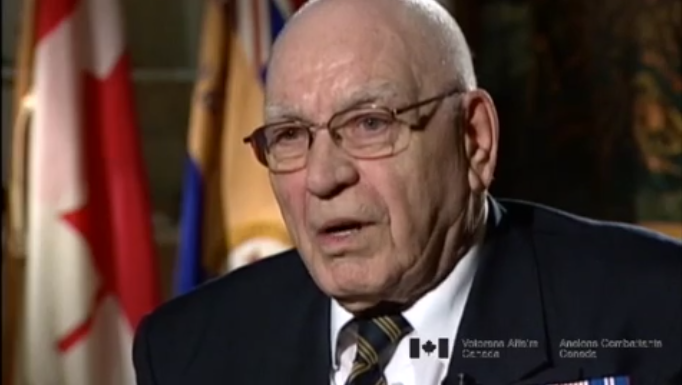
Donald Stewart Ethell
Donald Stewart Ethell est né en juillet 1937 et a grandi à Victoria (Colombie-Britannique). Son père était un ancien combattant de la Première Guerre mondiale et de la Seconde Guerre mondiale. Sa mère était infirmière. Sa soeur et lui ont étudié dans un pensionnat en raison des emplois qu’occupaient ses parents et ils retournaient à la maison seulement à Noël et pendant les vacances d’été. La mère de M. Ethell est décédée lorsque ce dernier n’avait que 10 ans. <br><br> Lorsqu’il s’est enrôlé, M. Ethell a joint les Queen's Own Rifles à Calgary. Après plusieurs années de service comme soldat d’infanterie, on l’a recommandé pour qu’il reçoive la formation d’officier. M. Ethell réussit le programme et s’éleva au rand de colonel. Plus tard, il a commandé des troupes canadiennes et des troupes des Nations Unies au cours de divers missions partout dans le monde. Au milieu des années 1990, Col. Ethell a pris sa retraite après plus de trente-cinq ans de services distingués.
Transcription
In the Balkans? That's a very interesting question, a couple things come to mind. I remember going on a hydrofoil believe it or not, from an area called Split, on the Dalmatian coast, with our Head of Mission and a number of other people, with a Croatian flag and a ECMM flag, European Community Monitoring Mission flag, with the clearance to go into Dubrovnik, which was being held by the Croats, but south of that, the Yugoslav Army headquarters and we had permission to go down there, and they wouldn't fire on us. That was interesting, first of all it was fascinating flying, literally flying, in a very fast moving hydrofoil, commercial, but went down there and sure enough we got in, it was not a problem and that stuck in my mind, doesn't sound like much but it was. The other was the helicopter that had been blown out of the sky by a Serbian Mig 21, fired three missiles, two, sorry, one hit the exhaust pipe of the Huey helicopter as it's called and it desintegrated. There was another helicopter there at about 1000 feet, it was what they called a Kiowa, a scout helicopter, as soon as he saw that, he put it on the ground, I mean in a hurry, it was still there. Well the Head of Mission said to the lawyer that was on site, the Dutch lieutenant colonel, he said, " I want the two of you and a Spanish pilot and Ethell I want you to head up the investigation", for the board of inquiry. So we obviously had to go out to the site where the individuals had, first of all the pilot and the co- pilot were decapitated, the rest of their bodies were in what was left of the air craft and the passengers were blown out like a, a blossom really, one over there, one over there, one over there, one over there. That kind of sticks with you and I really needed that like a hole in the head towards the end of my career. I had a number of months to stay there and get over it. We had to go and talk to the Serbian authorities in Belgrade and down in the Behash(sp) where the aircraft came out of, and the explanations that they came up with, " We thought it was a Croatian aircraft painted white with ECMM on the side, but that was their explanation, I think there was another one, but we won't get into that.