Attention!
Cette vidéo est disponible en anglais seulement.
Description
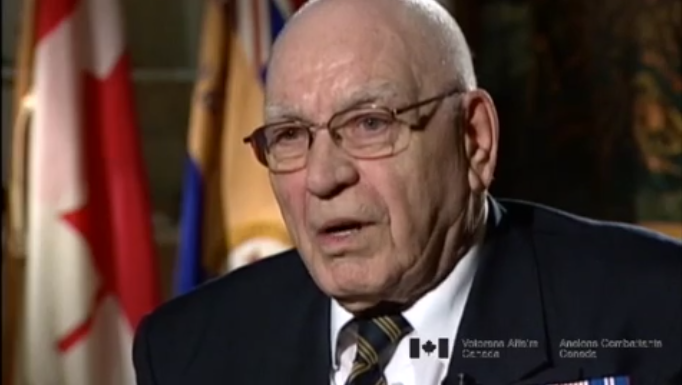
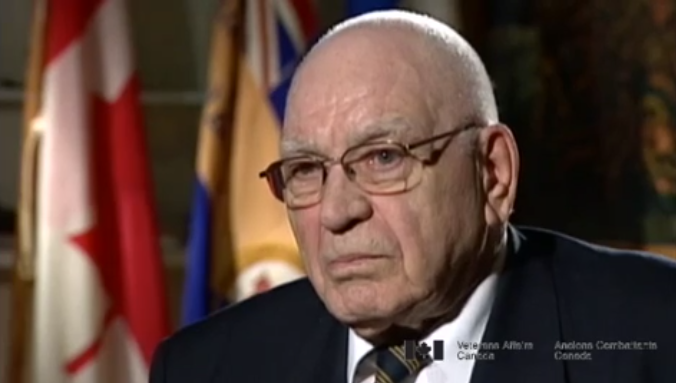
Mr. Carr describes Italy's terrain, living conditions and socialization
Transcription
We went, we went out to, to Sicily, to the Italian Campaign. And I can say I walked from Syracuse in Sicily up to Florence in northern Italy, surveying, of course, mostly through the central part of Italy, which is all mountainous. It's very rugged. The winters were cold. We'd have snow, very, a lot of snow at night. And the next morning, it didn't . . . sun would get up and it would be hot and there’d be mud then. For four, three, four months of the year, it was nothing but mud we travelled in. We think of the mud, and we'd also think of the beautiful climate in the summer time, or on the coast, on both coasts. The Adriatic or the Mediterranean, the temperature was very good, but in the mountains it was cold, miserable. Actually, we didn't have trenches, but every two people in our unit was given a pup tent. And in the winter, what we used to do when we would get into a position after we'd get our survey work done, we'd prepare to spend a night or two in that area. We would dig a hole in the ground, and this was snow and mud, mud and everything. We'd dig a hole about, about four feet deep. And then on the sides of it, we would dig a little side trench. We'd put a pup tent on it. And we could sit in, on . . . and we made our bed on the ledge, and our feet would be down in the deeper hole. And to warmth, we would take an empty shell case, which we had five and a half inch shells. What we using the shell casing, and we would bore holes in them. We'd put a little stove pipe on them. And we could always . . . we had plenty of oil. We would build a row of holes around the base of the shell. And we put oil and water in part way up, and set a little fire in the bottom. And then we got a blow-, almost like a blow torch, and this is the way we heated the tent. This is how we lived. And your feet would be wet all the time, and your blankets were wet, but still we, we survived. You, you worked four hours on and four hours off, four hours on, four hours off, and so on. And, so, in your four hours, you, you slept, and then you got up and you did four hours, and you went back and slept if it was still night and if not, you stayed up. And the women's institute, they were very good. They used to send little parcels, once in a while. And my parents would ,of course, send parcels. And I never smoked until I joined the army, 'til I got over there. But when you're sitting around four hours, what else could you do? You smoked. You always wrote nearly every week. You weren’t allowed to say very much, but . . . You, you were not to mention where you were, what you were doing, but you could just, you could say it was raining today, or something like that. But you couldn't say where you were, or anything, or what was going on around you, whether you'd been fighting or not, or you were just on the standby or just, or out. Because we would generally be into action for two, three weeks at a time. Then they'd pull you out for a week to get washed up and cleaned up because for probably for a month, you wouldn't, wouldn't see water, hardly. Do you have an idea of what we'd be like?
Catégories
Conditions in Italy
Médium
Video
Propriétaire
Veterans Affairs Canada
Guerre ou mission
Seconde Guerre mondiale
Personne interviewée
Robert Carr
Branche
Armée
Unité ou navire
1<sup>e</sup> Régiment moyen canadien
Military Rank
Staff Sergeant
Occupation
Arpenteur
Durée
3:32