Attention!
Cette vidéo est disponible en anglais seulement.
Description
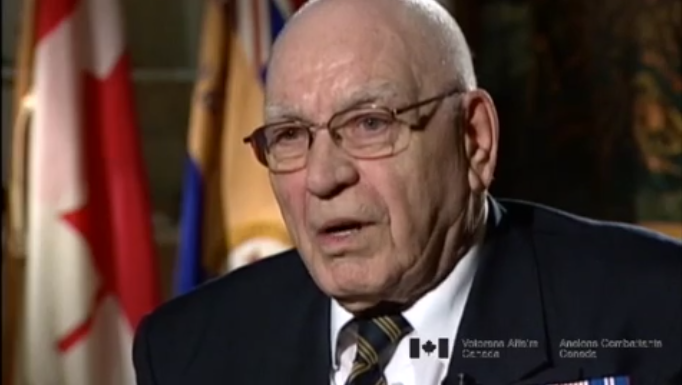
Mr. Carr discusses returning to Holland on the 40th and 50th anniversaries of VE Day
Transcription
The first one, the 40th anniversary was very, very exciting. That was my first trip to Holland, and it was back since the war. And not knowing the country then because it changed so much. Then in . . . the roads, for instance, were one vehicle wide in 40 . . . well, the 40th anniversary . . .but, when the war was there . . . But, at the 40th anni-, there were two and three lane highways, and more. And, of course, they, they didn't have . . . electricity was pretty well destroyed during the war. When 40 years, they had electricity, the flowers were just out of this world. And I can remember going into the Delph factory in Holland on the 40th, and my wife was with me, of course. And she was . . . I don't do shopping. I was just leaning against the . . . where the cashier was. And my wife was around to all the different places, looking at, in the, in the factory. And when she would see something she liked, she brought it up and set it alongside me at the, at this counter. And there was an elder, quite an elderly lady there, and, like, I think she was the chief cashier. She said to me, "Were you here during the war? " And I said, "Yes, I was." And my wife had put a plate down, a Delph plate. And this lady said, "We're, we've got some souvenir plates that are numbered. There's only a certain number made." And she said, "Would you like one? " And I said, "Of course." Well, she said, "I'll trade it." So, she took the plate that my wife had, put it under the counter, and went away, and come back with a plate with a number on it. And I have a numbered plate of a souvenir plate. Then in, on the 50th anniversary, I have a painting hanging in the den at home that Escher, an artist by the name of Escher, painted. And it is the dove coming out from the, from the, the war years and finally the pict-, the painted, and it just looks like a little blob of paint first, and as it goes up, comes up it, it becomes a full bird at the top. I have that and I have a tie from Escher with his name on them, as well, as they gave us souvenirs. Another thing that I could tell you, that I went into a pub. And we were in a hotel in the anniversary for the evening. And there was the group of us but I, I always went, head for the bar because it's a kind of nice place to be. And I ordered a drink up, and the bartender was talking to me and, finally, he said, "Were you here during the war? " And I said, "Of course I was." He said, "That drink is no good." And he just reached for it and he poured it out. And he poured me a great big drink and he said, "Here, this is on us." And this was the type of reception you got. They were was so pleased with . . . they, they seemed to respect the Canadians very much. They thought they were wonderful for some reason. Some of them were, I guess. In the, in the town where we were in, Baarne, a place called Baarne, in Holland, one night, they took us . . . There was fifty, approximately fifty of us in that area, billeted in that area. And they took us to the big cathedral. And they had enough . . . they had room for us and our wives. And the first few rows, and they had them all decorated with red velvet, on the seats, in the, in the basilica, just for us. And they, and they had a service for us, and it was just . . .then we were taken and given a big meal. Things we . . . that you remember. You couldn't help but remember.
Catégories
You Couldn’t Help But Remember
Médium
Video
Propriétaire
Veterans Affairs Canada
Guerre ou mission
Seconde Guerre mondiale
Personne interviewée
Robert Carr
Branche
Armée
Unité ou navire
1<sup>e</sup> Régiment moyen canadien
Military Rank
Staff Sergeant
Occupation
Arpenteur
Durée
4:08