Attention!
Cette vidéo est disponible en anglais seulement.
Description
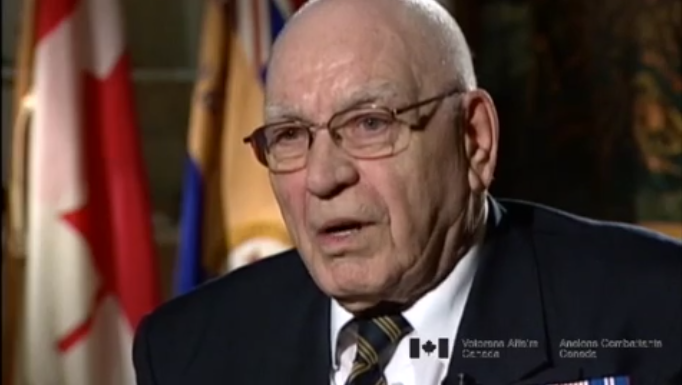
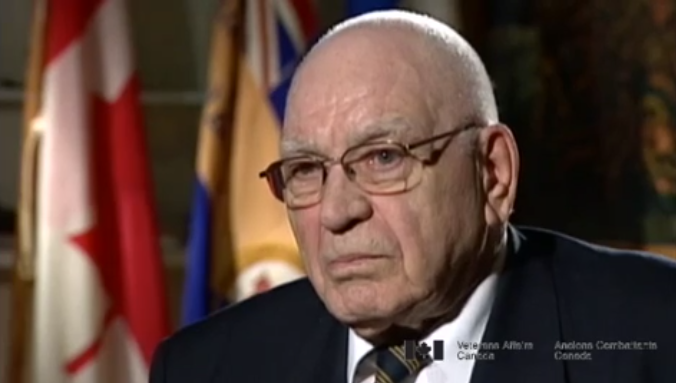
Mr. Melanson talks about his crossing aboard the Louis Pasteur as she sailed to England.
Transcription
We came from Shilo directly to Halifax. And we boarded the Louis Pasteur, which was in peace time was a French cruise ship. And the conditions onboard ship, well, for the number of people that were there, weren't too bad. The quarters were very, very close and some of us slept on the deck and others slept in hammocks, and so on. You see, there were something like five to six thousand troops on the ship. And like I say we, you know, we all had our wings and so on, so you recognize someone with who . . . and a lot of us had qualified together, you see, so it was a rather closely-knit group and we had very little to do with the, the other troops that were on the vessel. I think it took us something in the order of . . . the Louis Pasteur was a fair- fairly fast vessel, possibly fast enough to outrun the submarines that they were chiefly concerned with, and I think it took us possibly five, five and a half days to go from, from Halifax to England, and . . . but the conditions weren't bad and, you know, it was the usual line up for meals and, of course, it was our first introduction to English bangers. A sausage. And 50% of it was made of bread, made from bread. So, it was quite a shock to our systems these English . . . and other things that we ate while we were going over were quite a, quite a change from what we had been used to in Canada. But other than that, personally, I didn't, I didn't find it uncomfortable or anything like that . . .we didn't, while we were in, in transit, we didn't have any alerts. You know, we weren’t alerted because of a submarine scare or, you know, a U-boat rather, and that sort of thing. So, no, going over, it wasn't, it wasn't, wasn't bad at all.
Catégories
Life Aboard the Louis Pasteur
Médium
Video
Propriétaire
Veterans Affairs Canada
Guerre ou mission
Seconde Guerre mondiale
Emplacement géographique
Canada
Personne interviewée
Russel C Melanson Sr.
Branche
Armée
Unité ou navire
1<sup>e</sup> Bataillon canadien de parachutistes
Military Rank
Sergent
Occupation
Parachutiste
Durée
2:39