Attention!
Cette vidéo est disponible en anglais seulement.
Description
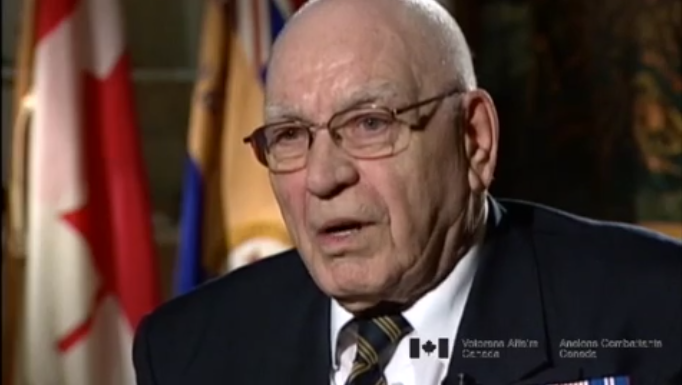
Mr. Walsh discusses the dangerous and time consuming strategy of leapfrogging along the dyked approaches to the German stronghold on Walcheren Island. He describes an alternative strategy, amphibious assault, which eventually succeeds. Finally, he expresses admiration for the impregnability of the German battlements on the island.
Transcription
The Walcheren Islands was all water and rain and mud, mud right clean to your knees at times. There was no place to dig a trench. If you laid down, you just laid down in the mud and water. But the way they took the, the way they took the Island was relaying. They could only put a, say a platoon of men on that causeway at a time and most of it was done in the night time in the dark. So you would take a pill box at a certain area and you’d hold there and then another platoon would come up, go through you and take another area like that. And it took three, four days of that. We never did capture the Island. For one reason was nobody believed the Dutch Resistance. They wanted to help us. They wanted to fight with us. And they didn’t want to get them tangled up. I could see reason why, but anyway, they knew a way to get onto the Island. When the tide was out, there was an area on the left hand side of the Island where you could actually cross only hip deep water, but nobody would take their word for it. So what actually happened was that someone had the bright idea that we had these buffalos. They were troop carrying water vehicles. They were tanks with tank tracks and it was the tracks that motivated the and they went out around all of this and they came in behind them and this went along with the British came in on the other side. They finally cleaned up the Island. But the Germans were hanging on until the very last minute. Well there was no place for them to go. They were trapped out there, but when we did get out there it was amazing to see the equipment that they had out. They had bunkers out there that were ten feet deep in concrete. Nothing could penetrate them. They had lots of scars on them and the guns were enormous guns that they had and they were making sure nothing was going up that causeway, up that canals to Antwerp. But they finally opened them. The winter set in, the fall set in. We more or less went into hibernation.
Catégories
Walcheren Island - a Tough Objective
Médium
Video
Propriétaire
Veterans Affairs Canada
Guerre ou mission
Seconde Guerre mondiale
Campagne
Libération des Pays-Bas
Personne interviewée
Graham Walsh
Branche
Armée
Unité ou navire
Royal Regiment of Canada
Occupation
Conducteur de char d'assaut
Durée
2:37