Tempête de verglas de 1998

1998 Ice Storm
Janvier à février 1998
En cas de catastrophe, l’armée canadienne peut intervenir. À l’hiver 1998, les Forces armées canadiennes sont intervenues ici même au pays, à la suite du genre de tempête qui ne survient qu’une fois dans une vie.

The gathering storm

From 4-10 January 1998, a major ice storm struck parts of Ontario, Quebec and New Brunswick. It was a series of smaller storms that caused a prolonged period of ice pellets and freezing rain in the region. Portions of the St. Lawrence Valley and Quebec’s Eastern Townships received up to 100 mm of ice pellets and freezing rain in a single week, more than double their yearly average.

A trail of devastation

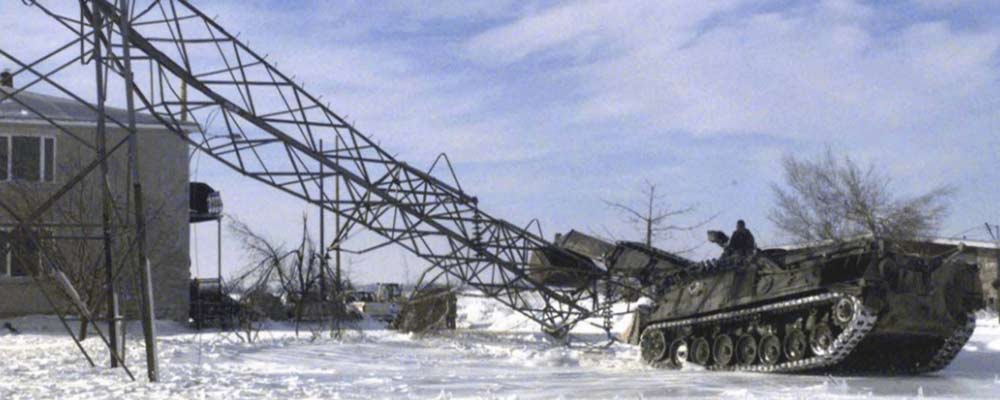
The powerful storm and cold temperatures that followed caused widespread devastation. Countless trees were toppled, power lines snapped and buildings damaged. The storm turned roads into impassable rivers of ice, where downed power lines were covered in ice. Life in large cities like Montreal and Ottawa was largely shut down, with millions left without electricity as power grids were destroyed. The Ice Storm of 1998 injured almost 1,000 people and temporarily displaced more than 600,000. Roughly 35 Canadian deaths were attributed to the storm.

9 Jan 1998, a convoy of troops from Petawawa arriving in Ottawa to assist during the State of Emergency that was declared due to numerous freezing rain storms that had fallen in the area during the previous four days. Photo: Department of National Defence ISC98-002-13.

Requests for help

On 7 January 1998, in the midst of the ice storm, the impacted provinces requested aid from the federal government. Responding to the requests from Ontario, Quebec and New Brunswick, the CAF launched Operation Recuperation the next day. The military helped municipal and provincial authorities in a wide array of recovery efforts. Working with local utility companies, they helped restore damaged electrical towers, and freed power lines that were trapped in centimetres of ice. They also helped their fellow Canadians in other ways, like clearing roads, downed trees and the debris around people’s homes. Canada’s military also provided shelter, food and medical care during the ice storm.

Members of the Canadian Forces reserve knock the heavy ice off of hydro lines in Kemptville, ON. These members were deployed as part of Operation RECUPERATION to aid victims of the January 1998 ice storm in Eastern Ontario and Western Quebec. Photo: Department of National Defence ISC98-015-24.

A massive mission

Operation Recuperation remains the largest domestic troop deployment in Canadian history, and the largest operational deployment since the Korean War. In total, more than 15,000 military personnel deployed to assist in recovery efforts. They were drawn from roughly 200 different units, from across the country and the three branches of the CAF.

Their remarkable determination and tireless efforts brought relief to countless people battered by the storm, until the end of the operation on 28 February 1998.

A CAF member talks with a child while fellow soldiers drain the basement of their house, during Operation RECUPERATION. Photo: Department of National Defence ISC98-014-15.

Table des matières
 

4 janvier 1998

Une série de tempêtes de pluie verglaçante et de grésil frappent l’est de l’Ontario et certaines parties du Québec et du Nouveau-Brunswick.


7 janvier 1998

Les gouvernements de l’Ontario, du Québec et du Nouveau-Brunswick demandent l’aide du gouvernement fédéral.


8 janvier 1998

Les Forces armées canadiennes lancent l’opération Récupération pour aider aux efforts de rétablissement après la tempête de verglas.


10 janvier 1998

La série de tempêtes dans l’est du Canada se termine.


8 janvier au 28 février 1998

Des membres des FAC sont envoyés dans trois provinces pour aider des millions de Canadiens touchés par la dévastation de la tempête de verglas.


28 février 1998

Fin de l’opération Récupération.