Attention!
Cette vidéo est disponible en anglais seulement.
Description
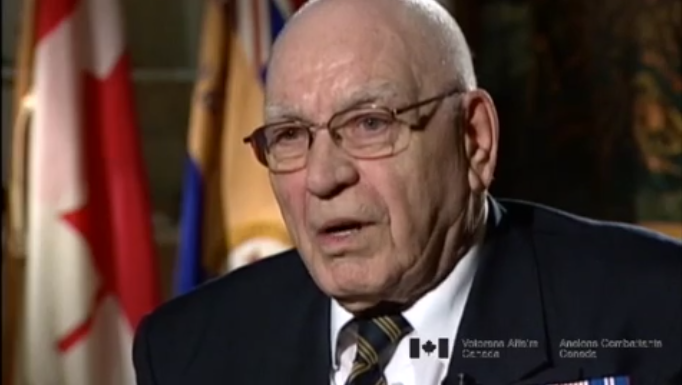
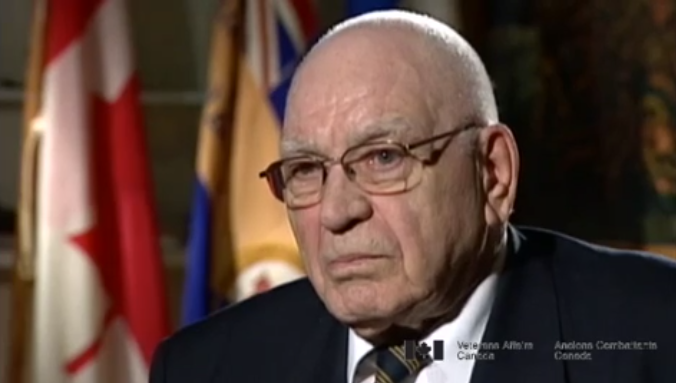
Mr. Barron outlines his enlistment, his service in Newfoundland, becoming a paratrooper and reaching England for active service.
Transcription
I joined the Princess Louise Fusiliers, which is an old-time regiment from Halifax. And being young and inexperienced and, I didn’t get along too well, and I had a few marks against me. I don’t want to go into detail. But, anyway, I got released in November, had basic training, so-called, foot and arm drill mainly, stayed home, helped my father in the woods from, till January ‘41, went in and joined the artillery, took some coast artillery training in Halifax, then went to Newfoundland in the 106th Battery and was posted to area headquarters, and I remained on that duty till late fall of ‘43. I was comparatively safe in Newfoundland. The only danger was the Newfoundland girls. But, if I hadn’t have volunteered for the paratroops, I think I would’ve been there till the war ended. But in the summer, early fall of ‘43 I volunteered for the paratroops. I was grabbed in a drafting company number six depot, went through a board of many many specialists and tests. There was about 30 odd who’d volunteered for paratroops and there was only four or five of us passed. They shipped us out to number 10 depot in Winnipeg, and then to Shilo, to the CPTC, Canadian Paratroop Training Centre. I took PT and runs, and my paratroop jumps, tower jumps, got my paratroop wings in early May of ‘44. Immediately got an embarkation leave, no, took advanced training in infantry for eight weeks I think it was. At the end of that I got an embarkation leave and went overseas, I think it was Aug of ‘44, so I was only overseas not quite a year, but I got into action. But anyway, I arrived in Salsburg Plains in early, fall of ‘44, went in the battalion, the First Canadian Parachute Battalion, which was part of the 6th Airborne Division and went in as reinforcements. They had been in France from D-Day, the boys, they went in with 600 and some men, and 200 came out, so I missed that. But, they sent us down to a Ringway to qualify with the British chute. We had qualified in Canada with the American chute, and it had a reserve. The British had no reserve. So, it had a psychological effect jumping with no reserve, but we managed to cope with it. And I took my jumps in, right near Manchester at the air training school there, air, the paratroop training school called Ringway. I went in the 4th platoon of the Battalion after that, and then in December was the first action I got into in the Ardennes.
Catégories
Only Four or Five of us Passed.
Médium
Video
Propriétaire
Veterans Affairs Canada
Guerre ou mission
Seconde Guerre mondiale
Emplacement géographique
Europe
Campagne
Europe
Personne interviewée
Reginald Roy Barron
Branche
Armée
Unité ou navire
1<sup>e</sup> Bataillon canadien de parachutistes
Military Rank
Private
Occupation
Parachutiste
Durée
3:27