Attention!
Cette vidéo est disponible en anglais seulement.
Description
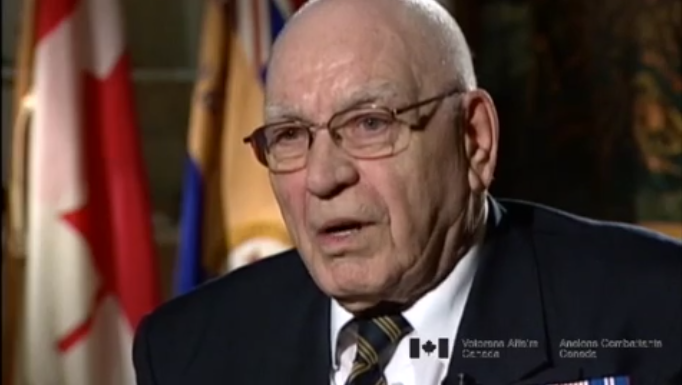
Mr. Johnston recalls how he became posted on an American base as part of a joint Canadian/American force. He also comments on the differences in Canadian and US military equipment.
Transcription
I was fortunate enough to go to Bangor, Maine, where we had the, Over-the-Horizon Back Scatter Radar was being developed, a joint Canadian and American manning, for an American project to develop it. The first site that they were developing was in Bangor and I was one of the first Canadians to go in on the component for the operation of it. And we never did get it fully operational because of funding and various other things came up in the meantime and they wound up mothballing it. But it was my first exposure to being transferred to the States if you will. I went there in ‘87 for that and got promoted in ‘89 and was offered a chance to go back flying and elected to go to Oklahoma, elected, wasn't much of an election, I was told to go there. Wound up going to Tinker Air Force Base in Oklahoma City, flying on the American AWACS E-3, and spent four years there.
Interviewer: Did you find it difficult when you first went to Bangor, the Canadian and American...
No, I actually didn't, Bangor being so close to the New Brunswick border, you're in New Brunswick, you're in Maine, other than crossing the border the people are remarkably the same. The climate's identical, pretty close to what they're doing and let's just say the people are so much like the people from New Brunswick that it's pretty hard to differentiate between the two.
Interviewer: Did you find much of a difference between the planes and the equipment you would use in Canada and what they had in America?
Eventually we did, when I wound up flying on the AWACS out of Oklahoma. Canada bought the CF-18 in 1982 and that is the most modern air plane that we fly obviously as a fighter aircraft. It's as modern as a majority of the American fighters, they just have so many more of them, and by having more they can develop them into different roles. Ours are pretty much limited to the role that they were designed for. The Americans for example the F-16's that the Americans fly, they can fly them as a reconnaissance type of aircraft devoted solely to that if they want to do that. They can have so many different variants of the same model of aircraft if you will, that they can specialize in different roles. And they just plain have so many of them that you can really structure a force when your going into a place like the Gulf War, the first Gulf War. You can structure your force for specialty aircraft to do a specific job, you don't have to rely on one type of aircraft to do everything.
Interviewer: Did you find it difficult when you first went to Bangor, the Canadian and American...
No, I actually didn't, Bangor being so close to the New Brunswick border, you're in New Brunswick, you're in Maine, other than crossing the border the people are remarkably the same. The climate's identical, pretty close to what they're doing and let's just say the people are so much like the people from New Brunswick that it's pretty hard to differentiate between the two.
Interviewer: Did you find much of a difference between the planes and the equipment you would use in Canada and what they had in America?
Eventually we did, when I wound up flying on the AWACS out of Oklahoma. Canada bought the CF-18 in 1982 and that is the most modern air plane that we fly obviously as a fighter aircraft. It's as modern as a majority of the American fighters, they just have so many more of them, and by having more they can develop them into different roles. Ours are pretty much limited to the role that they were designed for. The Americans for example the F-16's that the Americans fly, they can fly them as a reconnaissance type of aircraft devoted solely to that if they want to do that. They can have so many different variants of the same model of aircraft if you will, that they can specialize in different roles. And they just plain have so many of them that you can really structure a force when your going into a place like the Gulf War, the first Gulf War. You can structure your force for specialty aircraft to do a specific job, you don't have to rely on one type of aircraft to do everything.
Catégories
Canadians Posted South
Médium
Video
Propriétaire
Veterans Affairs Canada
Guerre ou mission
Forces armées canadiennes
Emplacement géographique
États-Unis
Personne interviewée
Alonzo Johnston
Branche
Aviation
Military Rank
Major
Durée
03:08