
Gallery
A Brush with the Korean War online Art Gallery
This is a collection of paintings of the Korean War by Canadian artist Ted Zuber.
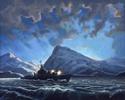
Daybreak, Gulf of Korea by Ted Zuber
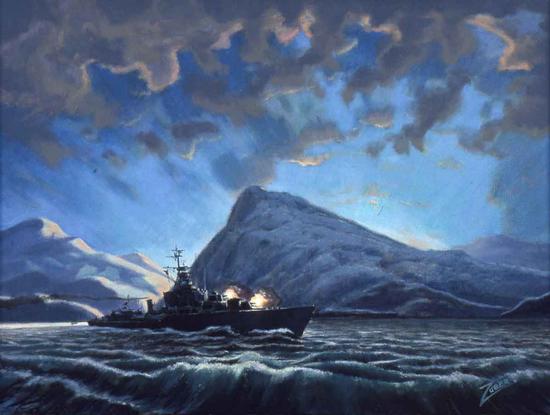
Image 1 of 6
Naval power was valued throughout the Korean War. The start of the war led to three Royal Canadian destroyers, HMCS Cayuga, HMCS Athabaskan and HMCS Sioux, setting sail in the waters off Korea. The ships performed a variety of duties for the rest of the conflict. One of the most interesting roles was being part of the "Trainbusters Club." The mountainous terrain in Korea often forced rail lines to hug the coast, which made trains tempting targets for our warships patrolling off shore. Damaging trains and railway tracks made it harder for the enemy’s transportation of supplies. In this artwork, Ted Zuber has painted a ship firing at enemy trains. This was a difficult and dangerous task. On October 2, 1952, HMCS Iroquois was exchanging fire with an enemy on shore when the ship took a direct hit. Three Canadian sailors died and ten were wounded in the explosion–our navy’s only combat casualties in the Korean War.
Canadian War Museum 19890328-013Beaverbrook Collection of War Art
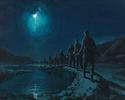
Freeze – Patrol Under Enemy Flare, by Ted Zuber
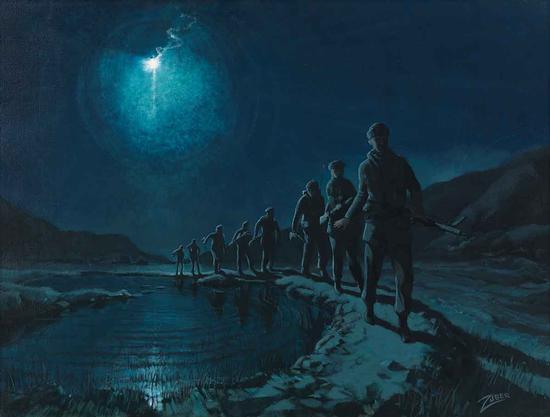
Image 2 of 6
The painting Freeze is of a soldier’s worst nightmare–suddenly being caught out in the open as a burst shell lights up the battlefield sky…and no place to hide. The group of Canadians are forced to stand perfectly still and silent, and pray they won’t suddenly hear gunfire that could potentially wipe out their entire unit. It’s a haunting piece, allowing us to really get a sense of the desperation these soldiers must have felt out there on cold night battles. This stunning painting has been selected to hang on banners in our nation’s capital this year to mark the 65th anniversary of the Korean War Amistice!
Canadian War Museum 19890328-012Beaverbrook Collection of War Art
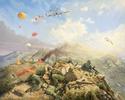
Holding at Kapyong by Ted Zuber.
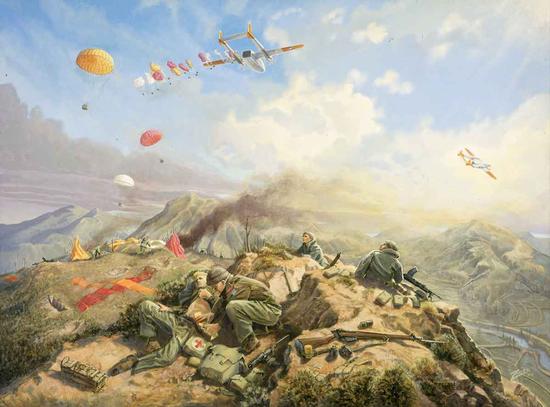
Image 3 of 6
Holding at Kapyong is one of Ted Zuber’s most popular war paintings. It shows the 2nd Battalion Princess Patricia’s Canadian Light Infantry being re-supplied by air on the morning after the Battle of Kapyong on April 25th 1951. Holding at Kapyong depicts a pivotal moment in the Korean War. If the airdrop had not been successful, the Patricia’s situation could have become disastrous. After fighting all night, they were tired and almost out of ammunition, food and medical supplies. They would have been vulnerable if the Chinese were to attack again. But it was successful, and it was at this very moment, they realized they would not die at Kapyong. It was a defining moment in Canada’s famous Korean battle.
Canadian War Museum 19900084-001Beaverbrook Collection of War Art
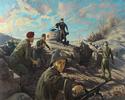
Incoming by Edward Zuber
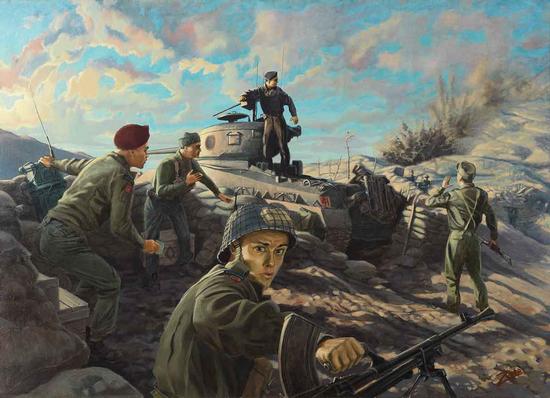
Image 4 of 6
The painting Incoming by Edward Zuber depicting Canadian action at Hill 355 in October 1952. This painting shows soldiers of B Company, the Royal Canadian Regiment, reacting to a communist artillery attack on their section of the line on October 23, 1952. The 45-minute bombardment was one of the heaviest Canadians endured in Korea.
Canadian War Museum 19890328-008Beaverbrook Collection of War Art
Reverse Slope – A Moment of Leisure by Ted Zuber
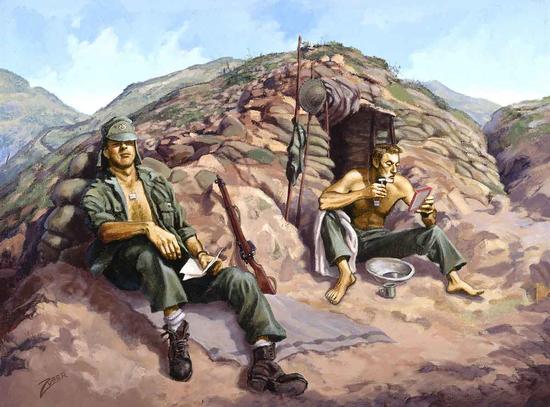
Image 5 of 6
In the Korean War, soldiers were in their trenches every night, from dusk to dawn. During the day, they spent their time on the reverse side of the slopes, out of enemy sight. In this painting, soldiers catch a moment of leisure on a “reverse slope,” taking time to shave, read a letter from home, and have a nap.
Canadian War Museum 19890328-011Beaverbrook Collection of War Art
Welcome Party by Ted Zuber
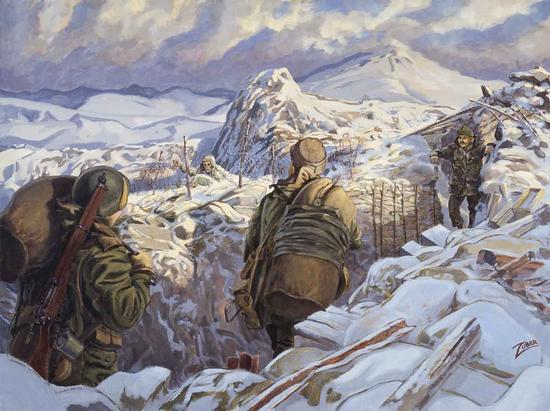
Image 6 of 6
During the Korean War, one of the front-line sectors where our soldiers saw action was in the area nicknamed “the Hook.” This image shows the landscape as seen from the Canadian trenches there. Korea is a rugged land, with many ranges of high hills and deep valleys. The Hook was a curved piece of high ground which overlooked a river valley. Canadian soldiers spent much time building up its defences and repelling raids to ensure it did not fall into enemy hands. In the painting, there is a hill above the head of the middle soldier. The ground to the right of it had the Chinese trenches only 200 to 300 metres away. The image also depicts two Canadian soldiers approaching their new platoon sergeant who is standing outside a bunker awaiting their arrival. To their left, and frozen in the barbed wire, are two dead soldiers, the “welcome party.”
Canadian War Museum 19890328-004Beaverbrook Collection of War Art
- Date modified: