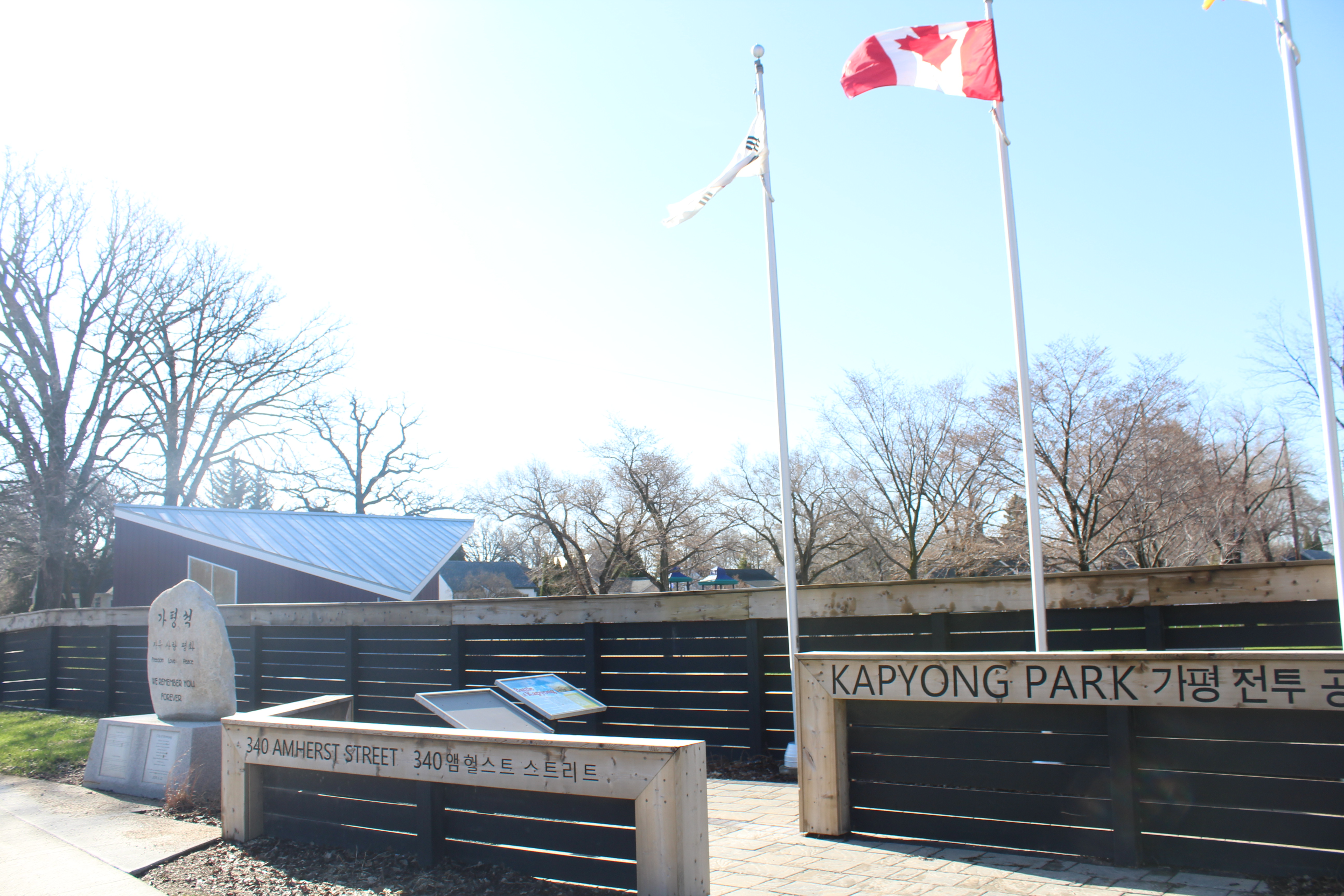
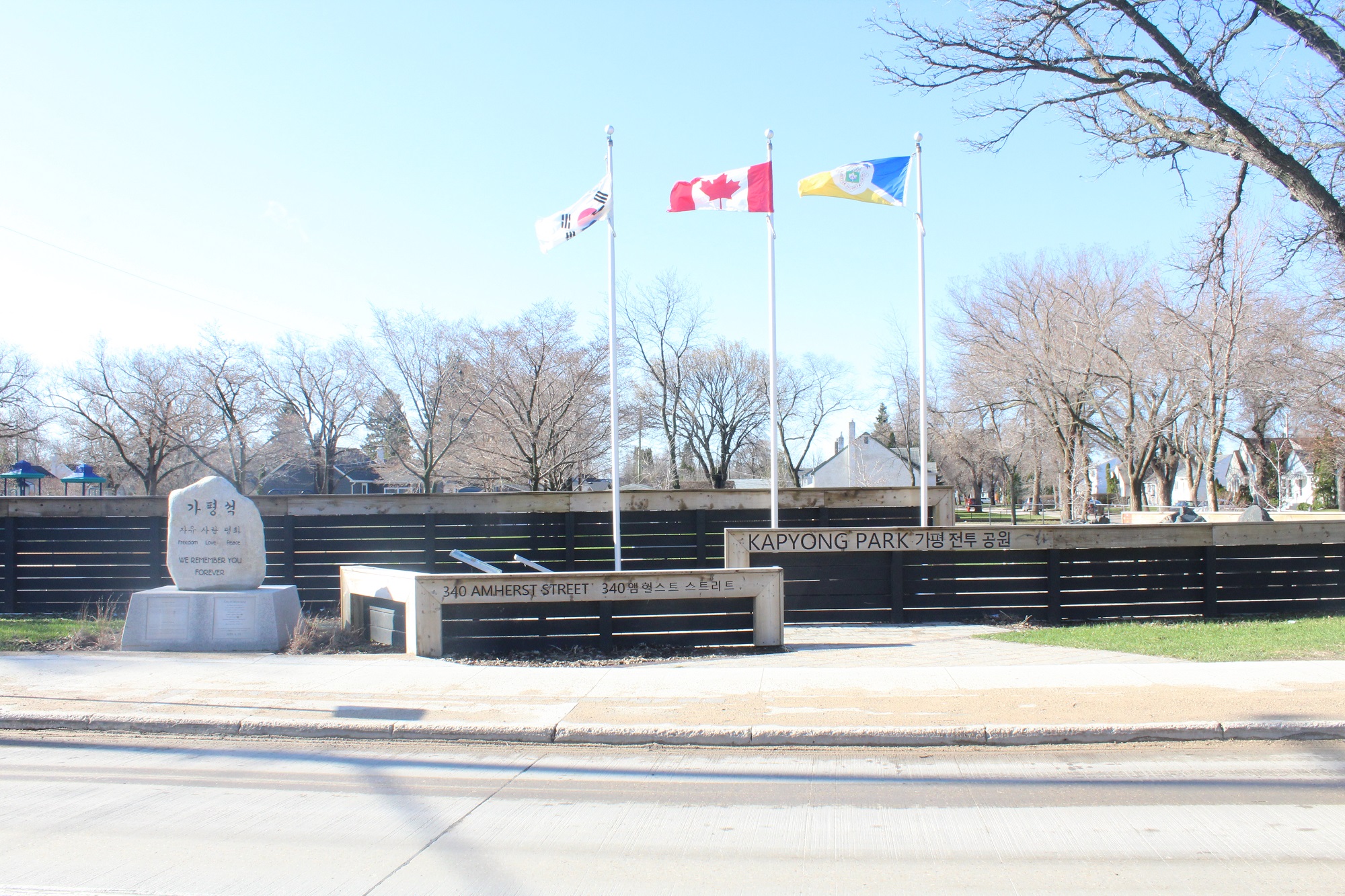
KAPYONG PARK
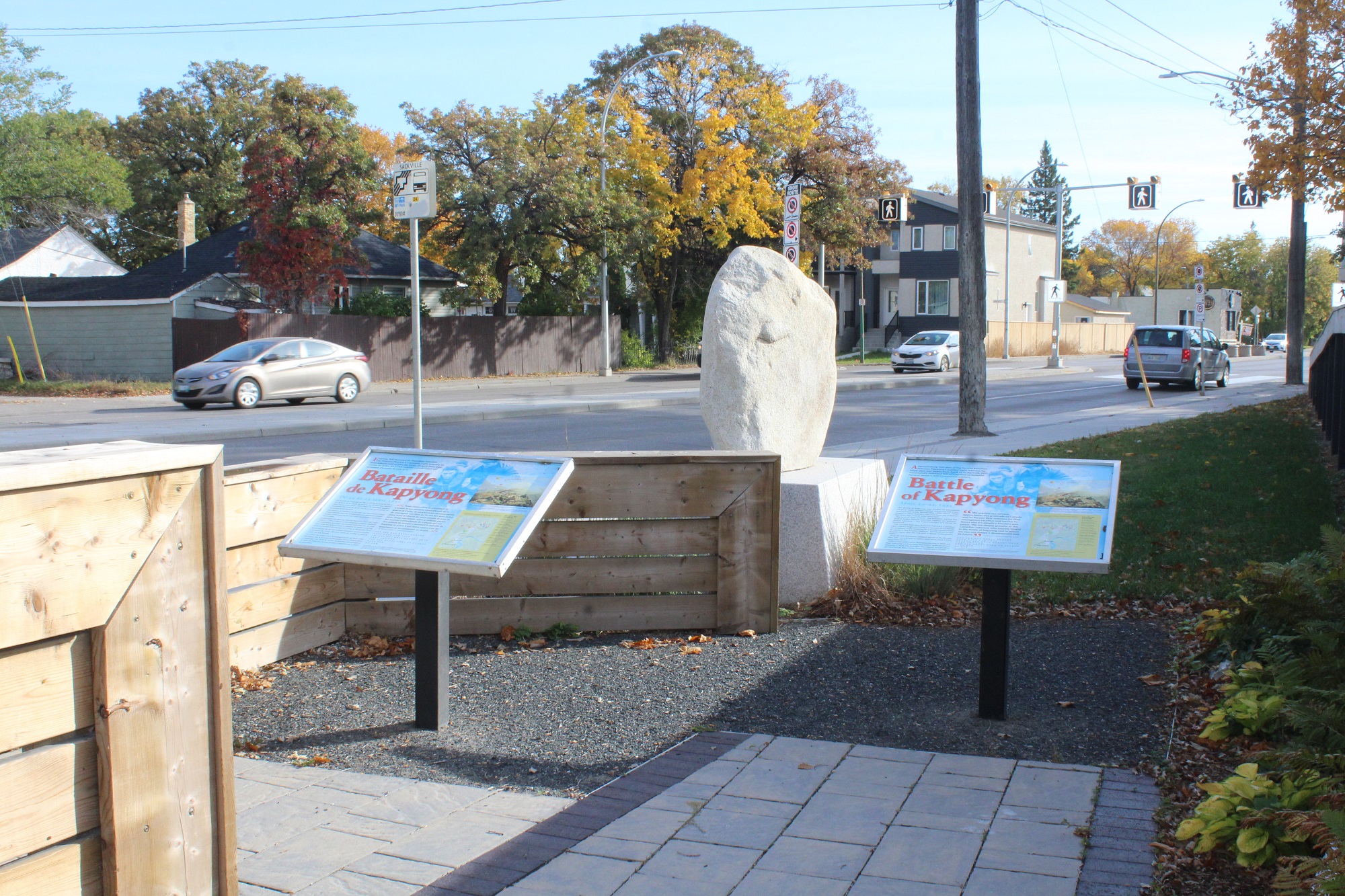
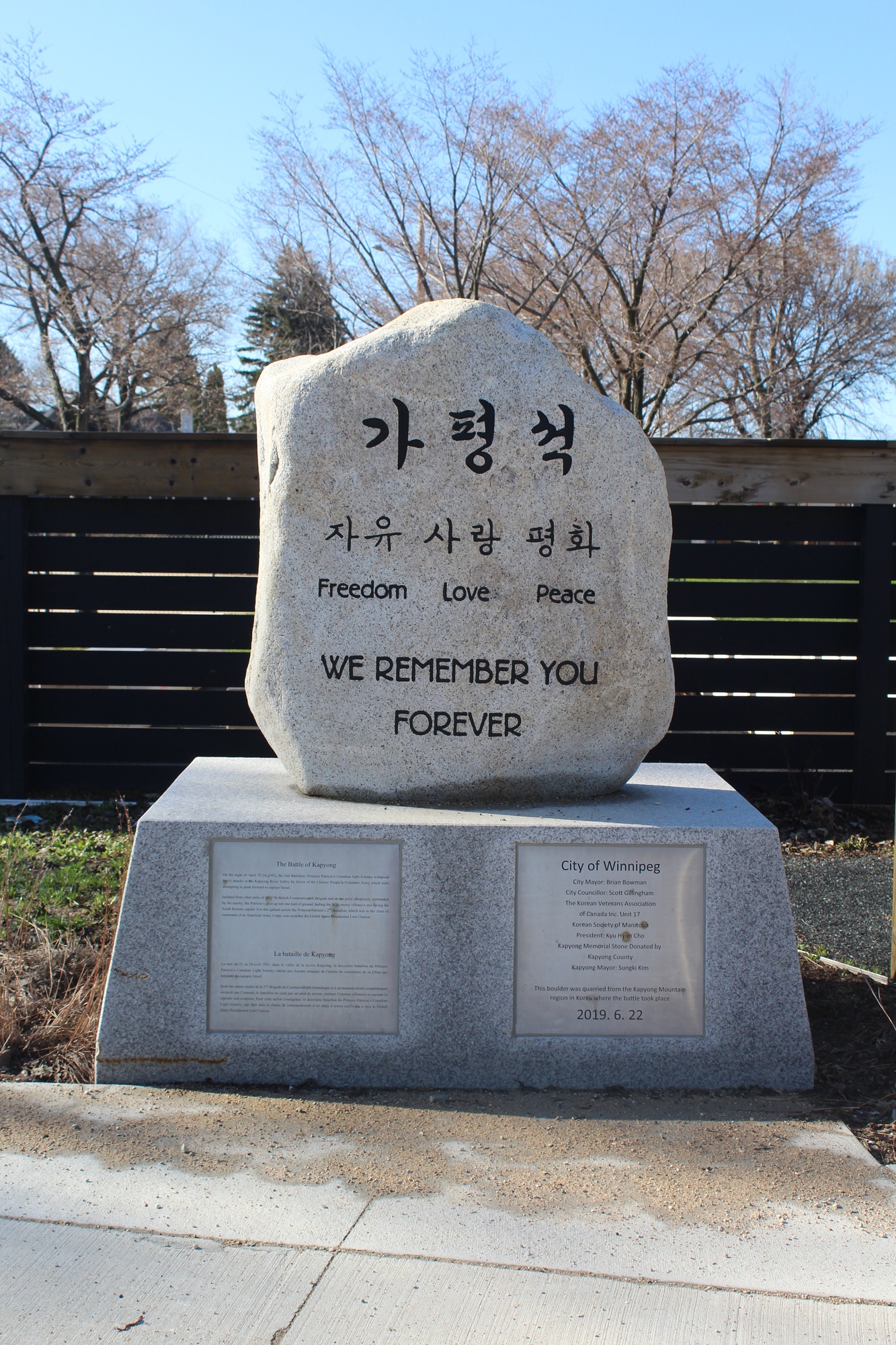
[boulder]
Freedom Love Peace
WE REMEMBER YOU
FOREVER
(plaque)
The Battle of Kapyong
On the night of April 23-24, 1951, the 2nd Battalion, Princess Patricia's Canadian light Infantry withstood
heavy attacks in the Kapyong River Valley by forces of the Chinese People's Volunteer Army which were
attempting to push forward to capture Seoul.
Isolated from other unites of the 27th British Commonwealth Brigade and at one point completely surrounded
by the enemy, the Patricia's gave up not one foot of ground, halting the huge eneme offensive and saving the
South Korean capital. For this gallant action the Princess Patricia's 2nd Battalion, which was in the chain of
command of an American Army Corps, was awarded the United States Presidential Unit Citation.
(plaque)
La bataille de Kapyong
La nuit du 23 au 24 avril 1951, dans la vallée de la rivière Kapyong, le deuxième bataillon du Princess
Patricia's Canadian light Infantry résista aux lourdes de l'armée de volontaires de la Chine qui
tentaient de capturer Séoul.
Isolé des autres unités de la 27e Brigade du Commonwealth britannique et à un moment donné complètement
encerclé par l'ennemi, le battaillon ne céda pas un pied de terrain, arrêtant l'énorme offensive et sauvant la
capitale sud-coréenne. Pour cette action courageuse, le deuxième bataillon du Princess Patricia's Canadian
Light Infantry, qui était dans la chaîne de commandement d'un corps d'armée américain, a reçu la United
States Presidential Unit Citation.
City of Winnipeg
City Mayor: Brian Bowman
City Counsellor: Scott Gillingham
The Korean Veterans Assocation
of Canada Inc. Unit 17
Korean Society of Manitoba
Presient: Kyu Yhon Cho
Kapyong Memorial Stone Donated by
Kapyong County
Kapyong Mayor: Sungki Kim
This boulder was quarried from the Kapyong Mountain
region in Korea where the battle took place
2019. 6. 22
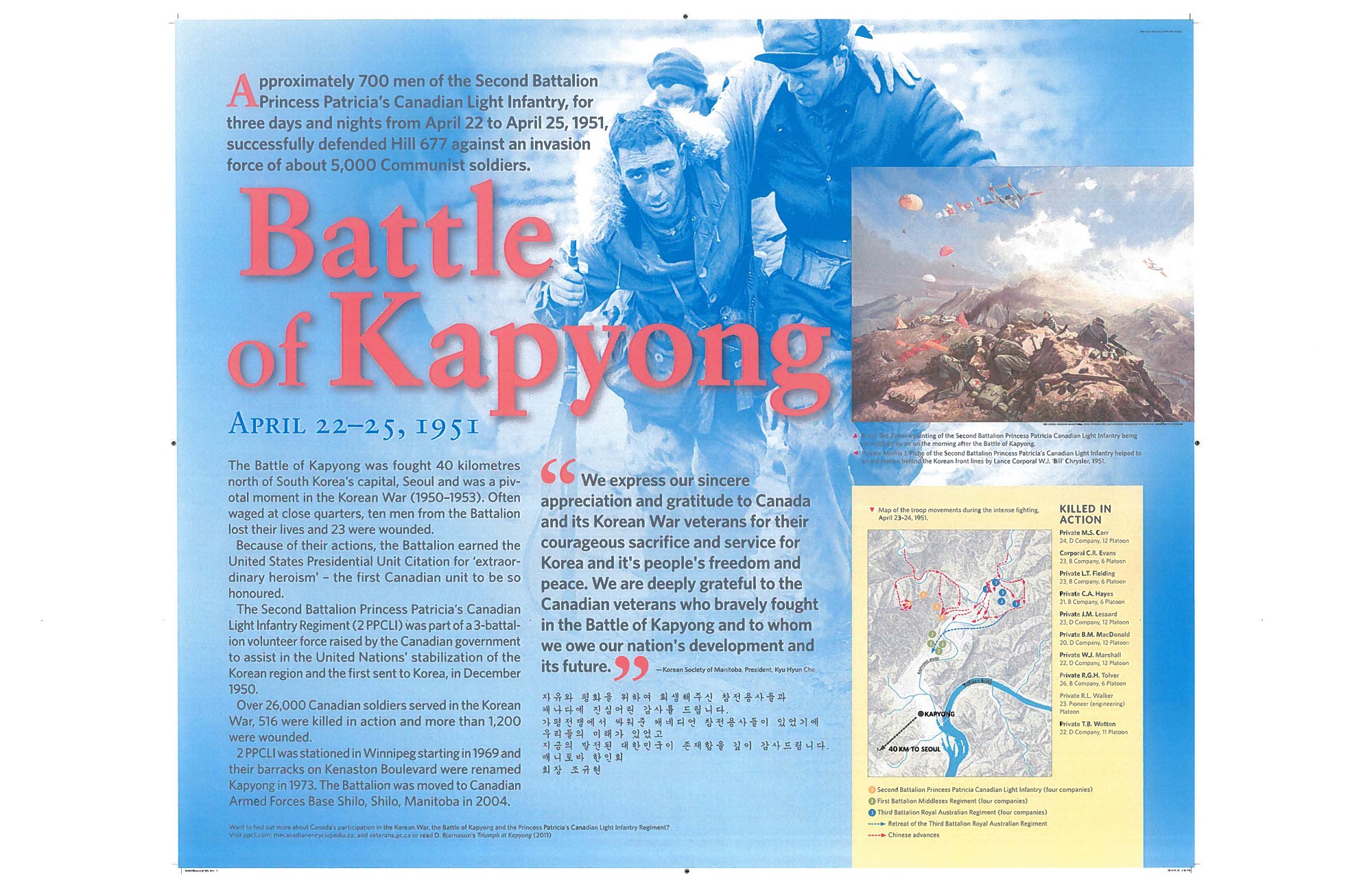
[English interpretive panel/panneau d’interprétation en anglais]
Approximately 700 men of the Second Battalion Princess Patricia’s Canadian Light Infantry, for three days and nights from April 22 to April 25, 1951, successfully defended Hill 677 against an invasion force of about 5,000 Communist soldiers.
Battle of Kapyong
April 22–25, 1951
The Battle of Kapyong was fought 40 kilometres north of South Korea’s capital, Seoul and was a pivotal moment in the Korean War (1950–1953). Often waged at close quarters, ten men from the Battalion lost their lives and 23 were wounded.
Because of their actions, the Battalion earned the United States Presidential Unit Citation for ‘extraordinary heroism’ – the first Canadian unit to be so honoured.
The Second Battalion Princess Patricia’s Canadian Light Infantry Regiment (2 PPCLI) was part of a 3-battalion volunteer force raised by the Canadian government to assist in the United Nations’ stabilization of the Korean region and the first sent to Korea, in December 1950.
Over 26,000 Canadian soldiers served in the Korean War, 516 were killed in action and more than 1,200 were wounded.
2 PPCLI was stationed in Winnipeg starting in 1969 and their barracks on Kenaston Boulevard were renamed Kapyong in 1973. The Battalion was moved to Canadian Armed Forces Base Shilo, Shilo, Manitoba in 2004.
“We express our sincere appreciation and gratitude to Canada and its Korean War veterans for their courageous sacrifice and service for Korea and it's people's freedom and peace. We are deeply grateful to the Canadian veterans who bravely fought in the Battle of Kapyong and to whom we owe our nation's development and its future.” - Korean Society of Manitoba, President, Kyu Hyun Cho
Killed in action
Private M.S. Carr 24, D Company, 12 Platoon
Corporal G.R. Evans 23, B Company, 6 Platoon
Private L.T. Fielding 23, B Company, 6 Platoon
Private C.A. Hayes 21, B Company, 6 Platoon
Private J.M. Lessard 23, D Company, 12 Platoon
Private B.M. MacDonald 20, D Company, 12 Platoon
Private W.J. Marshall 22, D Company, 12 Platoon
Private R.G.H. Tolver 26, B Company, 6 Platoon
Private R.L. Walker 23, Pioneer (engineering) Platoon
Private T.B. Wotton 22, D Company, 11 Platoon
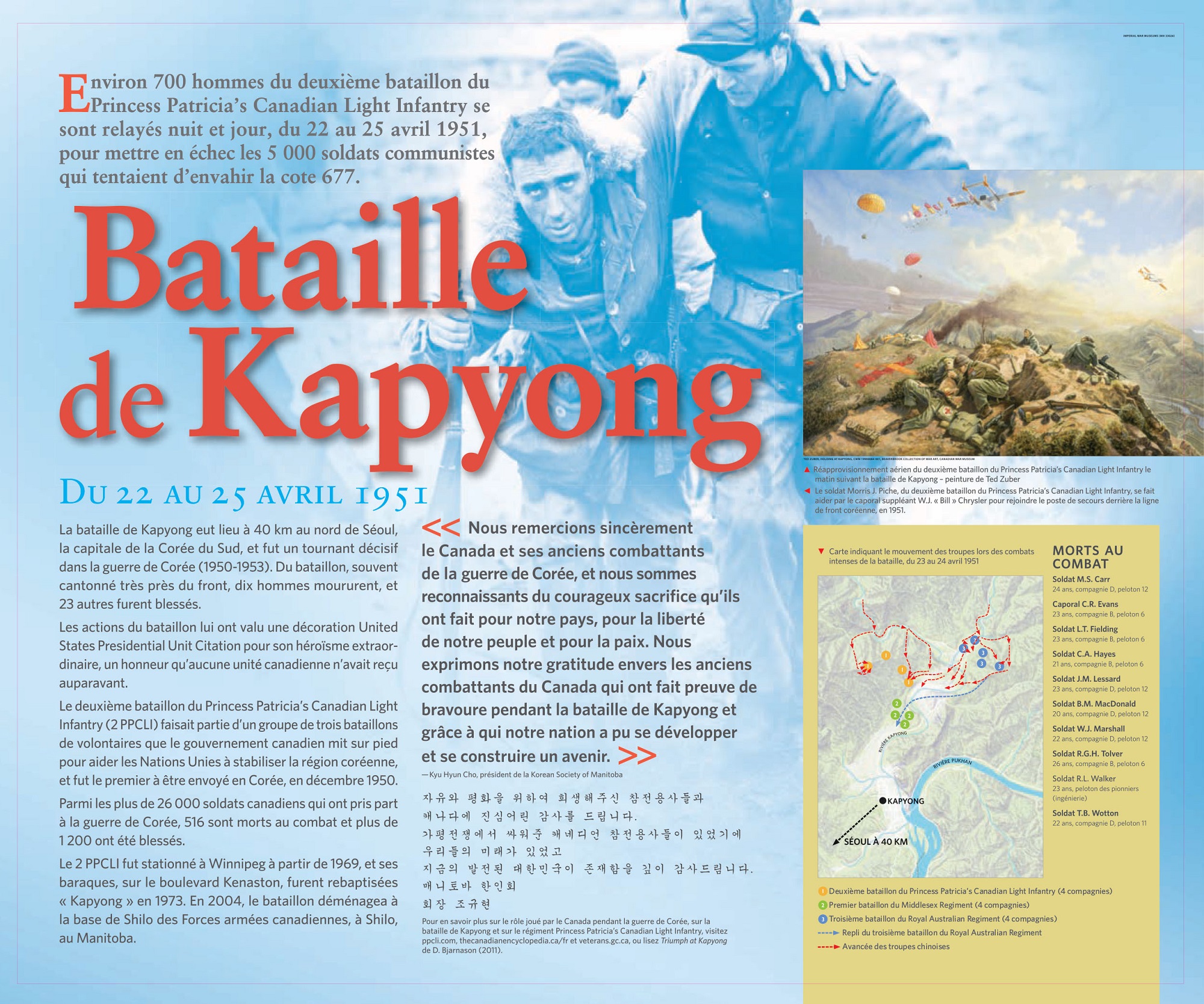
[French interpretive panel/panneau d’interprétation en français]
Environ 700 hommes du deuxième bataillon du Princess Patricia’s Canadian Light Infantry se sont relayés nuit et jour, du 22 au 25 avril 1951, pour mettre en échec les 5 000 soldats communistes qui tentaient d’envahir la cote 677.
Bataille de Kapyong
Du 22 au 25 avril 1951
La bataille de Kapyong eut lieu à 40 km au nord de Séoul, la capitale de la Corée du Sud, et fut un tournant décisif dans la guerre de Corée (1950-1953). Du bataillon, souvent cantonné très près du front, dix hommes moururent, et 23 autres furent blessés.
Les actions du bataillon lui ont valu une décoration United States Presidential Unit Citation pour son héroïsme extraordinaire, un honneur qu’aucune unité canadienne n’avait reçu auparavant.
Le deuxième bataillon du Princess Patricia’s Canadian Light Infantry (2 PPCLI) faisait partie d’un groupe de trois bataillons de volontaires que le gouvernement canadien mit sur pied pour aider les Nations Unies à stabiliser la région coréenne, et fut le premier à être envoyé en Corée, en décembre 1950.
Parmi les plus de 26 000 soldats canadiens qui ont pris part à la guerre de Corée, 516 sont morts au combat et plus de 1 200 ont été blessés.
Le 2 PPCLI fut stationné à Winnipeg à partir de 1969, et ses baraques, sur le boulevard Kenaston, furent rebaptisées « Kapyong » en 1973. En 2004, le bataillon déménagea à la base de Shilo des Forces armées canadiennes, à Shilo, au Manitoba.
« Nous remercions sincèrement le Canada et ses anciens combattants de la guerre de Corée, et nous sommes reconnaissants du courageux sacrifice qu’ils ont fait pour notre pays, pour la liberté de notre peuple et pour la paix. Nous exprimons notre gratitude envers les anciens combattants du Canada qui ont fait preuve de bravoure pendant la bataille de Kapyong et grâce à qui notre nation a pu se développer et se construire un avenir. » – Kyu Hyun Cho, président de la Korean Society of Manitoba
Morts au combat
Soldat M.S. Carr, 24 ans, compagnie D, peloton 12
Caporal G.R. Evans, 23 ans, compagnie B, peloton 6
Soldat L.T. Fielding, 23 ans, compagnie B, peloton 6
Soldat C.A. Hayes, 21 ans, compagnie B, peloton 6
Soldat J.M. Lessard, 23 ans, compagnie D, peloton 12
Soldat B.M. MacDonald, 20 ans, compagnie D, peloton 12
Soldat W.J. Marshall, 22 ans, compagnie D, peloton 12
Soldat R.G.H. Tolver, 26 ans, compagnie B, peloton 6
Soldat R.L. Walker, 23 ans, peloton des pionniers (ingénierie)
Soldat T.B. Wotton, 22 ans, compagnie D, peloton 11