
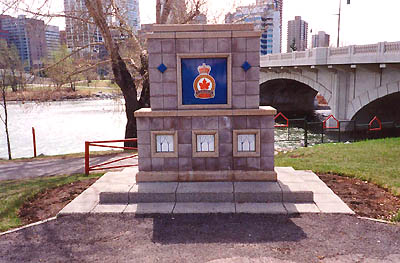
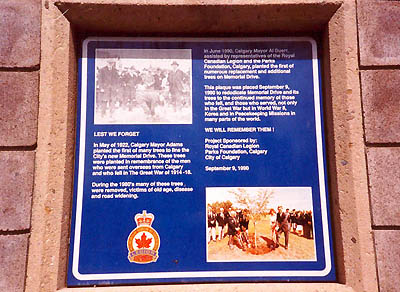
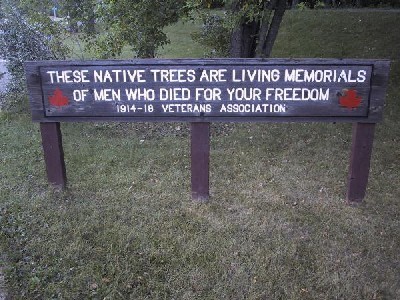
On May 10, 1922, a line of trees were planted along the new Memorial Drive and dedicated in memory of Calgarians who died during the First World War. The memorial was rededicated on 9 September 1990, to incorporate additional trees along Memorial Drive and the addition of the remembrance of local Veterans of the Second World War, Korean War and peacekeeping missions around the world.
The Calgary Parks Department in its annual report for 1919 referred to a local movement to plant memorial trees. Council chose to place the trees along a section of an existing boulevard on the north bank of the Bow River between Centre Street and St. George’s Island bridge. Nine hundred trees were planted the first year, many sponsored by city service groups and clubs as well as next-of-kin. By 1927, approximately 1,700 trees had been planted three rows deep.
Calgary’s Memorial Drive has been extended and widened into a major cross-city route, many of its original trees and all of its plaques have been lost.
In 1918, Canadians turned to the duty of commemorating the dead. Some promoted practical memorials like Roads of Remembrance. These linear tree-lined avenues had trees that were typically a single species, regularly spaced along each side of the avenue that would grow tall and stately. American elms were chosen for many of these avenues. A small plaque was used to assign a particular tree to a specific fallen soldier. In some cases, the next-of-kin was involved in purchasing the tree and/or plaque for the deceased soldier.
Roads of Remembrance were based on two symbol-laden images. The first was France’s tree-lined country avenues: “long straight roads, with large elms on either side, beautiful and useful, and loved by the Canadians overseas.” The second symbol was a living memorial: trees represented the victory of life over death. Memorial trees became living symbols of the sacrifices made overseas.