
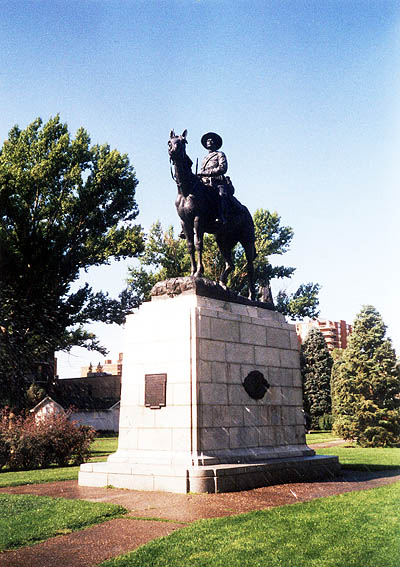

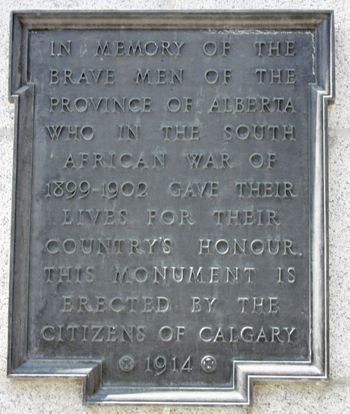
The South African War Memorial was unveiled on June 20, 1914. Only Veterans and their families were allowed in the park, while non-military citizens packed the streets. Boy scouts, fire fighters, and cadets were mobilized to guard the flower beds at the park. The memorial was unveiled by the District Officer Commander Colonel Cruickshank. R.B. Bennett, KC, MP, addressed the crowd.
In 1909, a man was found on the outskirts of city, frozen to death. The only documentation found on him were papers identifying him as a Veteran of the South African War, having been discharged from the Lord Strathcona’s Horse Regiment. The Veterans of Calgary raised funds and provided the man with a proper soldier's funeral and burial.
Word of the soldier's death reached his family in England and they insisted the Veterans be reimbursed the cost of the funeral. When the money arrived, the Veterans decided that it was more important that the memories of their brethren be remembered, and so the reimbursed funeral expenses became the beginning of a fundraising campaign to build a memorial to the fallen of the South African War.
A committee was formed with representatives from the Western Veterans Association, the Canadian Club, Imperial Order of the Daughters of the Empire, and the City of Calgary. In 1911, the committee approached the world famous French-Canadian sculptor Louis-Phippe Hebert in 1911 to design a memorial.
Hebert himself decided that the Central Memorial Park site was the best location for the statue. He went to great lengths to ensure the accuracy of his first and only equestrian monument. Hebert had a genuine Calgary Quarter Horse sent by train to his Montreal studio and came to Calgary periodically to study the Calgary Horses in their natural environment.
Hebert requested a “typical Canadian army man type” to be sent to him from the Canadian Army, but was given a new recruit fresh off the boat from the United Kingdom instead of an Albertan soldier. Captain Thomas Henry Johnson posed for the statue. When Hebert came to Calgary to make the final arrangements for the monument, he decided to take the opportunity to see “the western horse in its own setting” and make a few alterations to the horse and rider. Hebert had Eneas McCormick dress as a South African War soldier to model for the piece.
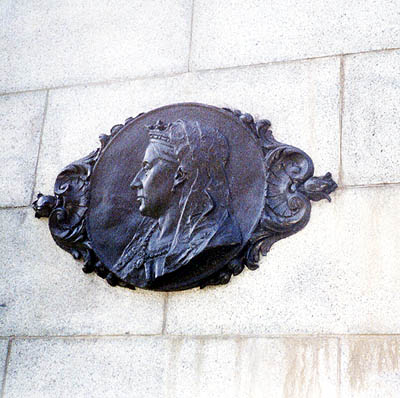
On the left side is a bronze plate with King Edward VII's profile and on the right side is a bronze plate with a profile of Queen Victoria. The memorial was completed in 1914. It was the last major piece of artwork Louis-Phippe Hebert completed and the only equestrian statue he ever made.