
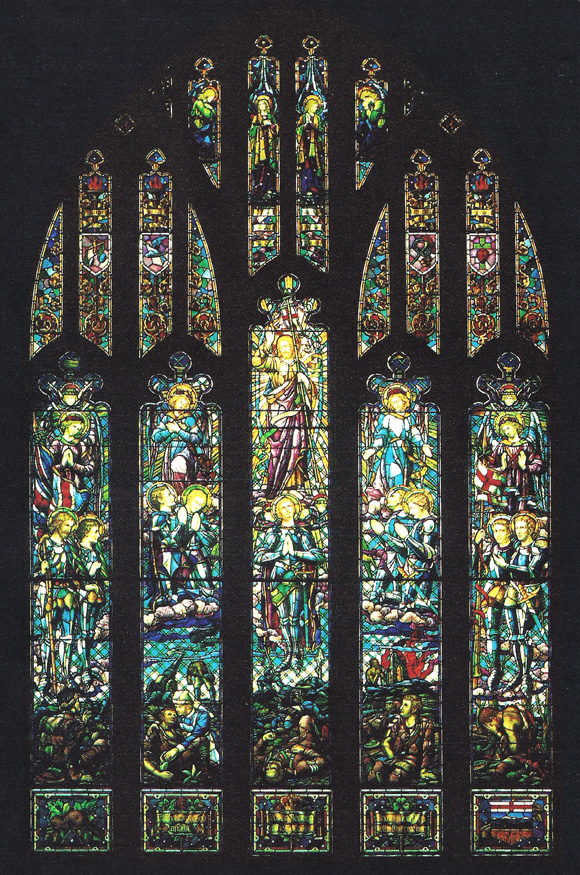
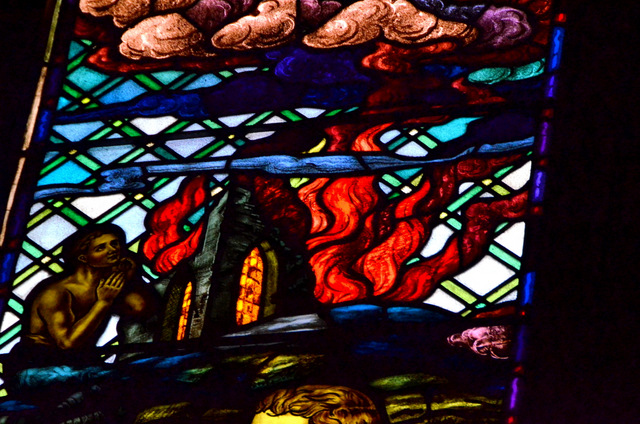
The stained glass window portrays suffering humanity lifted up, and looking up from life’s battle to Him from Whom all blessings flow. The central figure is the Risen Christ, Who carries in one hand the banner of Triumph over Death, whilst the other is raised in benediction. His inner garment is of white, cream, and gold, which signify Purity: the mantle is a soft blending of pink, crimson, and lavender, to symbolize His Passion and Death. On the emerald scroll which floats about Him is inscribed: – “I am the Resurrection.” His head is backed by a nimbus of elaborate ornament, in which will be noted the form of the Cross. A conventional oval of clouds surrounds Him, and from His figured extend rays that vary from white and cream to a light yellow and gold, terminating in a deep green and blue.
The other figures are arranged in corresponding tiers. The upper tier, which is on the same level as the figure of Christ, consists of angels and cherubs of various types and treatment, posed in a devotional attitude, and singing the praise of the Lord.
Below the angels are knights clad in the armour of light, representing glorified spirits, and typifying the following virtues (read from left to right): Fidelity, bearing the Union Jack crowned with laurels; Nobility; Honour; Humility; Devotion (this is the central figure); Patience; Sincerity; Brotherly Love, and Charity, carrying the Red Cross banner.
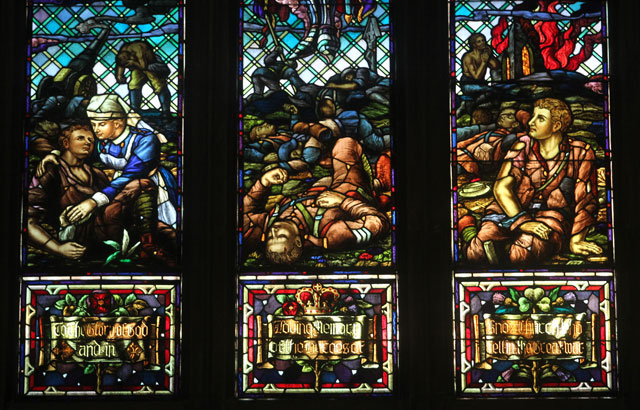
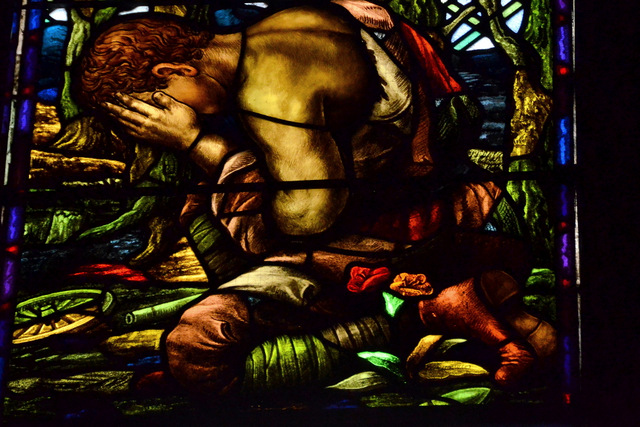
Below the Knights the horrors of war are represented. Reading from left to right, the figures represent: a wounded Canadian soldier, beholding the Heavenly vision; a Canadian dying in the arms of one of our heroic nurses, his expression denoting resignation and faith; a dying soldier, directly above whom stands the welcoming Christ; the face of the next figure represents the awakening of a soul that has strayed from the right way, but now sees the light once more; the figure on the extreme right represents a soul down in shame and penitence.
In the mid-distance and background are seen wounded, dying, and dead soldiers of both contending armies. On the central panel is seen a wayside shrine, which has escaped the ravages of war; on the panel to the left is a smoking gun, and on that to the right a village church in flames.
In the tracery above the main panels are pictured two angels, beneath which are scrolls with inscriptions: “The armies in Heaven followed Him”; and “He hath prepared for them a city.”
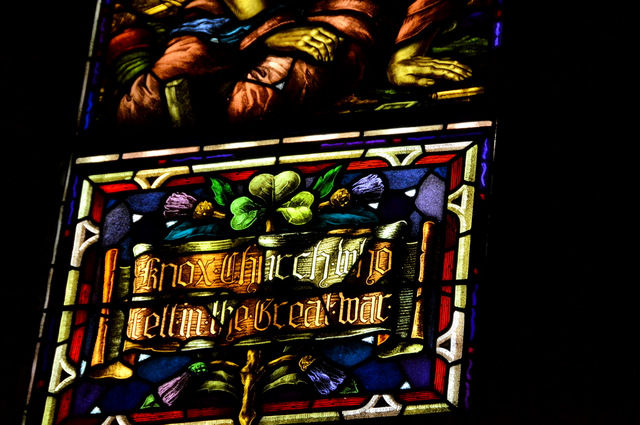
Each of the panels has a decorative base. These bases represent (from left to right): The Beaver and Maple Leaf, for Canada; The English Rose; The Rose and Thistle, surmounted by the Crown of Britannia; The Shamrock and Thistle; The beautiful Shield of Alberta.
This collection of windows was designed and executed by A.J. Larscheid and assistant corps of artists, in the studios of the Pittsburg Glass Company, Minneapolis, Minnesota, sometime after the First World War. The windows are dedicated to the memory of the men of Knox Presbyterian Church (now Knox United Church) of who 50 fell in the Great War.