
This memorial was erected by the Canada Lands Company, and unveiled on June 6th, 2010. This memorial is dedicated to the men and women who served in the Navy during "The Battle of the Atlantic". The story board include the history of the Second World War and the Battle of The Atlantic (1939 -1945).
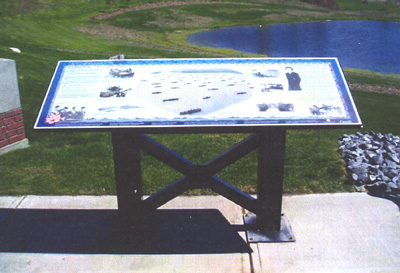
Story board
Don Stewart1
of
4
images
Left part of story board
1
of
4
images
Centre part of story board
1
of
4
images
Right part of story board
1
of
4
images
Type
Navy Plaza Storyboard
Edmonton, Alberta
Notice:
The National Inventory of Canadian Military Memorials is a public, crowd-sourced registry that helps Canadians learn about memorials in their communities. Inclusion in the Inventory does not imply VAC ownership or authority. Responsibility for the care, management, and any changes to a memorial rests with its owning or governing organization.
Inscription
[Storyboard/Tableau d'histoire]
(The Second World War and the Battle of The Atlantic (1939 -1945))
RCN SHIPS LOST DURING THE SECOND WORLD WAR
NAVIRES DE LA MARINE ROYALE CANADIENNE PERDUS
DURANT LA DEUXIEME GUERRE MONDIALE
HMCS FRASER
LOST JUNE 25, 1940
HMCS BRAS D`OR
LOST OCTOBER 19, 1940
HMCS MARGAREE
LOST OCTOBER 22, 1940
HMCS OTTER
LOST MARCH 26, 1941
HMCS LEVIS
LOST SEPTEMBER 19, 1941
HMCS WINDFLOWER
LOST DECEMBER 7, 1941
HMCS SPIKENARD
LSOT FEBRUARY 10, 1942
HMCS RACCOON
LOST SEPTEMBER 7, 1942
HMCS CHARLOTTETOWN
LOST SEPTEMBER 11, 1942
HMCS OTTAWA
LOST SEPTEMBER 13, 1942
HMCS LOUISBURG
LOST FEBRUARY 6,1943
HMCS WEYBURN
LOST FEBRUARY 22, 1943
HMCS ATHABASKAN
LOST APRIL 29, 1944
HMCS VALLEYFIELD
LOST MAY 7, 1944
HMCS REGINA
LOST AUGUST 8, 1944
HMCS ALBERNI
LOST AUGUST 21, 1944
HMCS SKEENA
LOST OCTOBER 25, 1944
HMCS SHAWINIGAN
LOST NOVEMBER 24, 1944
HMCS CLAYOQUOT
LOST DECEMBER 24, 1944
HMCS TRENTONIAN
LOST FEBRUARY 22, 1945
HMCS GUYSBOROUGH
LOST MARCH 17, 1945
HMCS ESQUIMALT
LOST JUNE 16, 1945
MTB`s 459, 461, 462, 465 and 466
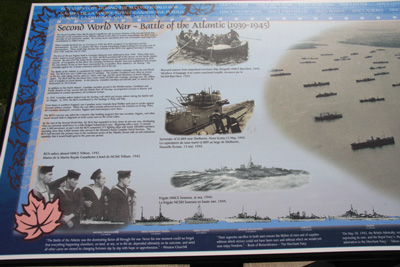
Second World War - Battle of the Atlantic (1939-1945)
The Royal Canadian Navy (RCN) played a significant role in various theatres of the Second World War.
However, in the protection of the Atlantic convoys in the effort to sustain Great Britain, the RCN made a
specialty of anti submarine warfare. Its convoy escort operations were one of Canada's most important
contributions to Allied victory.
When Canada declared war on Germany in 1939, the RCN consisted of six destroyers and five
minesweepers.In order to enhance this fleet, Canada immediately began building fx4 corvettes and 24
minesweepers. These small ships became the mainstay of the RCN's war against Germany's U-boats
from 1941 until the end of 1943.
the first of 70 new frigates built in Canadian shipyards were delivered in June 1943. These ships were
better suited to ocean-going duty. In 1943, the RCN provided half of the escorts on the North Atlantic convoys. by mid-1944 the entire North Atlantic convoy route was guarded almost exclusively by RCN
escorts. In recognition of this effort, the Canadian Northwest Atlantic Area was established and remains
the only theatre of war to have been commanded by a Canadian, Rear Admiral L.W. Murray. The
campaign against the U-boats continued until the end of the war.
The battle of the Atlantic is considered the longest continuous military campaign of the Second World
war. The RCN lost over 2,000 men and 24 warships. The weather conditions were often as vicious as the foe, with raging storms, pack ice, bitter cold, fog, and the dense blackness of North Atlantic
nights. The RCN and the Merchant Navy made nearly 26,000 safe crossings, carrying over 181 million tons of supplies to Great Britain. In the process, Canadian warships and aircraft sank, or shared in the
destruction of, 50 U-boats.
In addition to the North Atlantic, Canadian warships served in the Mediterranean, Caribbean and
Pacific theatres of war served with the British fleet off Norway, accompanied convoys to Russia, and
participated in coastal operations off northwest Europe.
In 1942, Canadian sailors helped man the landing craft which put troops ashore during the fateful raid
on Dieppe. In 1943, the RCN contributed to the landings in Sicily and Italy.
From bases in Southern England, two Canadian mortar torpedo boat flotillas took part in sorties against
German inshore convoys. When the vast allied armada advanced across the Channel on D-Day 1944,
60 Canadian destroyers, corvettes, frigates and minesweepers were there.
The RCN's success was aided by a massive ship-building program that saw corvettes frigates, and other
escort vessels built in shipyards on both coasts and on the Great Lakes.
By the end of the Second World War, the RCN had expanded to forty times its pre-war size, developing
from an extremely small force to a fully-fledged independent navy. Beginning with a mere 13 vessels and 3,500 personnel, at war's end the RCN comprised 373 fighting ships and nearly 100,000 members,
including more than 6,000 women who served in the Women's Royal Canadian Naval Services. The
RCN had become the primary navy in the northwest sector of the Atlantic Ocean with an anti-submarine capability that it would build upon in the post-war period.
(three first french paragraphs, need further research/trois premiers paragraphe français, recherche incomplète)
La Bataille de l`Atlantique fait partie des plus longues campagnes militaires continues
de la Deuxième guerre mondiale et durant cette période, 24 navires de la MRC
sont coulés, entrainant la mort de plus de 2,000 hommes. Ses violentes tempêtes,
ses banquises, son froid implacable, son brouillard et ses nuits très sombres rendent
l`Atlantique Nord tout aussi redoutable que l`ennemi. Malgré tout, la MRC et la marine
marchande réalisent près de 26,000 traversées et transportent plus de 181 millions de
tonnes de marchandises pour ravitailler la Grande-Bretagne. Durant cette campagne, la
marine et l`aviation canadiennes coulent ou détruisent 50 sous-marins allemands.
Outre l`Atlantique Nord, les navires de guerre canadiens servent en Méditerranée., dans les
caraïbes et le Pacifique. ils patrouillent aussi au large de la Norvège avec des navires de la
flotte britannique, accompagnent des convois en Russie et participent à des opérations au
large des côtes du nord-ouest de l`Europe.
En 1942, des Canadiens opèrent les péniches de débarquement qui servent à transporter
les troupes durant le raid de Dieppe, qui se solde par un échec. En 1943, la MRC
participe aux débarquements en Sicile et en Italie.
Depuis des bases du sud de l`Angleterre, deux flottes de vedettes lance-torpilles
participent aux sorties contre les convois côtiers allemands. Au jour 1 en 1944, 60
destroyers, corvettes, frégates et dragueurs de mines canadiens se joignent à la vaste flotte alliée qui franchis la Manche.
Le succès de la MRC résulte d`un programme intensifié de production de corvettes, frégates et autres bâtiments
d`escorte construits par des chantiers navals sur les deux côte et dans la région des Grands Lacs.
À la fin de la Deuxième guerre mondiale, l`envergure de la MRC se décuple pour atteindre quarante fois ses
effectifs d`avant-guerre, et devenant une marine complètement autonome. De ses 13 navires et 3,500 hommes
au début des hostilités, la MRC compte 373 navires et plus de 110, 000 membres, y compris plus de 6, 000
femmes du Service féminin de la Marine Royale du Canada (WRCNS) à la fin de la guerre. La MRC est devenu
la principale marine chargée du secteur nord-ouest de l`océan Atlantique, à l`aide des moyens de lutte aux sous-
marins qu`elle allait améliorer davantage durant l`après-guerre.
[buttom texts/texte au bas]
“The Battle of the Atlantic was the dominating factor all through the war. Never for one moment could we forget
that everything happening elsewhere, on land, at sea, or in the air, depended ultimately on its outcome, and amid
all other cares we viewed its changing fortunes day by day with hope or apprehension.” -Winston Churchill
Their supreme sacrifice in both wars ensure the lifeline of men and of supplies
without which victory could not have been ours and without which we would
not now enjoy freedom. - Book of Remembrance – The Merchant Navy
On May 10, 1945, the British Admiralty, sent a message
expressing its own, and the Royal Navy’s, thanks and
admiration to the Merchant Navy. - Valour at Sea
For more than five and a half years side by side with the Allied Merchant Navies in the face of continual and merciless attacks by the enemy you have
maintained the ceaseless flow of sea traffic on which the life and strength of this country depend… In this historic hour, we think with special gratitude
of the many merchant seamen who have fallen in the fight and whose service and sacrifice will always be a proud memory. - Valour at Sea.
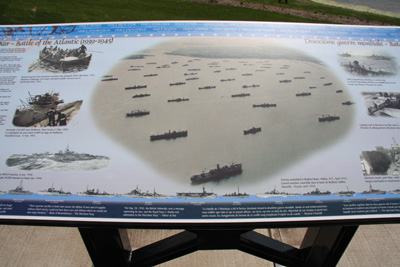
[Name of Canadian navy ships types under each ship image/nom du modèle de navire de la marine canadienne sous l' image de chaque navire]
V CLASS DESTROYER
2 IN SERVICE
ARMED MERCHANT CRUISERS
3 IN SERVICE
ARMED YACHTS
40 IN SERVICE
BANGOR MINESWEEPERS
64 IN SERVICE
CORVETTE
123 IN SERVICE
CRUISER
2 IN SERVICE
ESCORT CARRIER
2 IN SERVICE
FAIRMILE
80 IN SERVICE
FRIGATE
67 IN SERVICE
L.C.I.
24 IN SERVICE
L.C.M.
100 IN SERVICE
MOTOR TORPEDO BOATS
22 IN SERVICE
RIVER CLASS DESTROYER
14 IN SERVICE
TOWN CLASS DESTROYER
8 IN SERVICE
TRIBAL DESTROYER
4 IN SERVICE
V CLASS DESTROYER
2 IN SERVICE
[images descriptions/descriptions d'images]
RCN sailors aboard HMCS Trillium, 1942.
Marins de la Marine Royale Canadienne'a bord de NCSM Trillium, 1942.
Rescued seamen from torpedoed merchant ship alongside HMCS Red Deer, 1942.
Membres d'équipage d' un navire marchand torpillé, secourus par le
NCSM Red Deer, 1942.
Surrender of U-889 near Shelburne. Nova Scotia, 13 May, 1945.
La capitulation du sous-marin U-889 au large de Shelburne.
Nouvelle-Écosse, 13 mai, 1945.
Frigate HMCS Swansea, at sea, 1944.
La frégate NCSM Swansea en houte mer, 1944.
Convoy assembled in Bedford Basin, Halifax, N.S., Apr 1942.HMCS Kapuskasing refueling on convoy duty.
Le NCSM Kapuskasing effectue un ravitaillement en mer durant une mission ?? de convoie.
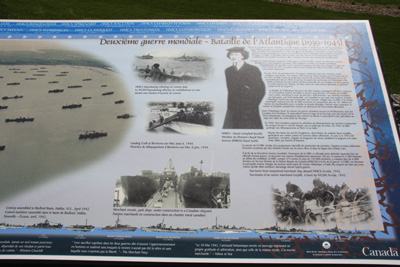
Landing Craft at Bernieres-sur-Mer, Jun. 6, 1944.
?? de d/barquement 'a Bernieres-sur-Mer, 6 juin, 1944
Merchant vessels, park ships, under construction in Canadian shipyard.
Navires marchands en construction dans un chantier naval canadien.
WRENS - Hazel ?? Juchli
Member de Women's Royal Naval Service (WREN) Hazel Juchli
Survivors from torpedoed merchant ship aboard HMCS Arvida, 1942.
Survivants d' un navire marchand torpil/, 'a bord du NCSM Arvida, 1942.
Street View
Location
Navy Plaza Storyboard
At the North-East edge of Bedford Basin Lake.
Edmonton
Alberta
Navy Plaza Storyboard
At the North-East edge of Bedford Basin Lake.
Edmonton
Alberta
GPS Coordinates
Lat. 53.60232
Long. -113.50602
Lat. 53.60232
Long. -113.50602