
Corvette Street

Edmonton, Alberta
Type
Other

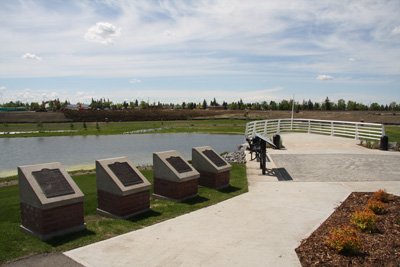
Corvette Street was dedicated to all the men and women who served on Royal Canadian Navy corvettes by the Canada Lands Company on August 25, 2010, as part of their redevelopment of Edmonton’s former Canadian Forces Base (Griesbach Barracks).

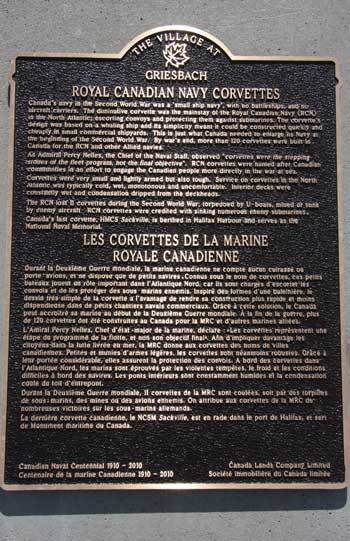
Canada's navy in the Second World War was a small ship navy without battleships or aircraft carriers. The corvette was the mainstay of the Royal Canadian Navy in the North Atlantic; escorting convoys and protecting them against submarines. Corvettes were built in Canada for the Royal Canadian Navy and other Allied navies. The Royal Canadian Navy corvettes were named after Canadian communities in an effort to engage the Canadian people more directly in the war at sea. They were very small and lightly armed, but also tough and with a long range that suited them to convoy protection.

Service on corvettes in the North Atlantic was typically cold, wet, monotonous, uncomfortable and interior decks were constantly wet and condensation dripped from the deckheads. Eleven Royal Canadian Navy corvettes were lost during the Second World War; torpedoed by U-boats, mined or sunk by enemy aircraft. Royal Canadian Navy corvettes were credited with sinking numerous enemy submarines. Canada’s last corvette, HMCS Sackville, is berthed in Halifax Harbour and serves as the National Naval Memorial.

The Royal Canadian Navy Corvettes plaque was unveiled on June 6, 2010.

Inscription

CORVETTE ST

[plaque]

THE VILLAGE AT
GRIESBACH

ROYAL CANADIAN NAVY CORVETTES

Canada's navy in the Second World War was a small ship navy, with no battleships, and no
aircraft carriers. The diminutive corvette was the mainstay of the Royal Canadian Navy (RCN)
in the North Atlantic; escorting convoys and protecting them against submarines. The corvette's
design was based on a whaling ship and its simplicity meant it could be constructed quickly and
cheaply in small commercial shipyards. This is just what Canada needed to enlarge its Navy at
the beginning of the Second World War. By war's end, more than 120 corvettes were built in
Canada for the RCN and other Allied navies.
As Admiral Percy Nelles, the Chief of the Naval Staff, observed "corvettes were the stepping
stones of the fleet program, not the final objective". RCN corvettes were named after Canadian
communities in an effort to engage the Canadian people more directly in the war at sea.
corvettes were very small and lightly armed but also tough. Service on corvettes in the North
Atlantic was typically cold, wet, monotonous and uncomfortable. Interior decks were
constantly wet and condensation dripped form the deck heads.
The RCN lost 11 corvettes during the Second World War; torpedoed by U-boats, mined or sunk by enemy aircraft. RCN were credited with sinking numerous enemy submarines.
Canada's last corvette, HMCS Sackville, is berthed in Halifax Harbour and serves as the
National Naval Memorial.

LES CORVETTES DE LA MARINE
ROYALE CANADIENNE

Durant la Deuxième Guerre mondiale, la marine canadienne ne compte aucun cuirasse ou
porte avions, et ne dispose que de petits navires. Connus sous le nom de corvettes, ces petits
bateaux jouent un rôle important dans l`Atlantique Nord, car ils sont chargés d`escorter les
convois et de les protéger des sous marins ennemis. Inspiré des formes d`une baleinière, le
dessin très simple de la corvette a l`avantage de rendre sa construction plus rapide et moins
dispendieuse dans de petits chantiers navals commerciaux. Grâce à cette solution, le Canada
peut accroître sa marine au début de la Deuxième Guerre mondiale. À la fin de la guerre, plus
de 120 corvettes ont été construites au Canada pour la MRC et d`autres marines alliées.
L`amiral Percy Nelles, Chef d`état-major de la marine, déclare: <>Afin d' impliquer davantage les
citoyens dans la lutte livrée en mer, la MRC donne aux corvettes des noms de villes canadiennes. Petites et munies d' armes légères, les corvettes sont néanmoins robustes. Grâce à
leur portée considérable, elles assurent la protection des convois. À bord des corvettes dans
l`Atlantique Nord, les marins sont éprouvés par les violentes tempêtes, le froid et les conditions
difficiles à bord des navires. Les ponts intérieurs sont constamment humide et la cdondensation
coule du toit d`entrepont.
Durant la Deuxième Guerre mondiale, 11 corvettes de la MRC sont coulées, soit par des torpilles
de sous-marins, des mines ou des avions ennemis. On attribue aux corvettes de la MRC de
nombreuses victoires sur les sous-marins allemands.
La dernière corvette canadienne, le NCSM Sackville, est en rade dans le port de Halifax, et sert de Monument maritime du Canada.

Canadian Naval Centennial 1910-2010
Centenaire de la marine Canadienne 1910-2010

Canada Lands Company Limited
Société immobilière du Canada limitée

Location
Corvette Street

Corvette Street
Edmonton
Alberta
GPS Coordinates
Lat. 53.6020469
Long. -113.5109305

plaque

Don Stewart
1 of 2 images

surroundings

Don Stewart
1 of 2 images
Table of contents