Service militaire
Lieu de l’enterrement/commemoration
Fils de Charles Michael et Catherine Devaney, de Edmonton, Alberta, Canada.
Galerie numérique de Sous-lieutenant d'aviation Edward Philip Devaney
- Onglets 1
- Onglets 2
- Onglets 3
- Onglets 4
- Onglets 5
- Onglets 6
- Onglets 7
- Onglets 8
- Onglets 9
- Onglets 10
- Onglets 11
- Onglets 12
- Onglets 13
- Onglets 14
- Onglets 15
- Onglets 16
- Onglets 17
Galerie numérique de
Sous-lieutenant d'aviation Edward Philip Devaney
Galerie numérique de
Sous-lieutenant d'aviation Edward Philip Devaney
RAF Training Report from No. 23 OTU (page 2)
This page shows that he was flying Wellington twin engined bombers and had only 15 hours of day and 11 hours of 'stick' time at the OTU. The lower half of the page states he has 83 hours at controls.
#8 states that he did no "Nickels". These were propaganda leaflet raids over France used to give new pilots experience over enemy territory.
Source: Library & Archives Canada RG24 Vol 25202 via Robert Whitehouse
Galerie numérique de
Sous-lieutenant d'aviation Edward Philip Devaney
Memo from No. 3 Missing Research and Enquiry Unit (RAF) 1 Apr 45
This memo refers to a body that washed ashore in Denmark. It had an ID disc with the partial inscription of James (E. or B. ?) Parker. It was barely legible. That could have referred to 1077776 Sgt Parker E. the flight engineer aboard Devaney's aircraft. He was RAF.
Authorities later decided that the body was that of an American aircrew.
Source of Document: Library & Archives Canada via Robert Whitehouse
Galerie numérique de
Sous-lieutenant d'aviation Edward Philip Devaney
Devaney Casualty Inquiry 17 Apr 46
This document taken from Devaney's file in Ottawa lists the crew by Service No., Rank, and crew position. Note that the only RAF member is the Flight Engineer. It was the discovery of a body with the ID tag of Parker that started the search for the crew.
Source: Library and Archives Canada RG24 Vol 25202 vis Robert Whitehouse
Galerie numérique de
Sous-lieutenant d'aviation Edward Philip Devaney
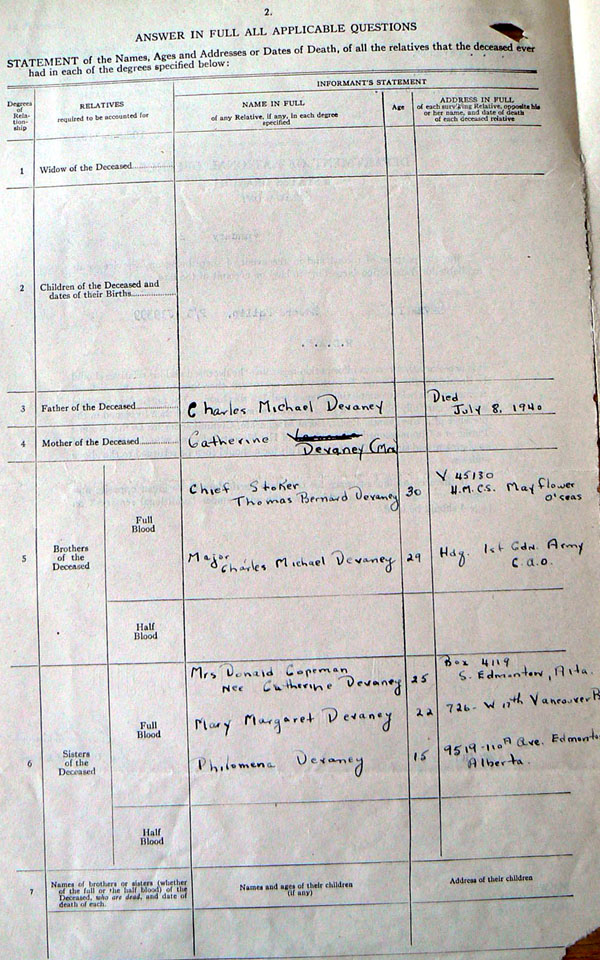
Declaration of Particulars by Family for the Estate of P/O E P Devaney pg 2
This document was filled out by Edward's mother on confirmation of his death. You can see that his father died just before he enrolled in the RCAF. He was supposedly 18 yrs old. Both brothers are in the Service and there are three sisters at home. Thus, there were no men at home for the Devaney's during the war.
Source: Library & Archives Canada RG24 Vol 25202 via Robert Whitehouse
Galerie numérique de
Sous-lieutenant d'aviation Edward Philip Devaney
Declaration of Particulars pg 3
His mother states that he was born in Liverpool England on April 3, 1924. His service records say 1923. Like many young men of the time, Edward couldn't wait to join up. Since it is doubtful his mother didn't remember his birthday, you have to wonder about the birth information he supplied the RCAF with. Thus, he really was just 19 when he died overseas.
If add up the years in section 13 of this document you can see that he was just 17 when he joined.
Source: Library & Archives Canada RG24 Vol 25202 via Robert Whitehouse
Galerie numérique de
Sous-lieutenant d'aviation Edward Philip Devaney
This is the document that got Edward into the RCAF at age 17. His mother deducted a year from his actual birth date so he could sign up. Because his birth was in England, the authorities had no way to check. His mother put his actual date of birth on the Estate Declaration after he was killed. Perhaps she forgot this document.<P>
Source: Library and Archives Canada RG24 Vol 25202 via Robert Whitehouse
Galerie numérique de
Sous-lieutenant d'aviation Edward Philip Devaney
Edward got himself in trouble with the RCAF during flight training when he did a little low level flying, contrary to orders and damaged his aircraft. If you think about a teen age boy in a high-powered aircraft just enjoying himself, you can understand. The RCAF frowned on this activity because the 'trainees' often made fatal mistakes that they could not recover from at such low altitudes. <P>
Ed received 29 days detention and loss of pay that came with it. He never did that again and his later instructors found him to be a better than average pilot and a good crew captain.<P>
Source: Library and Archives Canada RG24 Vol 25202 via Robert Whitehouse
Galerie d'images
-
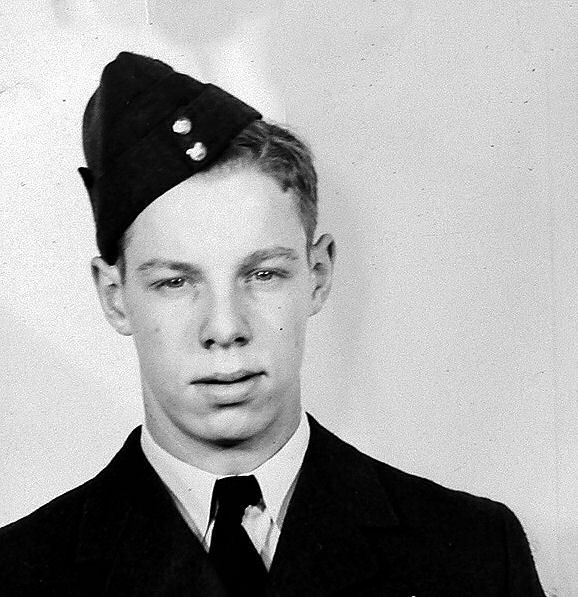
This picture of Edward Phillip Devaney was taken after his graduation as a pilot. He now has his sergeant's stripes. Source: Library and Archives Canada via R. W. Whitehouse
-
RCAF copy of the Investigation into the disappearance of his Halifax after a raid on Berlin. Source: Library and Archives Canada via R. W. Whitehouse
-
RAF Training Report from No. 23 OTU (page 1)<P> This is Devaney's final report on his refresher course in England. From Here he would be posted to a HCU (Heavy Conversion Unit) for experience on heavy bombers.<P> Source: Library & Archives Canada RG24 Vol 25202 via Robert Whitehouse
-
RAF Training Report from No. 23 OTU (page 2) This page shows that he was flying Wellington twin engined bombers and had only 15 hours of day and 11 hours of 'stick' time at the OTU. The lower half of the page states he has 83 hours at controls. #8 states that he did no "Nickels". These were propaganda leaflet raids over France used to give new pilots experience over enemy territory. Source: Library & Archives Canada RG24 Vol 25202 via Robert Whitehouse
-
Memo from No. 3 Missing Research and Enquiry Unit (RAF) 1 Apr 45 This memo refers to a body that washed ashore in Denmark. It had an ID disc with the partial inscription of James (E. or B. ?) Parker. It was barely legible. That could have referred to 1077776 Sgt Parker E. the flight engineer aboard Devaney's aircraft. He was RAF. Authorities later decided that the body was that of an American aircrew. Source of Document: Library & Archives Canada via Robert Whitehouse
-
Devaney Casualty Inquiry 17 Apr 46 This document taken from Devaney's file in Ottawa lists the crew by Service No., Rank, and crew position. Note that the only RAF member is the Flight Engineer. It was the discovery of a body with the ID tag of Parker that started the search for the crew. Source: Library and Archives Canada RG24 Vol 25202 vis Robert Whitehouse
-
Declaration of Particulars by Family for the Estate of P/O E P Devaney pg 2 This document was filled out by Edward's mother on confirmation of his death. You can see that his father died just before he enrolled in the RCAF. He was supposedly 18 yrs old. Both brothers are in the Service and there are three sisters at home. Thus, there were no men at home for the Devaney's during the war. Source: Library & Archives Canada RG24 Vol 25202 via Robert Whitehouse
-
Declaration of Particulars pg 3 His mother states that he was born in Liverpool England on April 3, 1924. His service records say 1923. Like many young men of the time, Edward couldn't wait to join up. Since it is doubtful his mother didn't remember his birthday, you have to wonder about the birth information he supplied the RCAF with. Thus, he really was just 19 when he died overseas. If add up the years in section 13 of this document you can see that he was just 17 when he joined. Source: Library & Archives Canada RG24 Vol 25202 via Robert Whitehouse
-
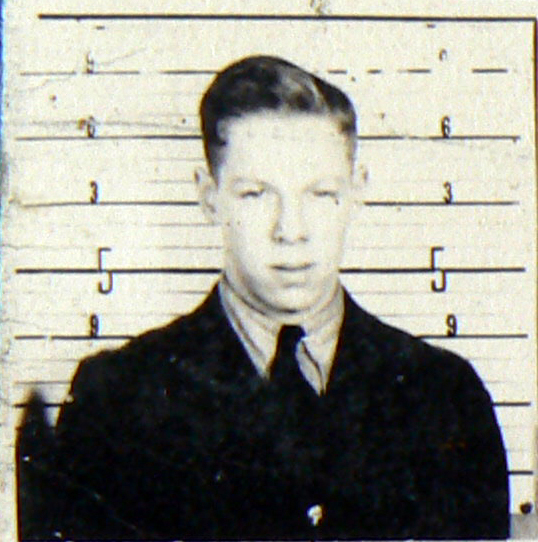
This picture was taken on 08 October 1941 for his ID Card. There is quite a change in his appearance from his intake photo.<P> Source:Library and Archives Canada RG24 Vol 25202 via Robert Whitehouse
-
This is the document that got Edward into the RCAF at age 17. His mother deducted a year from his actual birth date so he could sign up. Because his birth was in England, the authorities had no way to check. His mother put his actual date of birth on the Estate Declaration after he was killed. Perhaps she forgot this document.<P> Source: Library and Archives Canada RG24 Vol 25202 via Robert Whitehouse
-
Edward got himself in trouble with the RCAF during flight training when he did a little low level flying, contrary to orders and damaged his aircraft. If you think about a teen age boy in a high-powered aircraft just enjoying himself, you can understand. The RCAF frowned on this activity because the 'trainees' often made fatal mistakes that they could not recover from at such low altitudes. <P> Ed received 29 days detention and loss of pay that came with it. He never did that again and his later instructors found him to be a better than average pilot and a good crew captain.<P> Source: Library and Archives Canada RG24 Vol 25202 via Robert Whitehouse
-
From the Loyal Edmonton Regimental magazine the Fortyniner. Submitted for the project, Operation Picture Me
-
Pilot Officer Edward Philip Devaney is also commemorated on the Bomber Command Memorial Wall in Nanton, AB … photo courtesy of Marg Liessens
-
Pilot Officer Edward Philip Devaney is also commemorated on the Bomber Command Memorial Wall in Nanton, AB … photo courtesy of Marg Liessens
-
Father J P Lardie's comments as inscribed on the Bomber Command Memorial Wall in Nanton, AB … photo courtesy of Marg Liessens
-
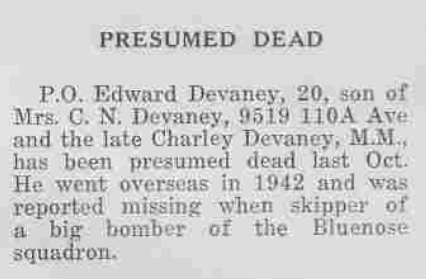
From the Edmonton Bulletin February 1944. Submitted for the project Operation Picture Me
-
From the Edmonton Bulletin October 1944. Submitted for the project Operation Picture Me
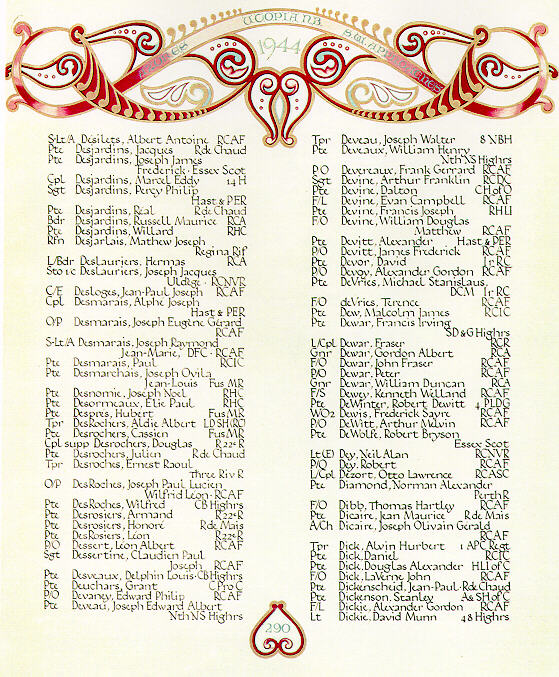
Dans les livres du souvenir
Inscription commémorative sur la :
Page 290 du Livre du Souvenir de la Seconde Guerre mondiale.
Commander cette page
Télécharger cette page
MÉMORIAL DE RUNNYMEDE Surrey, Royaume-Uni
Au cours de la Seconde Guerre mondiale, plus de cent seize mille hommes et femmes des forces aériennes du Commonwealth britannique sont morts au champ d'honneur. Plus de dix-sept mille d'entre eux étaient membres de l'Aviation royale canadienne ou des Canadiens qui servaient dans la Royal Air Force. Presque un tiers des morts n'ont pas de sépulture connue. De ce total, vingt mille quatre cent cinquante sont commémorés par nom au Mémorial de Runnymede situé à Englefield Green, près d'Egham, à trente-deux kilomètres à l'ouest de Londres.
L'architecture du Mémorial de Runnymede est originale et impressionnante. La pierre du Souvenir repose au centre d'un cloître qui domine une tour carrée perchée sur le sommet de la colline de Cooper qui surplombe la Tamise. Les allées du cloître aboutissent à deux observatoires, l'un donnant sur Windsor, l'autre sur l'aéroport de Londres à Heathrow. Les trois mille cinquante aviateurs canadiens tués au combat sont parmi ceux dont les noms sont gravés sur les revers de pierre des fenêtres étroites des allées cloîtrées et des observatoires.
Au-dessus de l'entrée à trois arches qui conduit au cloître, trône un aigle de pierre surmonté de la devise de la Royal Air Force «Per Ardua ad Astra». De chaque côté, figure une inscription en anglais dont voici la traduction :
« CE CLOÎTRE HONORE LES NOMS DE 20 000 AVIATEURS SANS SÉPULTURE CONNUE QUI SONT MORTS POUR LA LIBERTÉ LORS DES OPÉRATIONS AÉRIENNES AU-DESSUS DES ÎLES BRITANNIQUES, ET DES TERRES ET MERS DU NORD ET DE L'OUEST DE L'EUROPE. »
Dans la tour se trouve un sanctuaire voûté, paisible et propice à la méditation. On peut y lire, orné d'enluminures, un extrait d'un poème anglais de Paul H. Scott.
Pour plus d’informations, visitez la Commission des sépultures de guerre du Commonwealth (site disponible en anglais seulement).
L’image du coquelicot est une marque déposée de la Légion royale canadienne (Direction nationale) et est utilisée avec sa permission. Cliquez ici pour en savoir plus sur le coquelicot.
Avons-nous oublié quelque chose ?
Contribuer à cette page commémorative
Avez-vous des photos, des informations ou une correction concernant la page commémorative de cet individu? Apprenez-en plus sur le MVGC et les informations que nous collectons.