Service militaire
Lieu de l’enterrement/commemoration
Fils de Clifford William Chamberlin et d’Alda Graham Gardner, de Toronto, Ontario
. Frère du sergent Gordon Graham Chamberlin, de l’Aviation royale du Canada. Il a combattu outremer lors de la Seconde Guerre mondiale et a survécu au conflit.
Il a servi au Canada, aux Bahamas, en Grande-Bretagne et en Islande.
Galerie numérique de Sous-officier breveté de 1re classe John Gardner Chamberlin
- Onglets 1
- Onglets 2
- Onglets 3
- Onglets 4
- Onglets 5
- Onglets 6
- Onglets 7
- Onglets 8
- Onglets 9
- Onglets 10
- Onglets 11
- Onglets 12
- Onglets 13
- Onglets 14
- Onglets 15
- Onglets 16
Galerie numérique de
Sous-officier breveté de 1re classe John Gardner Chamberlin
A letter from the CO of the Squadron o the parents of Chamberlin detailing the circumstances of the accident and what evidence there was of the crash.
It was November and the aircraft took off in darkness to do a radar search for U-boats. It carried a Leigh light (very high intensity searchlight for illuminating surfaced submarines visually after they were located with radar. he aircraft would then attack with guns and depth charges. It was a very successful method of countering U-boats at night.<P>
Source: Library and Archives Canada via R. Whitehouse
Galerie numérique de
Sous-officier breveté de 1re classe John Gardner Chamberlin
Lost Aircraft message to the Air Ministry in London reporting the loss of an anti-submarine B24 Liberator from 53 (RAF) Sqdn. The aircraft was stationed in Iceland and was lost just south of Reykjavik. WO Chamberlin was a former student of Lawrence Park Collegiate Institute in Toronto, Ontario. The school lost 40 students during WW II.<P>
Source: Library and Archives Canada and LPCI School Archives via R. Whitehouse
Galerie numérique de
Sous-officier breveté de 1re classe John Gardner Chamberlin
Galerie d'images
-
R144134 Warrant Officer John G. Chamberlin born 01-10-23 Former student of Lawrence Park Collegiate Institute (Toronto)
-
School registration card for WO I John Chamberlin written in his own hand when he entered Lawrence Park Collegiate Institute in 1938.
-
Crash report from the Dutch organization Bomber Command Search (Christel & Ger Boogmans). Information taken from British and German sources.
-
Crash report from the Dutch organization Bomber Command Search (Christel & Ger Boogmans). Information taken from British and German sources.
-
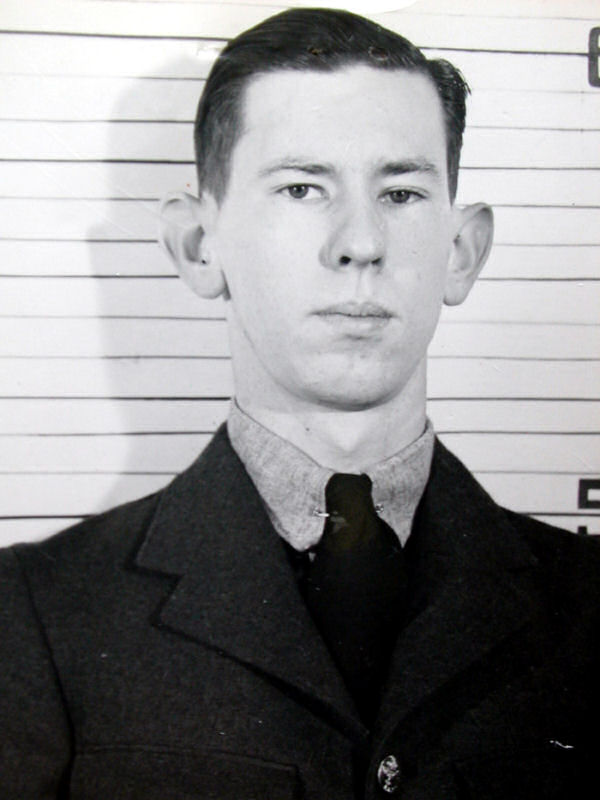
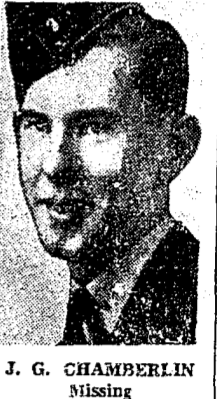
Chamberlin's initial ID photo taken when he joined the RCAF. Source: Whitehouse via Library/Archives Canada
-
Chamberlin's photo taken when he received his Wireless Operator/Air Gunner(WAG) Badge and sergeant's rank. Source: Whitehouse via Library/Archives Canada
-
Accident Letter lisiting the crew and giving the details known at the time. Source: Whitehouse via Library/Archives Canada
-
A letter from the CO of the Squadron o the parents of Chamberlin detailing the circumstances of the accident and what evidence there was of the crash. It was November and the aircraft took off in darkness to do a radar search for U-boats. It carried a Leigh light (very high intensity searchlight for illuminating surfaced submarines visually after they were located with radar. he aircraft would then attack with guns and depth charges. It was a very successful method of countering U-boats at night.<P> Source: Library and Archives Canada via R. Whitehouse
-
Lost Aircraft message to the Air Ministry in London reporting the loss of an anti-submarine B24 Liberator from 53 (RAF) Sqdn. The aircraft was stationed in Iceland and was lost just south of Reykjavik. WO Chamberlin was a former student of Lawrence Park Collegiate Institute in Toronto, Ontario. The school lost 40 students during WW II.<P> Source: Library and Archives Canada and LPCI School Archives via R. Whitehouse
-
This is page 1 of a letter sent to the RCAF by Chamberlin's father one week after the accident. It is obvious from the tone of the letter that the parents are still very upset.<P> Source: Library & Archives Canada RG 24 Vol 25032 via R. Whitehouse
-
This is page 2 of a father's letter.<P> Source: Library & Archives Canada RG 24 Vol 25032 via R. Whitehouse
-
Memorialized on the pages of the Globe and Mail. Submitted for the project, Operation Picture Me
-
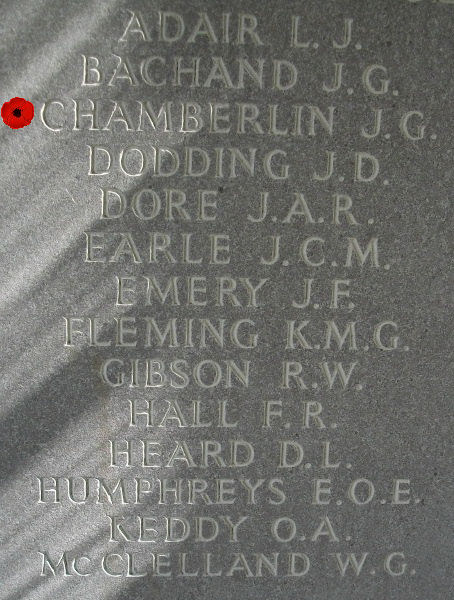
Inscription - Runnymede Memorial - April 2017 … photo courtesy of Marg Liessens
-
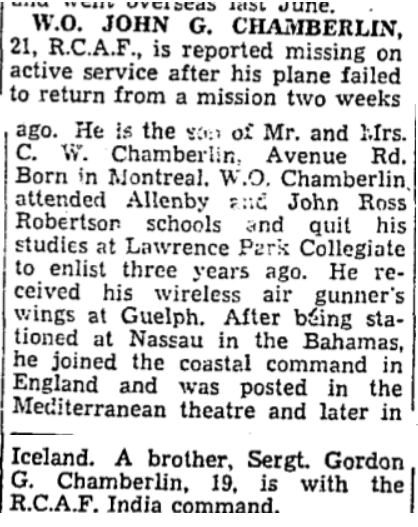
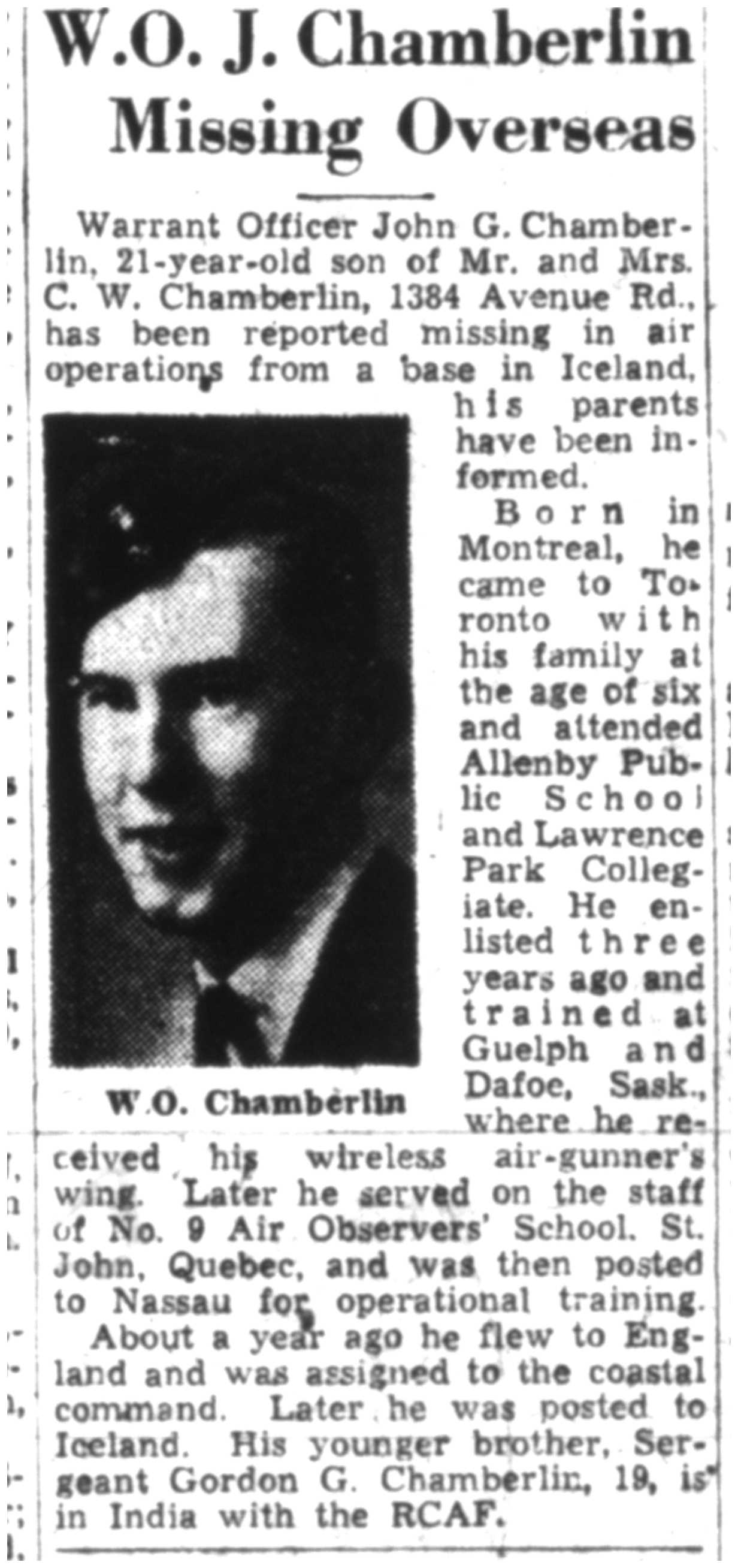
From theToronto Star December 1944. Submitted for the project Operation Picture Me
-
From theToronto Star December 1944. Submitted for the project Operation Picture Me
-
From the Toronto Telegram December 1944. Submitted for the project Operation Picture Me
Dans les livres du souvenir
Inscription commémorative sur la :
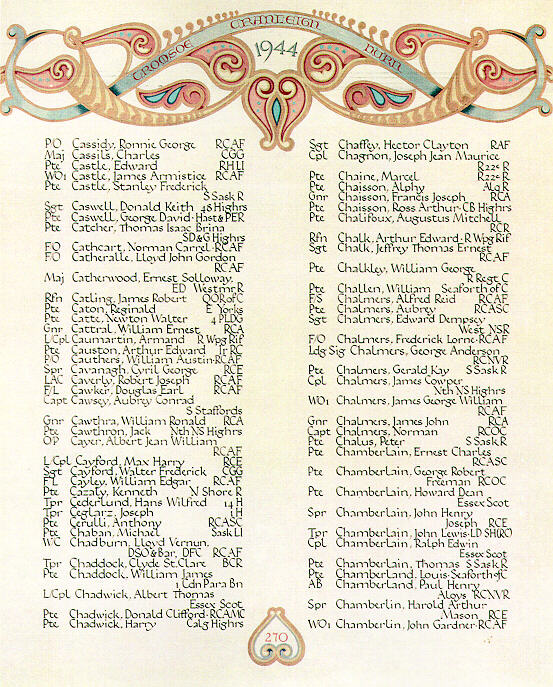
Page 270 du Livre du Souvenir de la Seconde Guerre mondiale.
Commander cette page
Télécharger cette page
MÉMORIAL DE RUNNYMEDE Surrey, Royaume-Uni
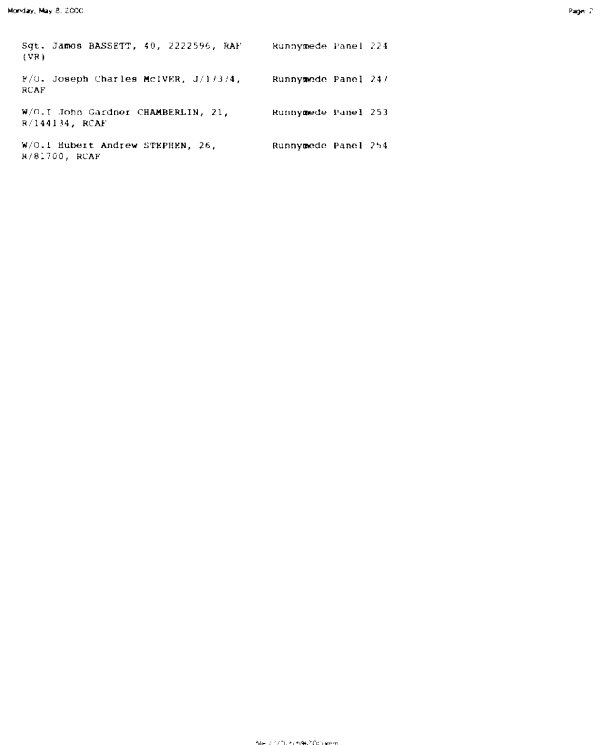
Au cours de la Seconde Guerre mondiale, plus de cent seize mille hommes et femmes des forces aériennes du Commonwealth britannique sont morts au champ d'honneur. Plus de dix-sept mille d'entre eux étaient membres de l'Aviation royale canadienne ou des Canadiens qui servaient dans la Royal Air Force. Presque un tiers des morts n'ont pas de sépulture connue. De ce total, vingt mille quatre cent cinquante sont commémorés par nom au Mémorial de Runnymede situé à Englefield Green, près d'Egham, à trente-deux kilomètres à l'ouest de Londres.
L'architecture du Mémorial de Runnymede est originale et impressionnante. La pierre du Souvenir repose au centre d'un cloître qui domine une tour carrée perchée sur le sommet de la colline de Cooper qui surplombe la Tamise. Les allées du cloître aboutissent à deux observatoires, l'un donnant sur Windsor, l'autre sur l'aéroport de Londres à Heathrow. Les trois mille cinquante aviateurs canadiens tués au combat sont parmi ceux dont les noms sont gravés sur les revers de pierre des fenêtres étroites des allées cloîtrées et des observatoires.
Au-dessus de l'entrée à trois arches qui conduit au cloître, trône un aigle de pierre surmonté de la devise de la Royal Air Force «Per Ardua ad Astra». De chaque côté, figure une inscription en anglais dont voici la traduction :
« CE CLOÎTRE HONORE LES NOMS DE 20 000 AVIATEURS SANS SÉPULTURE CONNUE QUI SONT MORTS POUR LA LIBERTÉ LORS DES OPÉRATIONS AÉRIENNES AU-DESSUS DES ÎLES BRITANNIQUES, ET DES TERRES ET MERS DU NORD ET DE L'OUEST DE L'EUROPE. »
Dans la tour se trouve un sanctuaire voûté, paisible et propice à la méditation. On peut y lire, orné d'enluminures, un extrait d'un poème anglais de Paul H. Scott.
Pour plus d’informations, visitez la Commission des sépultures de guerre du Commonwealth (site disponible en anglais seulement).
L’image du coquelicot est une marque déposée de la Légion royale canadienne (Direction nationale) et est utilisée avec sa permission. Cliquez ici pour en savoir plus sur le coquelicot.
Avons-nous oublié quelque chose ?
Contribuer à cette page commémorative
Avez-vous des photos, des informations ou une correction concernant la page commémorative de cet individu? Apprenez-en plus sur le MVGC et les informations que nous collectons.