Service militaire
Lieu de l’enterrement/commemoration
Galerie numérique de Lieutenant John Denison Jackson
- Onglets 1
- Onglets 2
- Onglets 3
- Onglets 4
- Onglets 5
- Onglets 6
- Onglets 7
- Onglets 8
- Onglets 9
- Onglets 10
- Onglets 11
- Onglets 12
Galerie numérique de
Lieutenant John Denison Jackson
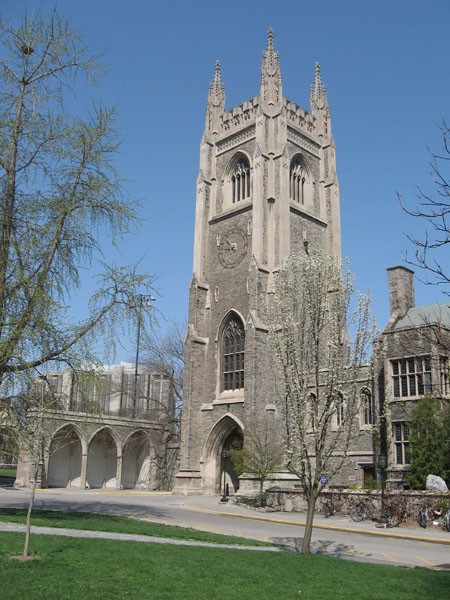
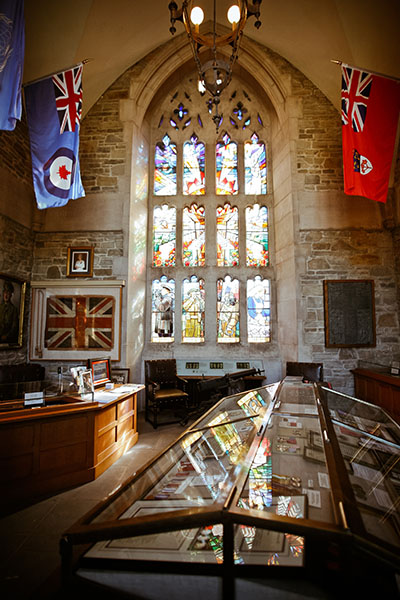
The Soldiers' Tower was built by the University of Toronto Alumni Association in 1924 as a memorial to the Great War of 1914-1918. The names of those who died in that conflict are carved on the Memorial Screen at photo left. After the Second World War, more names were carved in the Memorial Arch at the Tower's base. In total, almost 1,200 names are inscribed. A Memorial Room inside the Tower contains mementoes and artifacts, and a 51-bell carillon serves as the audio element of the living memorial to the alumni, students, faculty and staff who died in the World Wars. The Soldiers' Tower is the site of an annual Service of Remembrance. Photo: Kathy Parks, Alumni Relations.
Galerie numérique de
Lieutenant John Denison Jackson
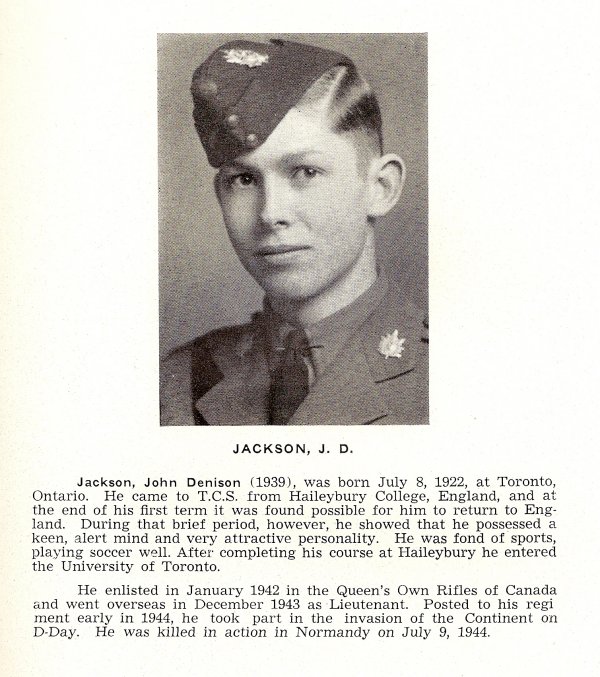
University of Toronto Memorial Book, Second World War 1939-1945. Edited by H. E. Brown, published by the Soldiers' Tower Committee, 1993. Entry on page 33 reads: "Lt John Denison JACKSON The Queen's Own Rifles of Canada. Former student in Trinity College, Arts 1940-41. Killed in action in North West Europe, 9 July 1944. Buried in Beny-sur-Mer Canadian War Cemetery, France."
Galerie numérique de
Lieutenant John Denison Jackson
Galerie numérique de
Lieutenant John Denison Jackson
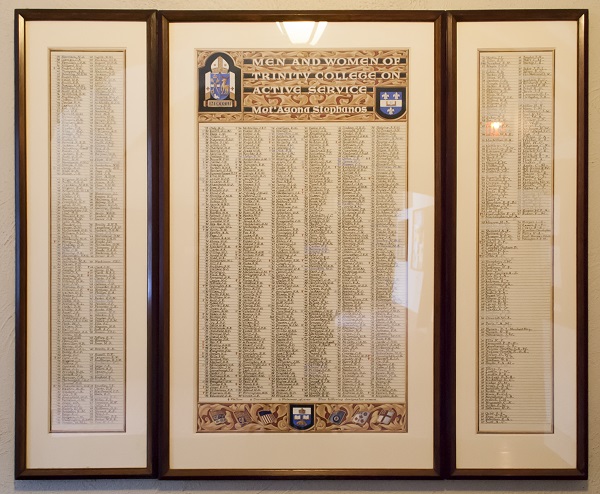
This framed illuminated scroll, written in calligraphy, is entitled "Men and Women of Trinity College on Active Service. Met'Agona Stephanos". It hangs in the hallway outside the narthex of the chapel at Trinity College in the University of Toronto. Small symbols beside the names indicate men and women who are fallen, decorated, and prisoner of war. The list of names includes: '44 Jackson, J.D. Photo: Cody Gagnon, courtesy of Alumni Relations.
Galerie d'images
-
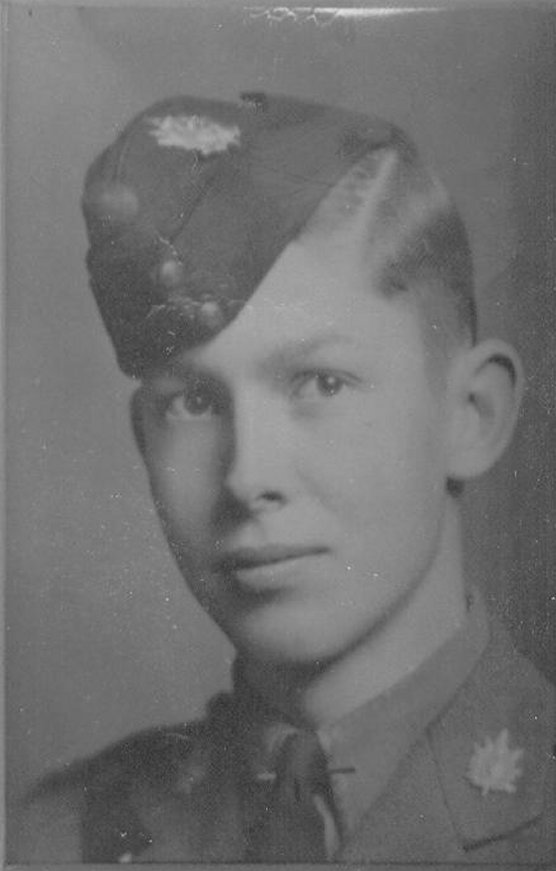
Lt. Jackson joined the QOR of C after D-Day as a replacement officer due to the large number of officer casualties in the first week of combat in Normandy. He was KIA on the final day of fighting for Carpiquet airfield.
-
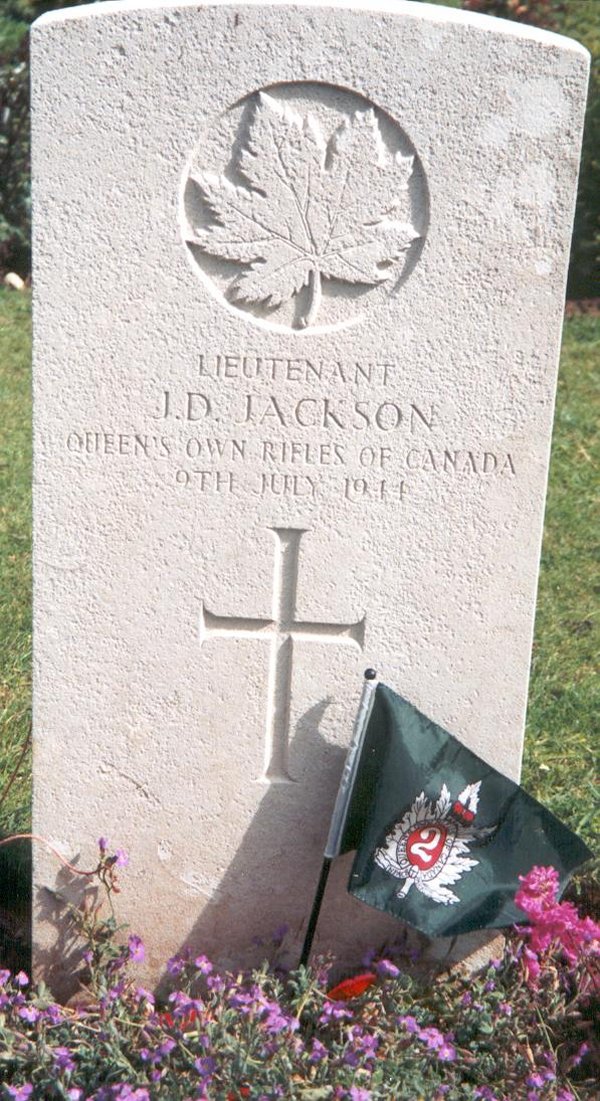
This photo of Lt. Jackson's grave at Beny-sur-mer Cemetery was taken by Craig B. Cameron, Padre of the QOR of C, during Op Normandie Return in June 1994.
-
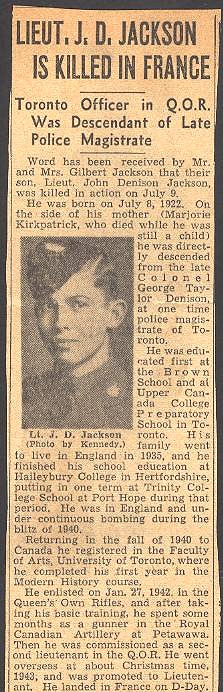
Lieutenant Jackson's obituary from a Toronto paper in July 1944.
-
-
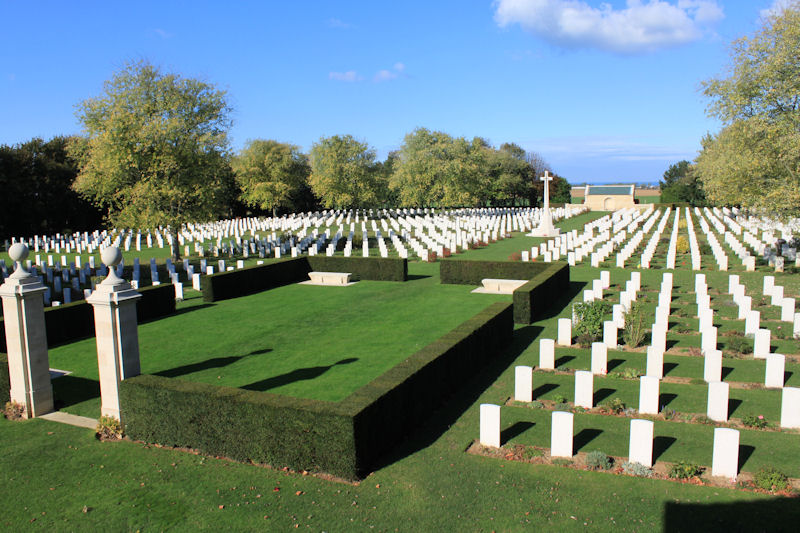
The Beny-sur-Mer Canadian War Cemetery, located at Reviers, about 4 kilometres from Juno Beach in Normandy, France. (J. Stephens)
-
The Soldiers' Tower was built by the University of Toronto Alumni Association in 1924 as a memorial to the Great War of 1914-1918. The names of those who died in that conflict are carved on the Memorial Screen at photo left. After the Second World War, more names were carved in the Memorial Arch at the Tower's base. In total, almost 1,200 names are inscribed. A Memorial Room inside the Tower contains mementoes and artifacts, and a 51-bell carillon serves as the audio element of the living memorial to the alumni, students, faculty and staff who died in the World Wars. The Soldiers' Tower is the site of an annual Service of Remembrance. Photo: Kathy Parks, Alumni Relations.
-
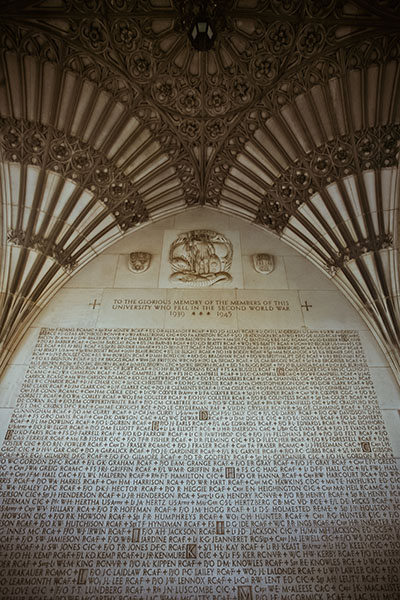
The names of those who died in the Second World War were added to the archway beneath the Soldiers' Tower in 1949. The name of "Lt. J.D. JACKSON C.I.C." is among the names inscribed.
-
Soldiers' Tower, University of Toronto. Photo: David Pike, courtesy of Alumni Relations.
-
University of Toronto Memorial Book, Second World War 1939-1945. Edited by H. E. Brown, published by the Soldiers' Tower Committee, 1993. Entry on page 33 reads: "Lt John Denison JACKSON The Queen's Own Rifles of Canada. Former student in Trinity College, Arts 1940-41. Killed in action in North West Europe, 9 July 1944. Buried in Beny-sur-Mer Canadian War Cemetery, France."
-
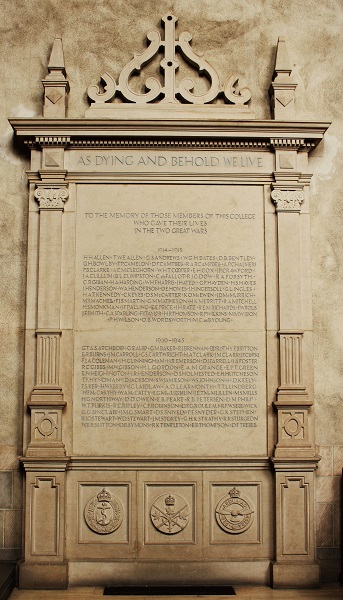
This stone stele is located in the chapel at Trinity College in the University of Toronto. "AS DYING AND BEHOLD WE LIVE. TO THE MEMORY OF THOSE MEMBERS OF THIS COLLEGE WHO GAVE THEIR LIVES IN THE TWO GREAT WARS." The name of "J.D. JACKSON" is among those inscribed.
-
This framed illuminated scroll, written in calligraphy, is entitled "Men and Women of Trinity College on Active Service. Met'Agona Stephanos". It hangs in the hallway outside the narthex of the chapel at Trinity College in the University of Toronto. Small symbols beside the names indicate men and women who are fallen, decorated, and prisoner of war. The list of names includes: '44 Jackson, J.D. Photo: Cody Gagnon, courtesy of Alumni Relations.
-
From the Toronto Telegram 1944. Submitted for the project Operation Picture Me
Dans les livres du souvenir
Inscription commémorative sur la :
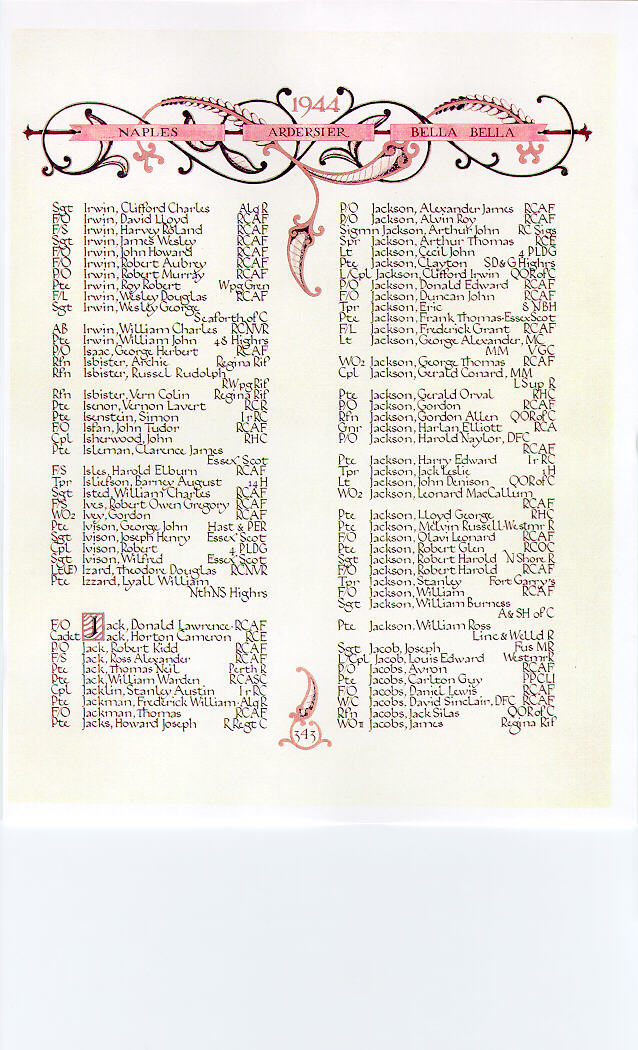
Page 343 du Livre du Souvenir de la Seconde Guerre mondiale.
Commander cette page
Télécharger cette page
CIMETIÈRE DE GUERRE CANADIEN DE BÉNY-SUR-MER Calvados, France
Le cimetière militaire canadien de Bény-sur-Mer est à environ 1 km à l'est du village de Reviers, sur la route de Creully-Tailleville-Ouistreham (D35). Reviers est un village et une commune du Calvados, à 15 km au nord-est de Caen, à 18 km à l'est de Bayeux et à 3,5 km au sud de Courseulles, un village sur la Manche. Le village de Bény-sur-Mer se trouve à environ 2 km au sud-est du cimetière. L'autocar entre Caen et Arromanches (via Reviers et Ver-sur-Mer) passe devant le cimetière.
C'est un peu au nord, sur la côte, qu'est débarquée la 3e Division du Canada le 6 juin 1944 et que 335 officiers et soldats ont été tués au combat ou sont morts de leurs blessures. Dans ce cimetière reposent les Canadiens qui ont péri lors du débarquement en Normandie et au cours des premières étapes de la campagne qui a suivi.
Les Canadiens qui sont morts vers la fin des combats en Normandie sont inhumés au cimetière militaire canadien de Bretteville-sur-Laize. Le cimetière militaire canadien de Bény-sur-Mer compte 2048 sépultures, ainsi qu'un monument spécial érigé à la mémoire d'un soldat du Corps canadien d'infanterie dont on sait qu'il a été inhumé ici, mais dont la tombe n'a jamais pu être trouvée.
Pour plus d’informations, visitez la Commission des sépultures de guerre du Commonwealth (site disponible en anglais seulement).
L’image du coquelicot est une marque déposée de la Légion royale canadienne (Direction nationale) et est utilisée avec sa permission. Cliquez ici pour en savoir plus sur le coquelicot.
Avons-nous oublié quelque chose ?
Contribuer à cette page commémorative
Avez-vous des photos, des informations ou une correction concernant la page commémorative de cet individu? Apprenez-en plus sur le MVGC et les informations que nous collectons.