Service militaire
Lieu de l’enterrement/commemoration
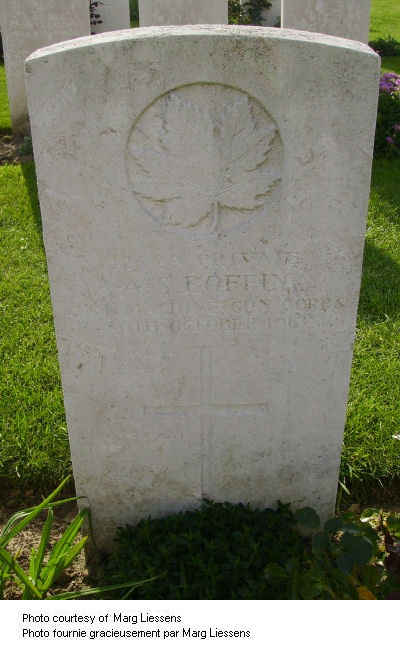
Fils de Ephraim James et Ellen Boffin, de Forest Hill, Oxford, Angleterre. Né dans 1893. Il était un fermier.
Galerie numérique de Soldat Alfred Sydney Boffin
Galerie numérique de
Soldat Alfred Sydney Boffin
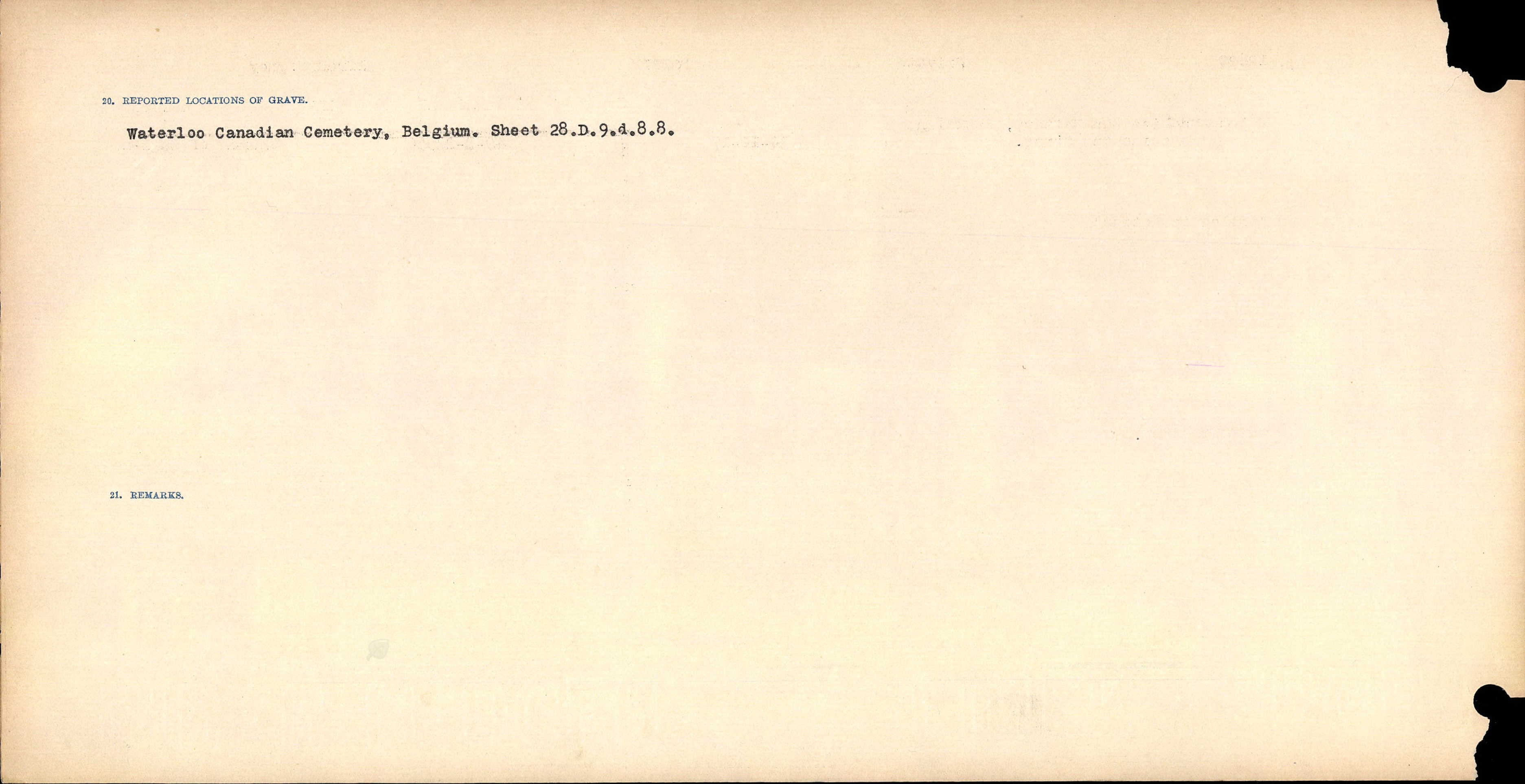
Private Boffin's remains were collected from the battlefield and buried at the Waterloo Farm (Canadian) Cemetery located at trench map coordinates 28.D.9.d.8.8. After the Armistice, his remains were exhumed from that cemetery and concentrated into the Tyne Cot Cemetery, a short distance to the southeast.
Galerie numérique de
Soldat Alfred Sydney Boffin
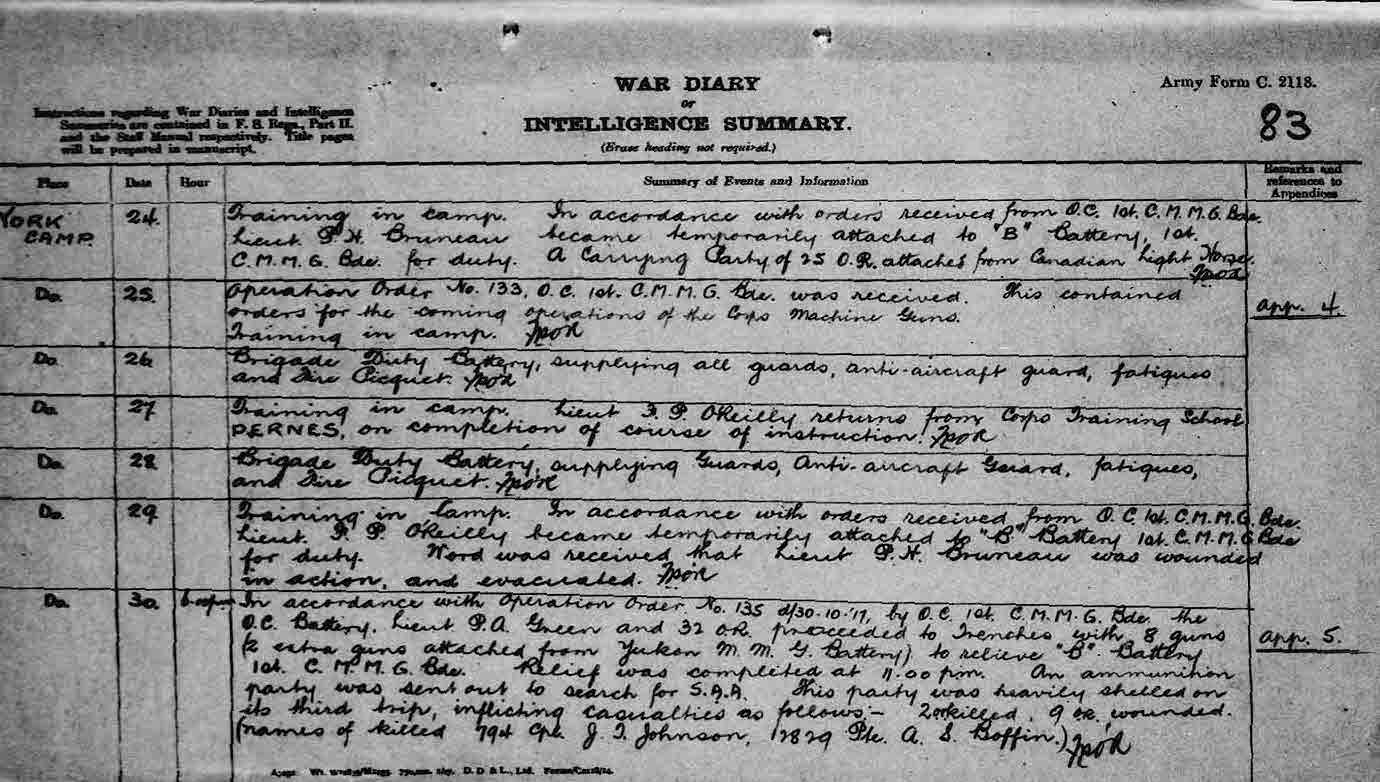
The war diary reports that Private Boffin #1289 and Corporal Johnston #794 were two of the men in an ammunition party that was sent out to find small arms ammunition to feed the 1st Canadian Machine Gun Brigade. Both Boffin and Johnston were killed and another 9 other ranks were wounded. Based on the location where Corporal Johnston was reported lost, we know that they were to the southeast of the Field Ambulance at Waterloo Farm Cemetery, specifically at trench map reference 28.D.16.b.75.45.
Galerie numérique de
Soldat Alfred Sydney Boffin
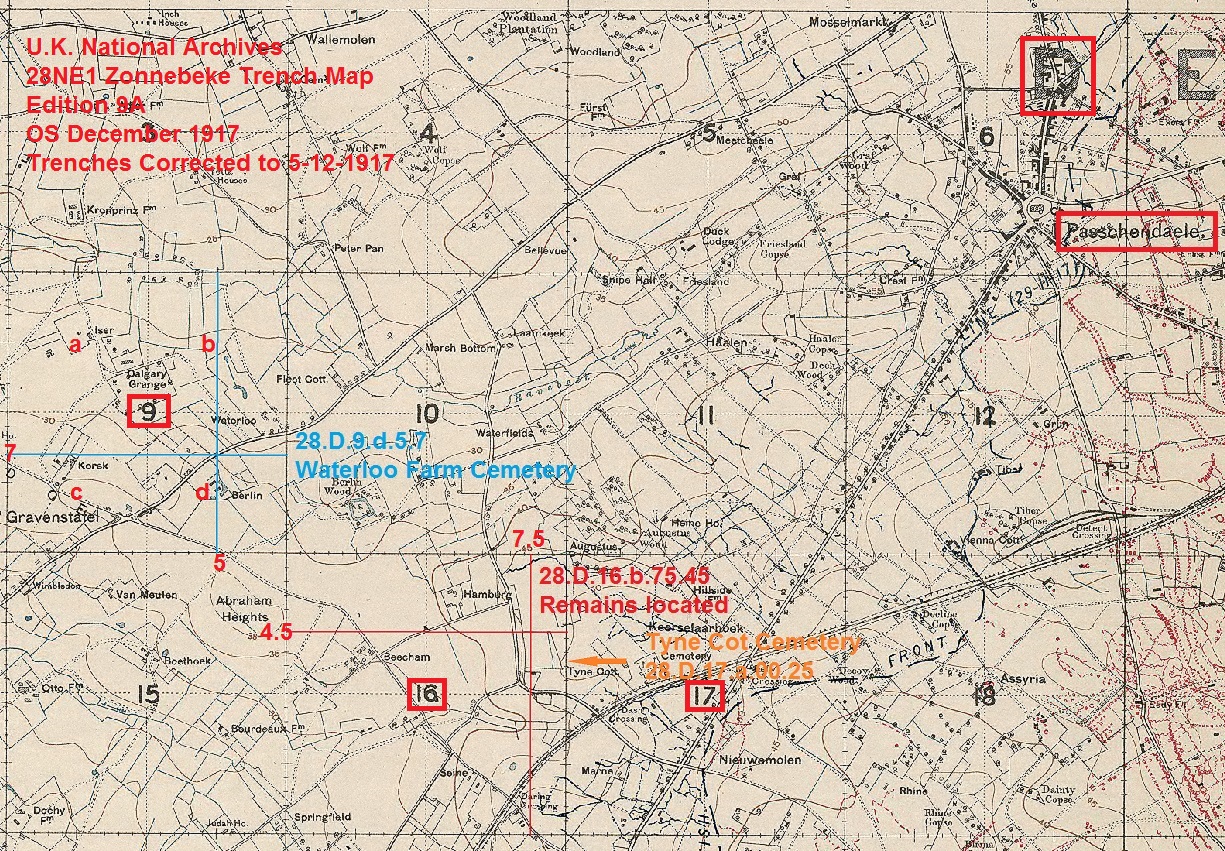
Corporal Johnston #794 and Private Boffin #12829, the two men killed in the shelling of the party collecting the ammunition were together at the time of their death. They fell in the vicinity of 28.D.16.b.75.45, as recorded for Corporal Johnston. They were initially buried at Waterloo Farm (Canadian) Cemetery. This local cemetery was later concentrated into the Tyne Cot Cemetery, where it is reported: "TYNE COT CEMETERY was greatly enlarged after the Armistice when remains were brought in from the battlefields of Passchendaele and Langemarck, and from a few small burial grounds, including the following: WATERLOO FARM CEMETERY, PASSCHENDAELE, 650 metres North-East of 's Gravenstafel, containing the graves of ten soldiers from Canada, seven from the United Kingdom and two from New Zealand, who fell in 1917-18".
Galerie d'images
-
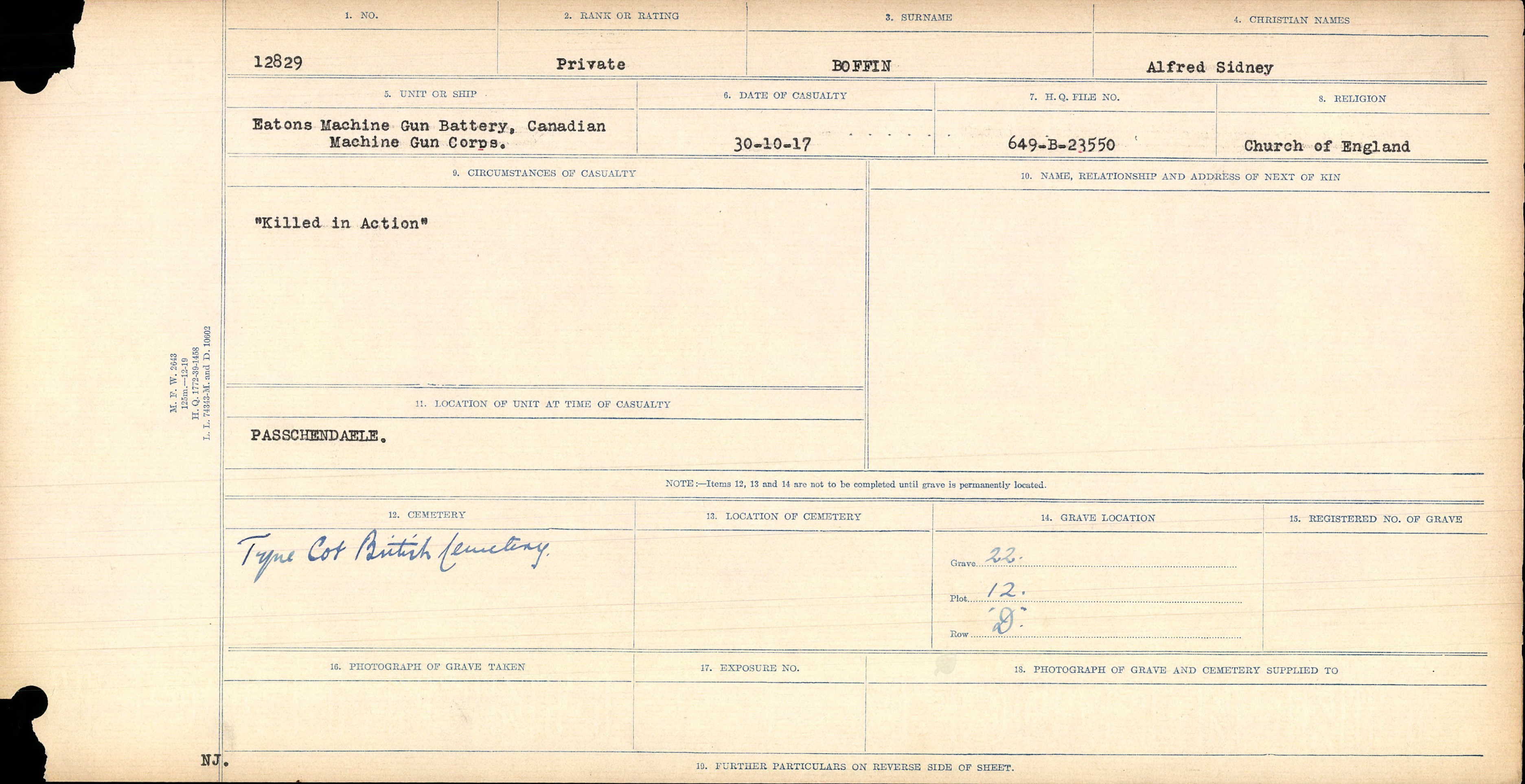
Private Boffin #12829 was killed in action during the attack on the Village of Passchendaele on 30 October 1917. He and Corporal Johnstone #794 were together at the time, both of which paid the ultimate sacrifice.
-
Private Boffin's remains were collected from the battlefield and buried at the Waterloo Farm (Canadian) Cemetery located at trench map coordinates 28.D.9.d.8.8. After the Armistice, his remains were exhumed from that cemetery and concentrated into the Tyne Cot Cemetery, a short distance to the southeast.
-
The war diary reports that Private Boffin #1289 and Corporal Johnston #794 were two of the men in an ammunition party that was sent out to find small arms ammunition to feed the 1st Canadian Machine Gun Brigade. Both Boffin and Johnston were killed and another 9 other ranks were wounded. Based on the location where Corporal Johnston was reported lost, we know that they were to the southeast of the Field Ambulance at Waterloo Farm Cemetery, specifically at trench map reference 28.D.16.b.75.45.
-
Corporal Johnston #794 and Private Boffin #12829, the two men killed in the shelling of the party collecting the ammunition were together at the time of their death. They fell in the vicinity of 28.D.16.b.75.45, as recorded for Corporal Johnston. They were initially buried at Waterloo Farm (Canadian) Cemetery. This local cemetery was later concentrated into the Tyne Cot Cemetery, where it is reported: "TYNE COT CEMETERY was greatly enlarged after the Armistice when remains were brought in from the battlefields of Passchendaele and Langemarck, and from a few small burial grounds, including the following: WATERLOO FARM CEMETERY, PASSCHENDAELE, 650 metres North-East of 's Gravenstafel, containing the graves of ten soldiers from Canada, seven from the United Kingdom and two from New Zealand, who fell in 1917-18".
-
-
-
Dans les livres du souvenir
Inscription commémorative sur la :
Page 203 du Livre du Souvenir de la Première Guerre mondiale.
Commander cette page
Télécharger cette page
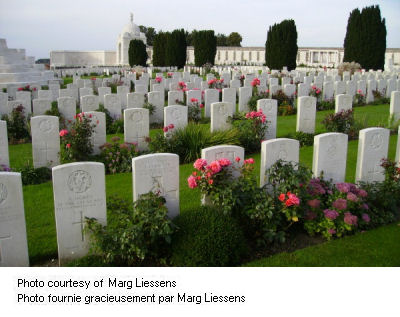
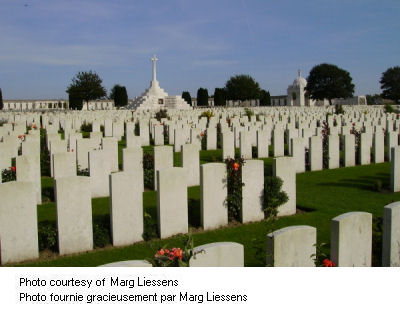
CIMETIÈRE DE TYNE COT Belgique
Le cimetière de Tyne Cot est situé à 9 kilomètres au nord-est du centre-ville d'Ypres sur la Tynecotstraat, une route qui rejoint la Zonnebeekseweg (N332). Le cimetière de Tyne Cot se trouve 700 mètres plus loin, sur le côté droit de la Tynecotstraat.
Des fusiliers de Northumberland ont donné le nom de « Tyne Cottages » ou « Tyne Cotts » à un groupe de blockhaus allemands ou casemates situés près du passage à niveau sur la route reliant Passchendaele à Broodseinde. Trois de ces fortins existent toujours dans le cimetière. Le plus gros, qui avait été pris par la troisième division australienne le 4 octobre 1917, a été choisi par le roi George V durant son pèlerinage aux cimetières du front ouest en Belgique et en France en 1922 pour y ériger la Croix du Sacrifice.
Le cimetière Tyne Cot constitue la dernière demeure de près de 12 000 soldats des forces du Commonwealth et compte donc le plus grand nombre de sépultures de tous les cimetières du Commonwealth pour les deux guerres mondiales.
Pour plus d’informations, visitez la Commission des sépultures de guerre du Commonwealth (site disponible en anglais seulement).
L’image du coquelicot est une marque déposée de la Légion royale canadienne (Direction nationale) et est utilisée avec sa permission. Cliquez ici pour en savoir plus sur le coquelicot.
Avons-nous oublié quelque chose ?
Contribuer à cette page commémorative
Avez-vous des photos, des informations ou une correction concernant la page commémorative de cet individu? Apprenez-en plus sur le MVGC et les informations que nous collectons.