Le monument commémoratif des guerriers algonquins a été dédié à tous les guerriers algonquins qui ont servi le Canada en temps de guerre et de paix.
Monument commémoratif des guerriers algonquins
Se connecter à Mon Dossier ACC
Le monument commémoratif des guerriers algonquins a été dédié à tous les guerriers algonquins qui ont servi le Canada en temps de guerre et de paix.
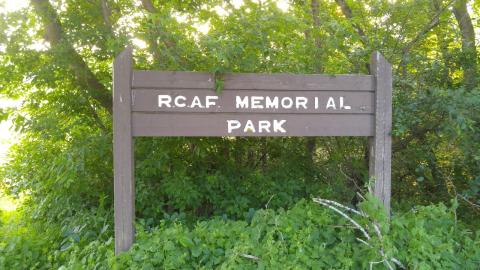
[park sign/enseigne du parc]
R.C.A.F. MEMORIAL
PARK
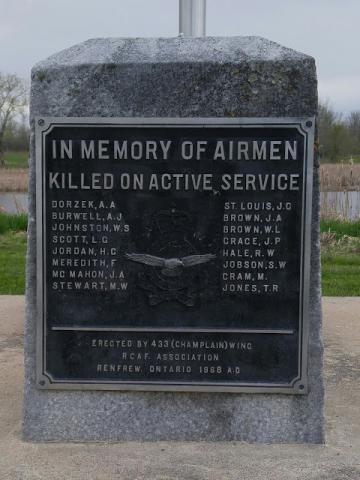
[memorial/monument]
IN MEMORY OF AIRMEN
KILLED ON ACTIVE SERVICE
DORZEK, A.A
BURWELL, A.J
JOHNSTON, W.S
SCOTT, L.G
JORDAN, H.C
MEREDITH, F
MC MAHON, J.A
STEWART, M.W
ST. LOUIS, J.C
BROWN, J.A
BROWN, W.L
GRACE, J.P
HALE, R.W
JOBSON, S.W
CRAM, M.
JONES, T.R
ERECTED BY 433 (CHAMPLAIN) WING
R.C.A.F. ASSOCIATION
RENFREW, ONTARIO 1968 A.D.
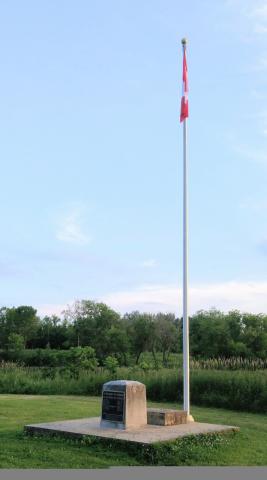
Le parc commémoratif de l’ARC a été inauguré en 1968 et rend hommage aux aviateurs de Renfrew qui ont été tués au cours de la Seconde Guerre mondiale. Son monument commémoratif se trouve au milieu du parc, près de la rivière, et se compose d’un mât et d’un cairn en béton reposant sur un support en ciment. Tout près se trouve un arbre soulignant le 60e anniversaire de l’Association de l’Aviation royale de Renfrew.
needs further research/recherche incomplète
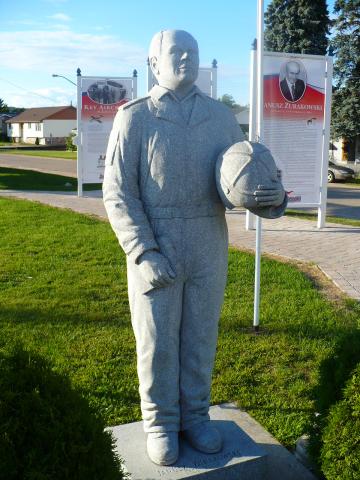
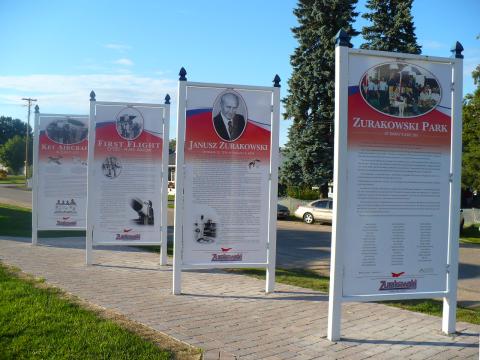
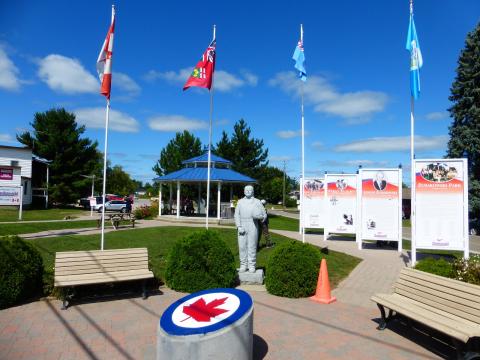
Janusz Zurakowski était l’un des pilotes les plus célèbres au monde. Ce Canadien d’origine polonaise a été à l’avant-garde de la technologie de pointe de l’aviation. Élevé en Pologne, il a rejoint la Force aérienne de la République polonaise en 1934 et, pendant la Seconde Guerre mondiale, s’est enfui en Angleterre en 1940. Après une brillante carrière en temps de guerre, il a effectué des vols d’essai en Angleterre et au Canada, où il a immigré en 1952. L’avion le plus remarquable qu’il a testé est l’intercepteur supersonique canadien connu sous le nom de CF-105 Avro Arrow.
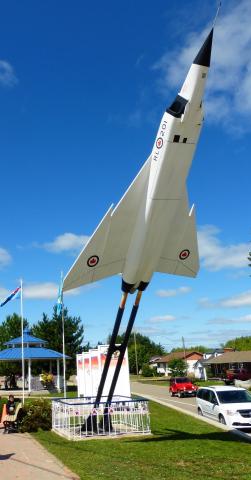
Le monument commémoratif comprend une statue de Janusz, une réplique du CF-105 Avro Arrow, une girouette de Spitfire et plusieurs panneaux expliquant l’histoire de Janusz et celle de l’Arrow. Le parc a ouvert ses portes le 26 juillet 2003, peu avant le décès de Janusz Zurakowski en 2004.
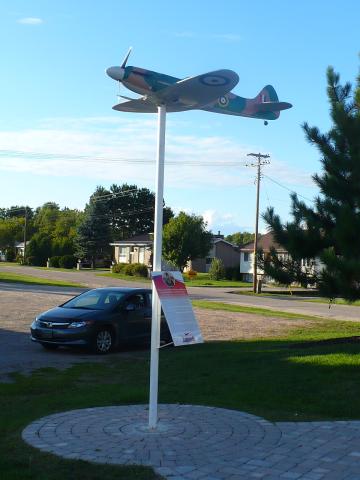
Au cours de l’été 2011, une version réduite du Spitfire à l’échelle 1:5 a été ajoutée au parc. C’est le même avion que Janusz a piloté pendant la bataille d’Angleterre. L’avion a été construit par Morris Towns de Madawaska et a nécessité plus de 1 500 heures de travail. Lorsqu’il est monté sur son mât dans le parc, il se déplace sur des roulements à billes comme une manche à vent. L’avion n’ayant pas été construit pour résister aux hivers du Nord canadien, il est entreposé durant les mois les plus froids.
WORLD WAR I 1914 - 1918
WORLD WAR II 1939 - 1945
KOREAN WAR 1950 - 1953
MERCHANT NAVY
PEACE KEEPING FORCES
LEST WE FORGET
IN GRATEFUL
REMEMBRANCE
OF THOSE WHO
SERVED
AND THOSE WHO
DIED
IN ALL OUR PAST
MILITARY CONFLICTS
The Denbigh Cenotaph was dedicated by the Royal Canadian Legion Branch 328 of Northbrook to honour the local citizens who served and died in the name of our country.
(Cairn)
In remembrance of the prarachutists
of 2 Sigs Sqn and 1 RCR who died by
drowning during an air exercise
on 8 May 1968
May God grant their gallntry
will live on in the hearts of their
countrymen
...
(Boulder)
1 RCR 2 SIG SQN AB TP
MWO Reginald Riddell Cpl. Dennis Clements
WO Michael McDonnell Cpl. Hugh Fields
Cpl. Bruce Chiswell Cpl. Bob Knight
Cpl. Jim Misener
They shall grow not old, as we that are left grow old:
Age shall not weary them, nor the years condemn.
At the going down of the sun and in the morning
We will remember them.
Donated by
Family, survivors, fellow jumpers, and friends
For the 50th memorial service of the tragedy
That took the lives of paratroopers
On May 8, 1968
Reflect Reconnect Never Forget
The Wegner Point Fallen Paratroopers Memorial commemorates seven soldiers (4 Signal Corps and 3 Royal Canadian Regiment) who drowned in the Ottawa River on 8 May 1968. Every year on 8 May a memorial service is held at Wegner Point by the members of 2 CMBG Headquarters and Signal Squadron, the 1st and 3rd Battalions of the Royal Canadian Regiment and the Airborne Regiment Association of Canada.
On 8 May 1968 at around 8:30 pm, the worst peacetime Canadian military training accident occurred at Camp Petawawa, 100 miles north-west of Canada’s capital city, Ottawa, Ontario. It was a cold and windy day that 26 paratroopers from the 1st Battalion, The Royal Canadian Regiment from Wollseley Barracks in London, Ontario, and 2 Signals Squadron, were participating in a training jump over Camp Petawawa.
Taking off in three Buffalo transport aircraft from the Bonnechere Airfield, an Air Defence Command auxiliary field, the paratroopers were expected to land in the designated landing zone on the Mattawa Plains within Camp Petawawa. The weather was good and a test dummy dropped earlier indicated no issues for the jumpers. In a tragic fluke, an unexpected wind shear at around 600 feet carried 22 of the paratroopers into the nearby Ottawa River, 1000 feet off shore near Wegner Point.
Weighted down by their heavy equipment and tangled in their parachutes, the soldiers struggled to make it out of the water. Rescue efforts saved all but seven of the soldiers. Some of the bodies weren’t recovered until days later, still entangled in their parachute harnesses.
A memorial cairn was erected at Wegner Point the following July, with the name of paratroopers lost etched on the monument. A wreath-laying ceremony is held each May at the memorial cairn, led by the Canadian Airborne Regiment Association. Serving members of the 1st and 3rd Battalions, Royal Canadian Regiment, and 2 Canadian Mechanized Brigade Group (2CMBG) Headquarters and Signals Squadron, gather alongside retired members and survivors of that horrible day to remember their comrades who never came home.
The seven paratroopers who died on 8 May 1968:
During the 50th Fallen Paratrooper Memorial Service on May 13, 2018 a large boulder inscribed with the names of the fallen, installed next to the cairn, was unveiled. It features the crests of the Royal Canadian Regiment, Signals Squadron and Paratroopers.
|
Centre Sportif et aquatique Dundonald Hall Fitness sports and aquatic centre |
||
|
Reopened by: |
|
Réouverture: |
|
|
Mr. Hector Cloutier M.P. Renfrew, Nippissing, & Pembroke |
|
|
On behalf of the Minister of National Defence 30 June 2000 |
|
Au nom du Ministère de la Défense nationale 30 juin 2000 |
|
|
|
|
|
Design build team: |
|
Équipe de construction conception: |
|
|
Westeinde Construction Limited Griffiths, Rankin, Cooke Architects BBS Construction |
|
|
|
|
|
|
Base Commander: |
|
Commandant de la base: |
|
|
Colonel K.C. McLeod, CD |
|
Dundonald Hall is named in honour of Lieutenant-General Douglas Mackinnon Baillie Hamilton Cochrane, 12th Earl of Dundonald, KCB, KCVO, the last British officer to command the Canadian militia. The building was originally built in the 1950s but extensively renovated in 2000.
Lieutenant-General Cochrane was born in 1852 and commissioned in the Life Guards in 1870. He served in the Nile Expedition, the Desert March and the Relief of Khartoum in 1885. In 1895, he was appointed Commanding Officer of 2nd Battalion, Life Guards. He served in the Second Boer War where in 1899 he was appointed Commander of the Mounted Brigade, part of the South Natal Field Force. He took part in the Relief of Ladysmith in February 1900. He was appointed General Officer Commanding the Militia of Canada in 1902. He served in the First World War in the British Admiralty Office. Lieutenant-General Cochrane, 12th Earl of Dundonald, died in 1935 at the age of 82.
[dedication palque]
This monument is dedicated to the Gunners of Canada
WW I, WW II, Korea and Afghanistan, Ubique
Various costs associated with the monument were donated in memory of
those fallen Gunners who gave their all for Canada
Lt. W. Turner; Bdr. M. Mansell; Capt. N. Goddard
Capt. J. Francis; Gnr. J. Dion; Bdr. J. Ouellet
Sgt. K. Taylor and Bdr. K. Manning
They shall not grow old, as we that are left grow old
Age shall not weary them nor the years condemn
At the going down of the sun and in the morning
We will remember them
[explanatory plaque]
M109 Howitzer
The M109 Howitzer was first introduced to Canada in 1967. Developed by the Ground System Division of United Defense LP, the Canadian M109 had a total crew of 10 that consisted of a detachment commander, driver, gunner, assistant gunner, and two ammunition handlers. Additionally, the M109 was accompanied by an ammunition vehicle, the M548, which included the detachment second in command, two more ammunition handlers as well as the driver.
The M109 and its subsequent variations is the most common western indirect-fire support weapon of maneuver brigades of armored and mechanized infantry divisions. In Canada, the M109 was in service by the Canadian Armed Forces until 2005 with the last rounds being fired at CFB Petawawa in April 2005. The M109A4 and other M109 variations were replaced in Canada by the 155mm howitzer M777 which is still in use today.
Internationally, the M109 saw its combat debut in Vietnam.
Ce monument est dédié aux artilleurs du Canada.
Petawawa
Veterans Bridge- Dedicated
to the McConnell
brothers
who served in
World War II
with various units.
All seven returned home.
Lorne – RCE
James – CPC
Alexander – CFC
Sydney – RCE
Clifford – RCASC
Edward – RCAF
Reginald – RCASC
Le pont des vétérans a été ouvert à Petawawa en 2006; il est dédié aux frères McConnell qui vivaient ici et qui ont combattu au cours de la Seconde Guerre mondiale.
In the service of Canada
Au service du Canada
Spr Short M.B. 23 Sept 2002
Killed in action, Kandahar, Afghanistan, Sgt Shane Stachnik, CD 03 Sep 06
Killed in action, Kandahar, Afghanistan, Sgt Gregory John Kruse, CD 27 Dec 08
Killed in action, Kandahar, Afghanistan, Spr Sean Greenfield 31 Jan 09
Killed in action, Kandahar, Afghanistan, Sgt James Patrick MacNeil 21 June 10
Ce monument a été dévoilé à la mémoire des membres du 2e Régiment du génie de combat (2 RGC) qui sont morts à l’entraînement ou pendant qu’ils servaient en Afghanistan.
Mariebeth Short est née en janvier 1980, à Comox (C.?B.). Elle s’est enrôlée dans les forces armées en janvier 2000 et, après avoir terminé le cours de sapeur (niveau de qualification 3), a été affectée au 2 RGC en avril 2001. La sapeuse Short a été tuée le 23 septembre 2002 à la suite d’un accident de véhicule blindé, au cours de son entraînement de chauffeuse.
Shane Hank Strachnik est né à Edmonton en 1975. Il s’est joint au 8e Régiment du génie en 1994 et est passé à la Force régulière un an plus tard. Une fois terminée son instruction de sapeur, il a été affecté au 2 RGC au sein duquel il est monté en grade et a fait deux déploiements en Bosnie, puis en Afghanistan en 2003 et au Sri Lanka en 2005, et une seconde fois en Afghanistan en 2006. Le sergent Strachnik a été tué le 3 septembre 2006 dans la ville de Kandahar, au cours d’une embuscade, à la tête de sa section au cours de l’opération MEDUSA. Il est inhumé au Cimetière militaire national de Beechwood à Ottawa.
Gregory John Kruse est né au mois de décembre 1968 à Campbellton (N.?B.). Il s’est enrôlé dans les forces armées en 1989 et, après avoir terminé son instruction de sapeur, il a été affecté au 4e Régiment d’appui du génie à Gagetown. Au sein de cette unité, il a été déployé en Croatie, en Bosnie et en Érythrée. Il a été affecté au 2 RGC en 2007 et est parti en déploiement en Afghanistan en août 2008. Le sergent Kruse a été tué le 27 décembre 2008 par un engin explosif pendant qu’il menait des opérations de sécurité dans le district de Panjwayi. Il est inhumé au Cimetière militaire national de Beechwood à Ottawa.
Sean David Greenfield est né en mars 1983 à Pinawa, au Manitoba. Il s’est enrôlé dans les forces armées en 2005 et, après avoir terminé son instruction de sapeur, il a été affecté au 2 RGC en février 2007. En septembre 2008, il a été déployé en Afghanistan pour effectuer sa première période de service opérationnel. Le sapeur Greenfield a été tué le 31 janvier 2009 pendant qu’il prenait part à une grande opération pour repérer et démanteler les installations talibanes de construction de bombes dans le district de Zhari. Il est inhumé au Cimetière militaire national de Beechwood à Ottawa.
James Patrick MacNeil est né en juillet 1981 à Glace Bay (N.?É.). Il s’est enrôlé dans les forces armées en 2000 et, après avoir terminé son instruction de sapeur, il a été affecté au 2 RGC au sein duquel il est monté en grade. Pendant qu’il faisait partie de cette unité, il a été déployé deux fois en Bosnie et en Afghanistan. Le sergent MacNeil accomplissait sa deuxième période de service en Afghanistan quand, le 21 juin 2010, il a été tué par un engin explosif improvisé au cours d’une patrouille à pied près du village de Nakhonay.
|
Canadian Military Engineers Génie militaire canadien |
Professional Engineers Ontario |
|
Presented to the / Présenté au
Canadian Military Engineers of CFB Petawawa, Ontario To commemorate the 100th Anniversary of dedicated Military Engineering for Canada
Génie militaire canadien de la BFC de Petawawa, Ontario Pour commémorer un siècle de Génie militaire dévoué au Canada |
|
|
2004 February 20 / 20 février 2004 Chalk River, Ontario, Canada |
Algonquin Chapter Professional Engineers Ontario |
Cette plaque a été dévoilée pour marquer le 100e anniversaire du Génie militaire canadien (GMC) et commémorer un siècle de services rendus au Canada.