Ontario

Province Code
ON
City/Municipality
Halton Hills (Georgetown)
Memorial Number
35028-040
Type
Address
Boulevard Normandy
in Canada
Oui
GPS Coordinates
43.6506847, -79.9141864
War or Conflict Term
Province
!4v1645035299038!6m8!1m7!1sgD1I8BivrQS0Ub2DhllsHw!2m2!1d43.65068465963748!2d-79.91418636465703!3f103.27880818765011!4f4.533660944846005!5f1.9934777228632083
Body Content

Le boulevard Normandy, construit en 1947, a été la première des quatre rues de maisons « Victory » construites à Halton Hills. Il porte le nom d’une bataille importante et stratégique de la Seconde Guerre mondiale qui a eu lieu sur les plages de Normandie, en France, le 6 juin 1944.

City
Halton Hills (Georgetown)
Country
Type Description
Street
Memorial CF Legacy ID
10774
City/Municipality
Halton Hills (Georgetown)
Memorial Number
35028-039
Type
Address
57, boulevard Normandy
in Canada
Oui
GPS Coordinates
43.6490759, -79.9174014
Inscription

OUR VICTORY (WARTIME) HOUSING HERITAGE

Normandy Blvd.,
Georgetown

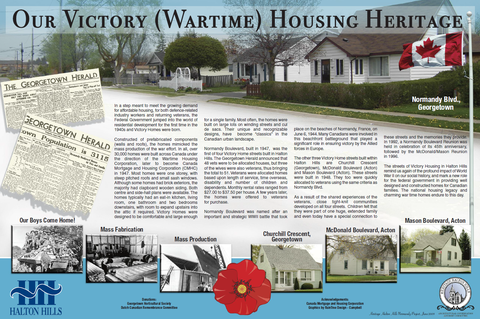
In a step meant to meet the growing demand for affordable housing, for both defence-related industry workers and returning veterans, the Federal Government jumped into the world of residential development for the first time in the 1940s and Victory Homes were born.

Constructed of prefabricated components (walls and roofs), the homes mimicked the mass production of the war effort. In all, over 30,000 homes were built across Canada under the direction of the Wartime Housing Corporation, later to become Canada Mortgage and Housing Corporation (CMHC) in 1947. Most homes were one storey, with steep pitched roofs and small sash windows. Although some homes had brick exteriors, the majority had clapboard wooden siding. Both centre and side-hall plans were available. The homes typically had an eat-in kitchen, living room, one bathroom and two bedrooms downstairs, with room to expand upstairs into the attic if required. Victory Homes were designed to be comfortable and large enough for a single family. Most often, the homes were built on large lots on winding streets and cul de sacs. Their unique and recognizable designs, have become “classics” in the Canadian urban landscape.

Normandy Boulevard, built in 1947, was the first of four Victory Home streets built in Halton Hills. The Georgetown Herald announced that 48 vets were to be allocated houses, but three of the wives were also veterans,  thus bringing the total to 51. Veterans were allocated homes based upon  length of service, time overseas, disability and number of children and dependents. Monthly rental rates ranged from $27.00 to $37.50 per house. A few years later, the homes were offered to veterans for purchase. 

Normandy Boulevard was named after an important and strategic WWII battle that took place on the beaches of Normandy, France, on June 6, 1944. Many Canadians were involved in this beachfront battleground that played a significant role in ensuring victory by the Allied forces in Europe. The other three Victory Home streets built within Halton Hills are Churchill Crescent (Georgetown), McDonald Boulevard (Acton) and Mason Boulevard (Acton). These streets were built in 1948. They too were quickly allocated to veterans using the same criteria as Normandy Blvd.

As a result of the shared experiences of the veterans, close tight-knit communities developed on all four streets. Children felt that they were part of one huge, extended family and even today have a special connection to these streets and the memories they provide. In 1992, a Normandy Boulevard Reunion was held in celebration of its 45th anniversary, followed by the McDonald/Mason Reunion in 1996.

The streets of Victory Housing in Halton Hills remind us again of the profound impact of World War II on our social history, and mark a new role for the federal government in providing well designed and constructed homes for Canadian families. The national housing legacy and charming war time homes endure to this day.

Image
Crédit photo
Town of Halton Hills
Légende
storyboard
1 sur 2 images
Image
Crédit photo
Town of Halton Hills
Légende
inscription
1 sur 2 images
War or Conflict Term
Province
!4v1645033343793!6m8!1m7!1s1Jer_ttrVgaYd_tJ7xl1Tw!2m2!1d43.64907588401462!2d-79.91740144291931!3f257.94126434722864!4f-6.512261540260326!5f1.9587109090973311
Body Content

Au cours des années 1940, le gouvernement canadien a fait un effort concerté pour fournir des logements aux hommes et aux femmes qui travaillaient dans les secteurs axés sur la défense et, plus tard, aux vétérans de retour de la Seconde Guerre mondiale. De nombreuses lois, dont la Loi sur les terres destinées aux anciens combattants, ont financé cet effort, et de petits lotissements ont vu le jour dans presque toutes les grandes villes du Canada.

La plupart des logements Victory Housing étaient préfabriqués. Ils comptaient généralement un étage et demi et étaient munis d’un toit à forte pente et d’avant-toits peu profonds sans lucarnes. Les maisons construites pour les vétérans de la Seconde Guerre mondiale ont servi de modèle pour les banlieues.

Ce scénarimage a été dévoilé le 6 juin 2009.

City
Halton Hills (Georgetown)
Country
Type Description
Interpretive Panel
Memorial CF Legacy ID
10773
City/Municipality
Halton Hills (Georgetown)
Memorial Number
35028-038
Type
Address
60, rue Guelph
Location
Église anglicane St. George
in Canada
Oui
GPS Coordinates
43.6511949, -79.9223329
Inscription

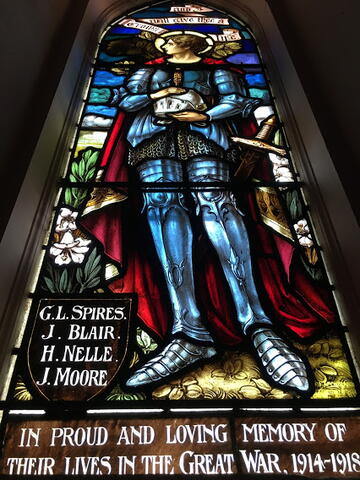
BE THOU FAITHFUL UNTO DEATH AND I WILL GIVE THEE A CROWN OF LIFE

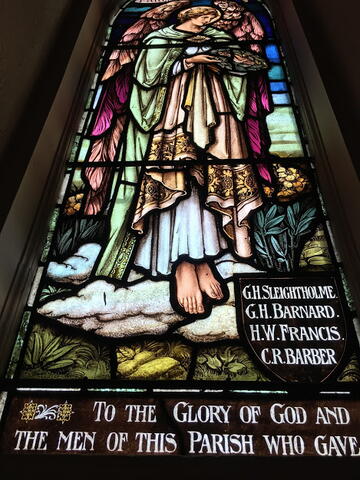
TO THE GLORY OF GOD AND IN PROUD MEMORY OF
THE MEN OF THIS PARISH WHO GAVE THEIR LIVES IN THE GREAT WAR, 1914-1918

Image
Légende
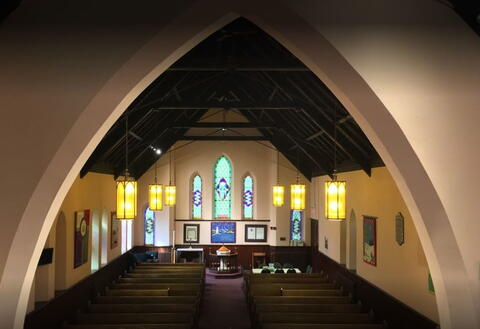
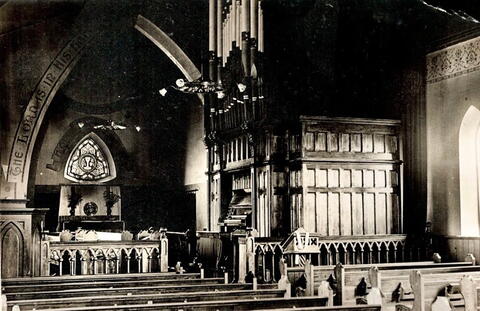
St. George's Anglican Church Great War Window
1 sur 4 images
Image
Légende
Window - depicts an angel holding a wreath.
1 sur 4 images
Image
Légende
Window - depicts a knight who persisted unto death.
1 sur 4 images
Image
Légende
Expansion of sanctuary to make room for the two Great War windows, 1921.
1 sur 4 images
War or Conflict Term
Province
!4v1729173911902!6m8!1m7!1sek-666LN-4nQi9qJVru2aw!2m2!1d43.65119488695695!2d-79.92233285091288!3f185.2359178990896!4f3.9635322622205393!5f0.7820865974627469
Body Content

Lorsque l’église anglicane St. George fut agrandie en 1921, un vitrail commémoratif a été dévoilé par le lieutenant-gouverneur H. O. Cockshatt et inauguré par l’évêque Clark aux membres de la congrégation qui ont perdu la vie pendant la Première Guerre mondiale. Le vitrail illustre un ange tenant une couronne, la couronne de vie et un chevalier qui a persévéré jusqu’à la mort.


City
Halton Hills (Georgetown)
Country
Type Description
Stained glass window
Photo Credit
Église anglicane St. George
Memorial CF Legacy ID
10409
City/Municipality
Halton Hills (Georgetown)
Memorial Number
35028-037
Type
Address
127, rue Mill
Location
Sur la façade de la Légion royale canadienne, filiale 120
in Canada
Oui
GPS Coordinates
43.6489985, -79.9267093
Image
Province
!4v1625502313968!6m8!1m7!1sLPukk0JVYfN-b9WCd6HyGg!2m2!1d43.6489984558294!2d-79.92670927170357!3f128.4804513288969!4f5.75981504933911!5f0.4000000000000002"
Body Content

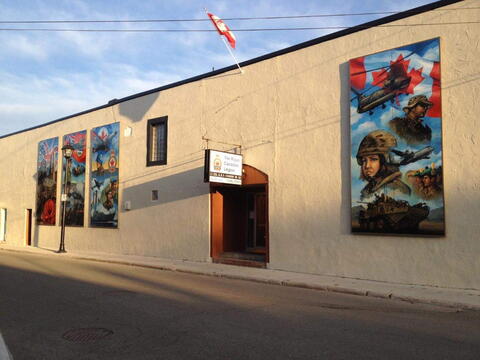
Robert Johannsen was commissioned by the Royal Canadian  Legion Georgetown branch 120 to paint a mural in 2012. The mural depicts the military history of the town in War and peacekeeping missions.

City
Halton Hills (Georgetown)
Country
Type Description
Mural
Memorial CF Legacy ID
10240
City/Municipality
Halton Hills (Acton)
Memorial Number
35028-036
Type
Address
Rues McDonald et Wallace
in Canada
Oui
GPS Coordinates
43.636979, -80.039468
Inscription

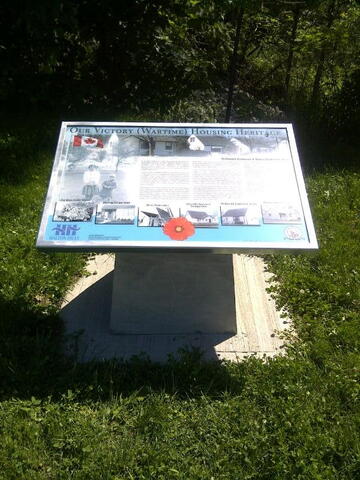
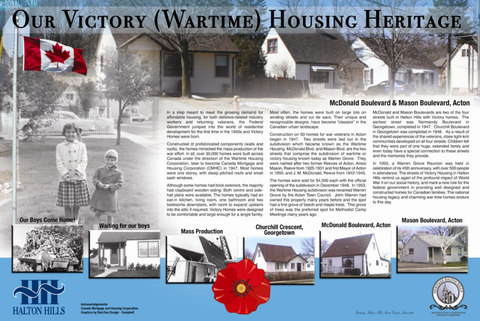
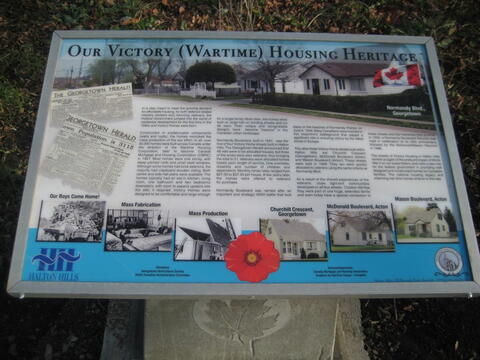
OUR VICTORY (WARTIME) HOUSING HERITAGE

McDonald Boulevard & Mason Boulevard, Acton

In a step meant to meet the growing demand for affordable housing, for both defence-related industry workers and returning veterans, the Federal Government jumped into the world of residential development for the first time in the 1940s and Victory Homes were born.

Constructed of prefabricated components (walls and roofs), the homes mimicked the mass production of the war effort. In all, over 30,000 homes were built across Canada under the direction of the Wartime Housing Corporation, later to become Canada Mortgage and Housing Corporation (CMHC) in 1947. Most homes were one storey, with steep pitched roofs and small sash windows.

Although some homes had brick exteriors, the majority had clapboard wooden siding. Both centre and side-hall plans were available. The homes typically had an eat-in kitchen, living room, one bathroom and two bedrooms downstairs, with room to expand upstairs into the attic if required. Victory Homes were designed to be comfortable and large enough for a single family. Most often, the homes were built on large lots on winding streets and cul de sacs. Their unique and recognizable designs, have become “classics” in the Canadian urban landscape.

Construction on 50 homes for war veterans in Acton began in 1947. Two streets were laid out in the subdivision which became known as the Wartime Housing. McDonald Blvd. and Mason Blvd. are the two streets that comprise the subdivision of wartime or victory housing known today as Warren Grove. They were named after two former Reeves of Acton, Amos Mason, Reeve from 1925-1931 and first Mayor of Acton in 1950; and J. M. McDonald, Reeve from 1942-1945.

The homes were sold for $4,500 each with the official opening of the subdivision in December 1948. In 1953, the Wartime Housing subdivision was renamed Warren Grove by the Acton Town Council. John Warren had owned this property many years before and the spot had a fine grove of beech and maple trees. This grove of trees was the preferred spot for Methodist Camp Meetings many years ago.

McDonald and Mason Boulevards are two of the four streets built in Halton Hills with Victory homes. The earliest street was Normandy Boulevard in Georgetown, completed in 1947. Churchill Boulevard in Georgetown was completed in 1948. As a result of the shared experiences of the veterans, close tight-knit communities developed on all four streets. Children felt that they were part of one huge, extended family and even today have a special connection to these streets and the memories they provide.

In 1993, a Warren Grove Reunion was held in celebration of its 45th anniversary, with over 500 people in attendance. The streets of Victory Housing in Halton Hills remind us again of the profound impact of World War II on our social history, and mark a new role for the federal government in providing well designed and constructed homes for Canadian families. The national housing legacy and charming war time homes endure to this day.

Image
Crédit photo
Town of Halton Hills
Légende
storyboard
1 sur 2 images
Image
Crédit photo
Town of Halton Hills
Légende
inscription
1 sur 2 images
War or Conflict Term
Province
!4v1645017279634!6m8!1m7!1sYh92_aJj4CmB9mzrRK2zSQ!2m2!1d43.63697902475796!2d-80.03946802956173!3f260.17200736440265!4f-3.2255790410855525!5f0.7820865974627469
Body Content

Au cours des années 1940, le gouvernement canadien a fait un effort concerté pour fournir des logements aux hommes et aux femmes qui travaillaient dans les secteurs axés sur la défense et, plus tard, aux vétérans de retour de la Seconde Guerre mondiale. De nombreuses lois, dont la Loi sur les terres destinées aux anciens combattants, ont financé cet effort, et de petits lotissements ont vu le jour dans presque toutes les grandes villes du Canada.

La plupart des logements Victory Housing étaient préfabriqués. Ils comptaient généralement un étage et demi et étaient munis d’un toit à forte pente et d’avant-toits peu profonds sans lucarnes. Les maisons construites pour les vétérans de la Seconde Guerre mondiale ont servi de modèle pour les banlieues.

Le 10 septembre 2013, Rick Bonnette, maire de Halton Hills, la conseillère Moya Johnson, présidente de Heritage Halton Hills, et John Wagg, président de la Légion royale canadienne, filiale 197 Acton, ont dévoilé le scénarimage nouvellement installé qui met en valeur les logements Victory Housing, uniques sur le plan architectural et importants sur le plan historique.

City
Halton Hills (Acton)
Country
Type Description
Interpretive Panel
Memorial CF Legacy ID
10771
City/Municipality
Halton Hills (Georgetown)
Memorial Number
35028-034
Type
Address
1, avenue Park
Location
Expositions de Georgetown
in Canada
Oui
GPS Coordinates
43.6458068, -79.9272846
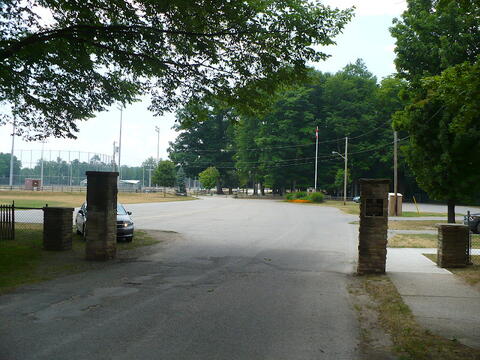
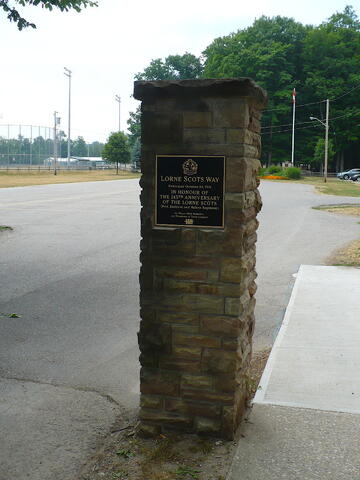
Inscription

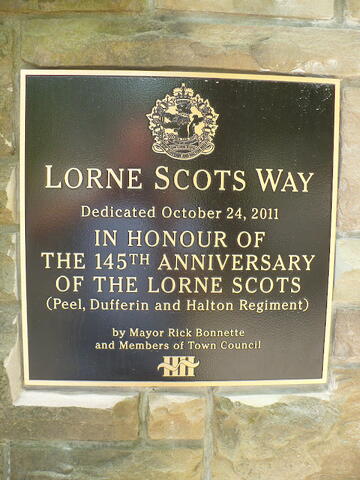
LORNE SCOTS WAY
Dedicated October 24, 2011

IN HONOUR OF
THE 145TH ANNIVERSARY
OF THE LORNE SCOTS
(Peel, Dufferin, and Halton Regiment)

by Mayor Rick Bonette
and Members of Town Council

Image
Crédit photo
Gerardo Cacella
Légende
Gateway to park.
1 sur 3 images
Image
Crédit photo
Tim Laye, Ontario War Memorials
Légende
Column with plaque.
1 sur 3 images
Image
Crédit photo
Tim Laye, Ontario War Memorials
Légende
inscription
1 sur 3 images
Province
!4v1625501893732!6m8!1m7!1sYW6cp6T2kHtgxamBGJ7EFA!2m2!1d43.64580613220517!2d-79.92728918260683!3f222.2460450735785!4f-3.6756316877577433!5f1.5041220219451086"
Body Content

Ces portes et l’entrée du parc municipal et du champ de foire ont été dédiées au Lorne Scots Regiment à l’occasion de son 145e anniversaire de service.

City
Halton Hills (Georgetown)
Country
Type Description
Gate - columns
Memorial CF Legacy ID
9435
City/Municipality
Glen Williams Village, Halton Region
Memorial Number
35028-033
Type
Address
517, rue Main
in Canada
Oui
GPS Coordinates
43.6680812, -79.9266667
Inscription

[side 1/côté 1]

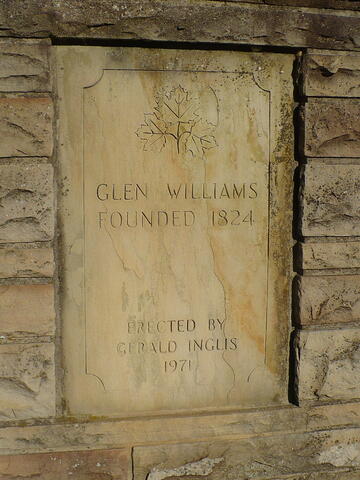
GLEN WILLIAMS
FOUNDED 1824
ERECTED BY
GERALD INGLIS
1971

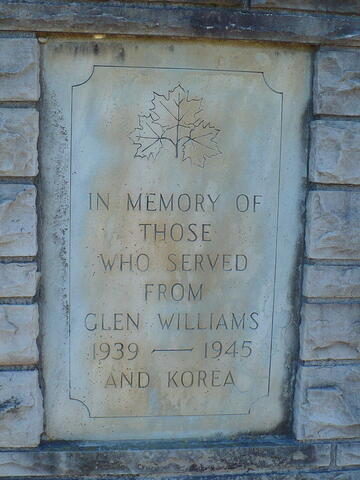
[side 2/côté 2]
IN MEMORY OF
THOSE
WHO SERVED
FROM
GLEN WILLIAMS
1939--1945
AND KOREA

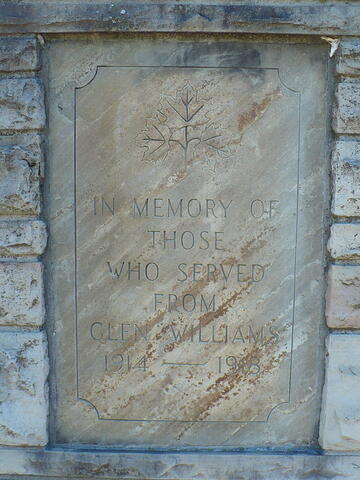
[side 3/côté 3]
IN MEMORY OF
THOSE
WHO SERVED FROM
GLEN WILLIAMS
1914--1918

Image
Légende
Glen Williams War Memorial
1 sur 5 images
Image
Légende
side 1
1 sur 5 images
Image
Légende
side 2
1 sur 5 images
Image
Légende
side 3
1 sur 5 images
Image
Légende
surroundings
1 sur 5 images
Province
4v1623939874412!6m8!1m7!1sCAoSLEFGMVFpcE1oM1ZmaE9fLWllSWtlXzk3ZDNsRVRyU2hjRnlfMkIzVENrQ1RH!2m2!1d43.66808115003471!2d-79.9266666546464!3f91.1!4f-6.650000000000006!5f0.7820865974627469
Body Content

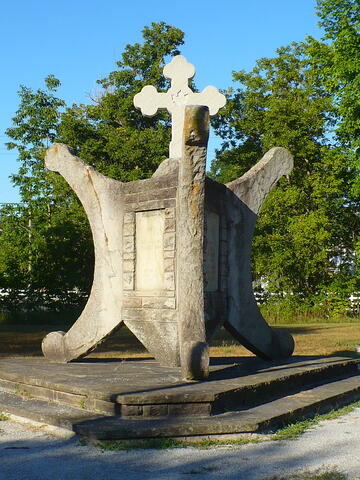
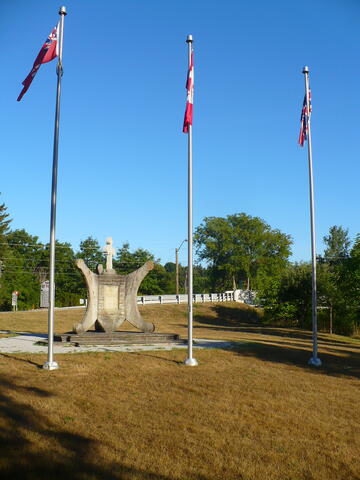
Despite longstanding interest in erecting a war memorial in Glen Williams following the end of the Second World War, the existing monument was not constructed until the 1970s. In 1971, local stonemason Gerald Inglis hand-carved the monument from freestone sourced from the Inglis farm on the 10th Line. Since its installation, the memorial has served as the central gathering place for Glen Williams residents during annual Remembrance Day services.

In 2010, Glen Williams stonemasons Gerry and Ryan Inglis, restored the memorial by reinstalling a stone cross. The cross, weighing approximately 200 pounds, was hand-cut by the duo from freestone at the Inglis farm, a few miles from the Glen Williams village center.

ms.

City
Glen Williams Village, Halton Region
Country
Type Description
Sculpture
Photo Credit
Tim Laye, Ontario War Memorials
Memorial CF Legacy ID
9433
City/Municipality
Norval (Georgetown)
Memorial Number
35028-032
Type
Address
9118, rue Winston Churchill
Location
À l'intérieur du Centre Franciscain Croate Reine de la Paix
in Canada
Oui
GPS Coordinates
43.6290555, -79.8269403
Inscription

[front/devant]

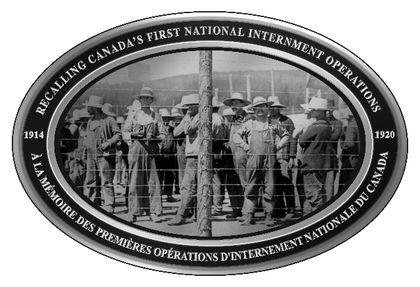
Recalling Canada's First National Internment Operations 1914-1920

A la mémoire des premières opérations d’internement nationale du Canada 1914-1920

Image
Crédit photo
Victoria Edwards
Légende
Plaque
War or Conflict Term
Province
!4v1636732790487!6m8!1m7!1s_NNUmm9vyNjaUAVoHEntKQ!2m2!1d43.62905548132222!2d-79.82694033884054!3f239.93050565125057!4f3.081212444715163!5f2.8814538312188387"
Body Content

Cette plaque commémorative rappelle une injustice historique que les Canadiens devraient commémorer, au même titre que la Première Guerre mondiale et le courage des femmes et des hommes canadiens qui y ont participé. Elle rend hommage à la mémoire des milliers de « sujets d’un pays ennemi » qui ont été privés de leurs droits civils et emprisonnés lors des premières opérations d’internement qu’a menées le Canada entre 1914 et 1920, suite à l’entrée en vigueur de la Loi sur les mesures de guerre. L’année 2014 marquait le 100e anniversaire de la Loi sur les mesures de guerre qui fut adoptée le 22 août 1914, pendant la Première Guerre mondiale. Cette loi a été utilisée pour emprisonner, dans les 24 camps d’internement du pays, des Canadiens d’origine ukrainienne et d’autres origines, notamment allemande, hongroise, serbe, croate et arménienne.

M. Lubomyr Luciuk (Ph. D.), professeur au Collège militaire royal du Canada et ancien président de l’Association ukraino-canadienne des libertés civiles (UCCLA), a décidé un jour de prendre les choses en mains pour la création du monument commémoratif. Dans le cadre du projet « CTO » (« Cent » en ukrainien), 100 plaques en aluminium ont été inaugurées simultanément, le 22 août 2014, dans 100 endroits différents du pays à 11 heures, heure locale. La première a été inaugurée à Amherst, en Nouvelle-Écosse, puis les inaugurations se sont succédé d’une province à l’autre, vers l’ouest, pour se terminer à Nanaimo, en Colombie-Britannique. Les plaques, qui ont coûté 1 000 $ chacune, ont été financées grâce à la générosité du Fonds pour la reconnaissance de l’internement de personnes au Canada pendant la Première Guerre mondiale.

City
Norval (Georgetown)
Country
Type Description
Plaque, aluminum
Memorial CF Legacy ID
9083
City/Municipality
Halton Hills (Georgetown)
Memorial Number
35028-031
Type
Address
91, rue Todd
Location
Manège militaire du Colonel J. R. Barber
in Canada
Oui
GPS Coordinates
43.6533943, -79.8958099
Inscription

[front/devant]

Colonel JR Barber Armoury

Province
!4v1625501244982!6m8!1m7!1sbfxC20-JfMJVILS1ndOm3A!2m2!1d43.65339429617709!2d-79.89580993775948!3f158.10775193684373!4f4.90530075684174!5f1.6444770629411924"
Body Content

Ce manège militaire, le Colonel JR Barber Armoury, porte le nom du Colonel John Roaf Barber, ED, CD.

John Roaf Barber est né à Georgetown, dans le Haut-Canada, en juillet 1841. Il a entrepris ses études à Georgetown et prévoyait les poursuivre au Royal Military College en Angleterre. Il est plutôt resté à Georgetown pour aider à la gestion de l’usine de papier de propriété familiale dont il a pris la direction en 1880. Mais Barber était aussi membre à part entière de sa collectivité. De 1861 à 1905, il a servi dans la milice, d’abord dans la première compagnie d’infanterie de la milice volontaire de Georgetown (la Georgetown Volunteer Militia Infantry Company), puis dans le 20e Bataillon (Halton) (les Lorne Rifles). Il a été en service actif en 1866, à Ridgeway contre les féniens. Il a été promu au rang de major en 1876 et, pendant de nombreuses années, il a été l’officier payeur du 20e Bataillon. Plus tard, il est devenu le commandant du 8e Régiment. Sa participation à la vie communautaire l’a mené jusque dans l’arène politique : il a été membre de nombreux conseils locaux et il a été le préfet de Georgetown de janvier 1867 à décembre 1876 et de nouveau en 1882, alors qu’il occupait aussi le poste de préfet du comté de Halton. De 1898 à 1904. Il a été le député provincial libéral de Halton. Il est décédé à Georgetown en mars 1917.

City
Halton Hills (Georgetown)
Country
Type Description
Building - armoury
Memorial CF Legacy ID
8930
City/Municipality
Milton
Memorial Number
35028-030
Type
Address
8815, chemin Britannia
Location
Église presbytérienne d'Omagh
in Canada
Oui
GPS Coordinates
43.4944707, -79.8264269
Inscription

[front/devant]

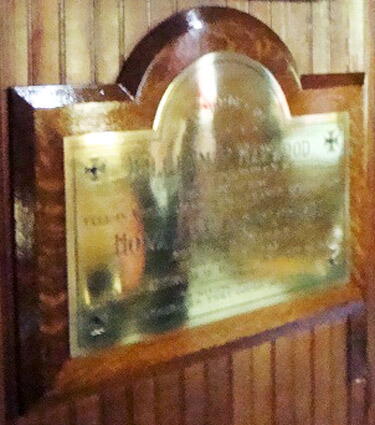
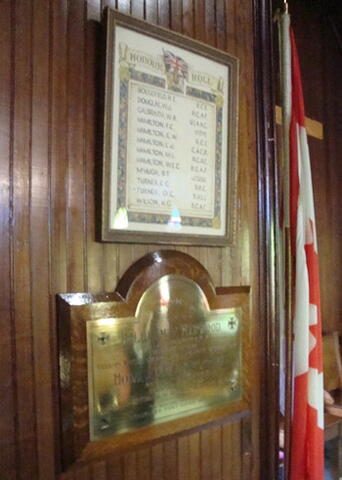
William P. Harwood
Cavalry Regiment of CEF
Born Nov. 1st 1897
Fell in action near ARRAS FRANCE
September 19, 1917

Howard C. Robertson (should read “Howard C. Robinson” confirmed record is #648785)
159th Battalion CEF Born July 15th 1890 Fell in action near ARRAS FRANCE
September 2, 1918

“IN SAVING OTHERS THEMSELVES THEY COULD NOT SAVE”.

Image
Crédit photo
Richard Laughton
Légende
front view
1 sur 3 images
Image
Légende
front and surroundings
1 sur 3 images
Image
Légende
church
1 sur 3 images
War or Conflict Term
Province
!4v1629301832749!6m8!1m7!1sd5z87zY9FVjBFkaq3EooQQ!2m2!1d43.49447073839543!2d-79.8264268892358!3f319.72823470616686!4f7.207014430196196!5f1.5397427113343776"
Body Content

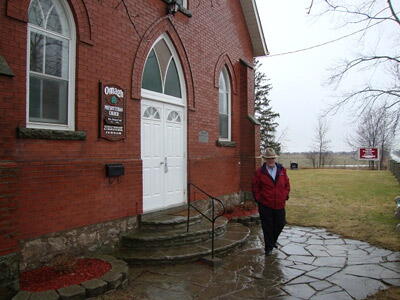
Ce mémorial érigé par l`église Omagh Presbyterian Church est dédié en mémoire des membres de la congrégation morts au combat durant la Grande Guerre.

City
Milton
Country
Type Description
Bronze plaque on wooden frame
Memorial CF Legacy ID
8480