Autre

City/Municipality
Langley
Memorial Number
59023-009
Type
Address
21559, route Fraser
Location
Arboretum Derek Doubleday
in Canada
Oui
GPS Coordinates
49.0996176, -122.6379471
Inscription

[front/devant]

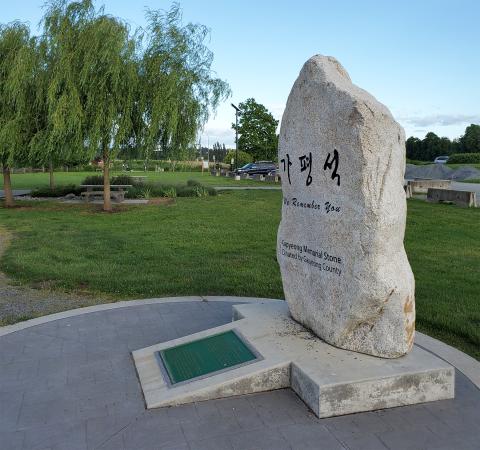
We Remember You

Gapyeong Memorial Stone
Donated by Gapyeong County

[plaque]

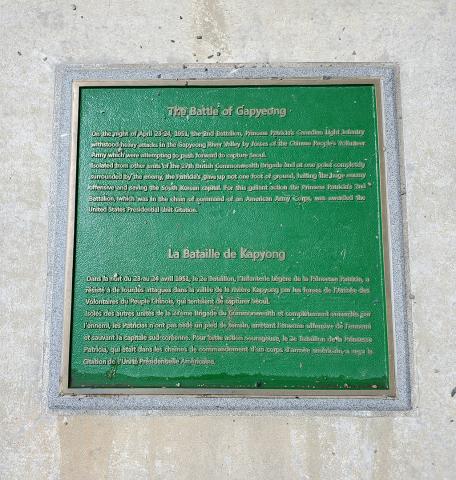
The Battle of Gapyeong

On the night of April 23-24, 1951, the 2nd Battalion, Princess Patricia's Canadian Light Infantry withstood heavy attacks in the Gapyeong River Valley by forces of the Chinese People's Volunteer Army which were attempting to push forward to capture Seoul.
Isolated from other units of the 27th British Commonwealth Brigade and at one point completely surrounded by the enemy, the Patricia's gave up not one foot of ground, halting the huge enemy offensive and saving the South Korean capital. For this gallant action the Princess Patricia's 2nd Battalion, which was in the chain of command of an American Army Corps, was awarded the United States Presidential Unit Citation.

La Bataille de Kapyong

Dans la nuit du 23, au 24 avril 1951, le 2e Bataillon, l'Infanterie Légère de la Princesse Patricia, a résisté à de loudes attaques dans la vallée de la rivière Kapyong par les forces de l'Armée des Voluntaires du Peuple Chinois, qui tentaient de capturer Séoul.
Isolés des autres unités de la 27ème Brigade du Commonwealth et compltèement encerclés par l'ennemi, les Patricias n'ont pas cédé un pied de terrain, arrétant l'énorme offensive de l'ennemi et sauvant la capitale sud-coréenne. Pour cette action courageuse, le 2e Bataillon de la Princesse Patricia, qui était dans les chaînes de commandement d'un corps d'armée américain, a reçu la Citation de l'Unité Présidentielle Arméricaine.

Image
Légende
Gapyeong Stone Korean War Memorial
1 sur 2 images
Image
Légende
plaque
1 sur 2 images
War or Conflict Term
!4v1622225593434!6m8!1m7!1sxzqvnxVaY_FTbcVJQ815Ew!2m2!1d49.09961995525853!2d-122.6379542177643!3f13.452706016901638!4f-0.0973939122912384!5f2.9547363560753394
Body Content

Le 22 janvier 2019, le comté de Gapyeong, en Corée du Sud, a présenté cette pierre provenant de la région où a eu lieu la bataille de Gapyeong au canton de Langley, en reconnaissance de la contribution du Canada pendant la guerre de Corée. Le don a été facilité par le Gapyeong Stone Committee, qui était composé de membres de l’Association canadienne des vétérans de la Corée, de la Korean War Veterans Association, de la Korean Veterans Association et de la Vietnam War Veterans Association. Le maire du comté de Gapyeong, Sungki Kim, et son personnel chargé des relations internationales, le consul général de la République de Corée, Byun-won Chung, le consul Dongsoo Han, la sénatrice canadienne Yonah Martin, le capitaine du Princess Patricia’s Canadian Light Infantry, Adam Goddard, des membres de la Légion royale canadienne et des vétérans de la guerre de Corée ont assisté à la cérémonie.

City
Langley
Country
Type Description
Slab, plaque
Photo Credit
Canton de Langley
Memorial CF Legacy ID
10502
City/Municipality
Langley
Memorial Number
59023-008
Type
Address
21559, route Fraser
Location
Arboretum Derek Doubleday
in Canada
Oui
GPS Coordinates
49.099503, -122.6373388
War or Conflict Term
!4v1714742822909!6m8!1m7!1squOA7BOnkojDDz-NfRkjVQ!2m2!1d49.0995029963744!2d-122.6373387709732!3f2.46!4f5.230000000000004!5f1.3173716720535973
Body Content

Le 23 septembre 2017, un petit arbre d’une illustre lignée s’est ajouté au A Walk to Remember de l’arboretum Derek Doubleday. Ce chêne de Vimy a été officiellement planté par John Aldag, conseiller municipal de Cloverdale-Langley City, l’aîné Lekeyten de la Première Nation Kwanten et le conseiller municipal Bob Long. Ce chêne de Vimy se veut un mémorial commémoratif vivant du centenaire de la bataille de la crête de Vimy. 

Après la victoire de la bataille de la crête de Vimy le 12 avril 1917, le lieutenant Leslie Miller, un soldat de l’Ontario, a ramassé une poignée de glands en souvenir de cette victoire historique. De retour au Canada, il a planté les glands sur ses terres, appelant sa propriété la ferme de Vimy Oaks. Aujourd’hui, plusieurs des chênes qu’il a plantés sont encore debout.

La société de Legs des chênes-de-Vimy (Vimy Oaks Legacy) a rapatrié les chênes canadiens de Vimy sur la crête de Vimy et de jeunes arbres ont été plantés dans le cadre des célébrations du centenaire en 2017 et en 2018. De jeunes chênes de Vimy ont été proposés à la vente aux filiales de la Légion royale canadienne de tout le pays à la mémoire des soldats de la Première Guerre mondiale.

City
Langley
Country
Type Description
Tree
Memorial CF Legacy ID
10042
City/Municipality
Langley
Memorial Number
59023-007
Type
Address
21559, route Fraser
Location
Arboretum Derek Doubleday
in Canada
Oui
GPS Coordinates
49.099503, -122.6373388
Inscription

needs further research/recherche incomplète

Image
Crédit photo
LEES+Associates
Légende
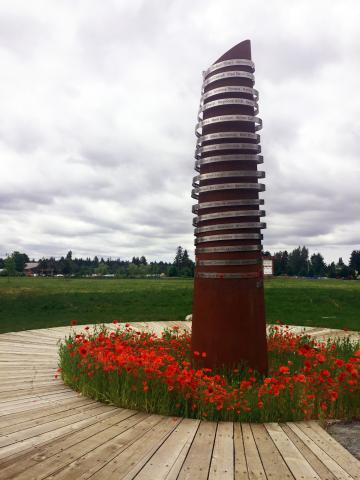
A Walk to Remember
War or Conflict Term
!4v1622129314765!6m8!1m7!1sUKqT2Pvwi2Uc5yzPPixdfA!2m2!1d49.09949352434208!2d-122.6374316257466!3f2.464191536779273!4f5.231941062188994!5f1.502837074960162
Body Content

Deux jeunes du canton de Langley Michael et Elizabeth Pratt, assistés par l’organisme qu’ils ont fondé, Langley Youth for the Fallen, ont créé un monument intitulé Walk to Remember pour commémorer les membres des Forces canadiennes qui ont péri en Afghanistan. Au total, 158 arbres ont été plantés à l’arboretum en l’honneur des 158 Canadiens qui ont perdu la vie.

L’élément central de ce monument commémoratif symbolise un arbre abattu trop tôt. Un ruban d’acier portant les noms des Canadiens tombés au combat enveloppe le tronc et se dresse vers le ciel. Le sentier de gravier qui ceint le parc est bordé de cèdres deodar, indigènes d’Afghanistan, et est flanqué de deux points d’observation commandités par le club Rotary de Langley, qui sont tous deux orientés vers le nord, vers le point où le ruisseau Fraser et la rivière Nicomekl se rencontrent.

Des architectes paysagistes de la société Lees and Associates ont participé à la planification du monument en 2011.

City
Langley
Country
Type Description
Pillar, trees, path
Memorial CF Legacy ID
10041
City/Municipality
Langley
Memorial Number
59023-006
Type
Address
20550, croissant Douglas
Location
Parc Douglas
in Canada
Oui
GPS Coordinates
49.1031268, -122.6539681
Inscription

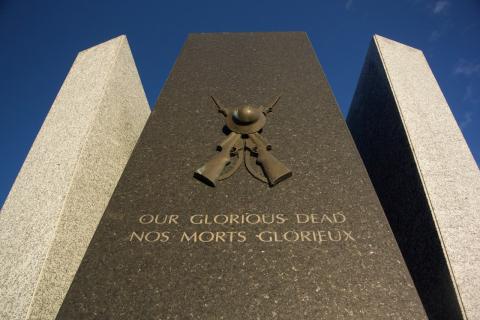
Our Glorious Dead

Nos Morts Glorieux

Image
Crédit photo
FSgt G. Simeon
1 sur 4 images
Image
Crédit photo
FSgt G. Simeon
1 sur 4 images
Image
Crédit photo
Mark Forsythe
Légende
inscription
1 sur 4 images
Image
Crédit photo
Mark Forsythe
Légende
detail
1 sur 4 images
!4v1622128672588!6m8!1m7!1sV9DlSfz0upE_cwoNOspoWg!2m2!1d49.10312678573385!2d-122.6539681462064!3f177.05031970355145!4f-5.717826494014119!5f1.5068218599248957
Body Content

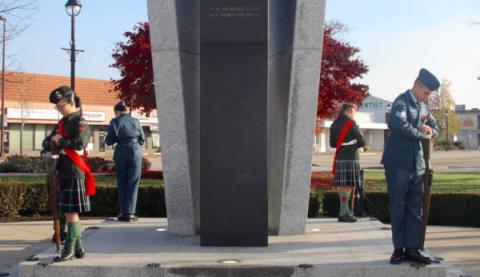
Le cénotaphe du parc Douglas est composé de trois dalles de granit sur lesquelles sont gravés les mots Our Glorious Dead/Nos Morts Glorieux. Le nouveau cénotaphe, qui est l’œuvre d’un sculpteur, a été conçu avec soin et réflexion à la mémoire de la guerre et représente l’espoir d’un avenir paisible. Il a été érigé par la Ville de Langley de concert avec la filiale 21 de la Légion royale canadienne. Le monument est dédié aux citoyens qui ont servi durant les deux Grandes Guerres et la guerre de Corée.

De couleur noire, la pièce centrale du cénotaphe symbolise les guerres passées et évoque un sentiment de perte et de tristesse pour ceux qui regardent le monument. Cette pièce est flanquée de deux ailes protectrices légères incarnant l’espoir de la paix et notre espoir en l’avenir. L’effet sombre et léger invite au recueillement et à l’optimisme et rappelle par sa prestance les tourments d’une paix sacrifiée. Don de la société Langley Heritage, la sculpture aux fusils croisés occupe une place d’importance au centre du cénotaphe, et le contraste entre le bronze et le noir est un rappel frappant de notre aspiration à un avenir paisible.

City
Langley
Country
Type Description
Cenotaph - granite
Memorial CF Legacy ID
9165
City/Municipality
White Rock
Memorial Number
59023-005
Type
Address
15322, avenue Buena Vista
Location
Hôtel de ville de White Rock
in Canada
Oui
GPS Coordinates
49.023595, -122.7987826
Inscription

[plaque/plaque]

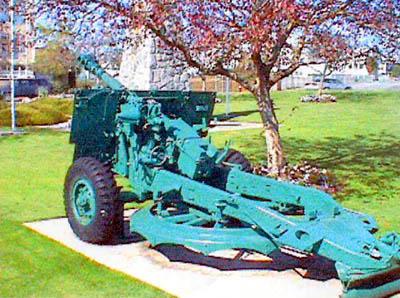
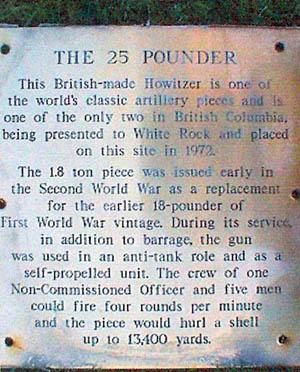
THE 25 POUNDER

This British-made Howitzer is one of the world's classic artillery pieces and is one of the only two in British Columbia, being presented to White Rock and placed on this site in 1972.

The 1.8 ton piece was issued early in the Second World War as a replacement for the earlier 18-pounder of First World War vintage. During its service, in addition to barrage, the gun was used in an anti-tank role and as a self-propelled unit. The crew of one Non-Commissioned Officer and five men could fire four rounds per minute and the piece would hurl a shell up to 13,400 yards.

Image
Légende
weapon (back)
1 sur 2 images
Image
Légende
weapon (plaque)
1 sur 2 images
War or Conflict Term
!4v1622127827403!6m8!1m7!1slrSymKG6nKUZUWD8brop4A!2m2!1d49.02359500063086!2d-122.798782562493!3f95.04583630381458!4f-4.9207837091746!5f3.015836391494047
Body Content

Ce mémorial, un canon d’artillerie de campagne de 25 livres, est fait partie des pièces d’artillerie qu’utilisait l’armée canadienne durant la Seconde Guerre mondiale. Il a été offert à la ville de White Rock et dévoilé en 1972.

City
White Rock
Country
Type Description
Weapon
Memorial CF Legacy ID
2681
City/Municipality
White Rock
Memorial Number
59023-004
Type
Address
15322, avenue Buena Vista
Location
Hôtel de ville de White Rock
in Canada
Oui
GPS Coordinates
49.0236741, -122.7987214
Inscription

[first plaque/première plaque]

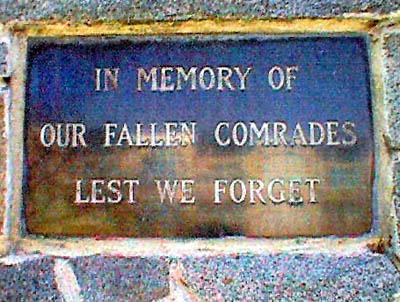
IN MEMORY OF FALLEN COMRADES
LEST WE FORGET

[second plaque/seconde plaque]

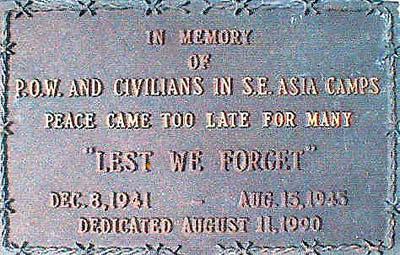
IN MEMORY OF
P.O.W. AND CIVILIANS IN S.E. ASIA CAMPS
PEACE CAME TOO LATE FOR MANY
"LEST WE FORGET"

DEC. 8, 1941 - AUG. 15, 1945
DEDICATED AUGUST 11, 1990

Image
Légende
obelisk (west side)
1 sur 4 images
Image
Légende
obelisk (east side)
1 sur 4 images
Image
Légende
obelisk (first plaque)
1 sur 4 images
Image
Légende
obelisk (second plaque)
1 sur 4 images
War or Conflict Term
!4v1622127452793!6m8!1m7!1snJjQG9qlf_5jeENvTBc09g!2m2!1d49.02367412259732!2d-122.7987213745024!3f92.90677161093687!4f0.7957795779067283!5f1.4011083721839576
Body Content

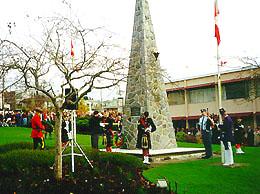
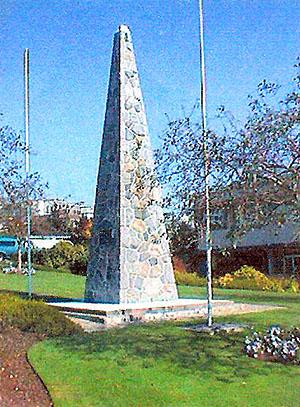
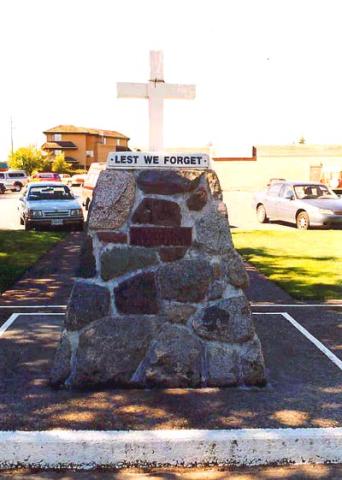
Ce mémorial a été érigé à l’origine en l’honneur des camarades morts au combat. Il a été construit en 1967 à la mémoire de tous les anciens combattants des guerres de 1914-1918 et de 1939-1945, qui ont donné leur vie pour que nous puissions vivre libres. Les travaux ont duré de juin à novembre 1967, et ont été financés par des dons des citoyens de White Rock et de South Surrey. Le mémorial est entretenu par un comité du cénotaphe composé de quatre personnes : George Bryant (président), George Stephens (trésorier), Art Daley et Bill Wallace. Le comité reçoit à cette fin des dons des organisations de la région. Le cénotaphe comprend également un canon de 25 livres, qui vient d’être nettoyé au jet de sable et peint au coût de 1 800 $. Une plaque en mémoire des prisonniers de guerre et des civils tenus prisonniers dans les camps du sud-est de l’Asie durant la Seconde Guerre mondiale a été ajoutée le 11 août 1990.

City
White Rock
Country
Type Description
Stone obelisk
Memorial CF Legacy ID
1339
City/Municipality
Langley
Memorial Number
59023-003
Type
in Canada
Oui
GPS Coordinates
0, 0
Inscription

[east side/côté est]

LEST WE FORGET

TO OUR GLORIOUS DEAD

WORLD WAR I
1914 - 1918

[south side/côté sud]

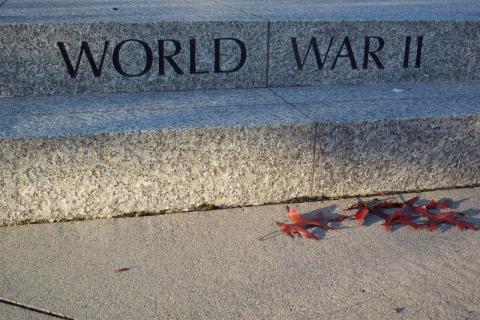
WORLD WAR II
1939 - 1945

[west side/côté ouest]

LEST WE FORGET

IN MEMORY OF COMRADE FRANK FLINT

[north side/côté nord]

KOREA
1950 - 1953

Image
Légende
east side
1 sur 4 images
Image
Légende
south side
1 sur 4 images
Image
Légende
west side
1 sur 4 images
Image
Légende
north side
1 sur 4 images
Body Content

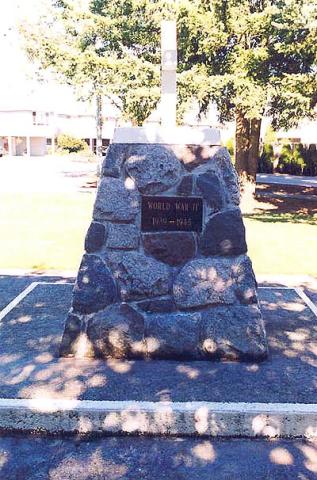
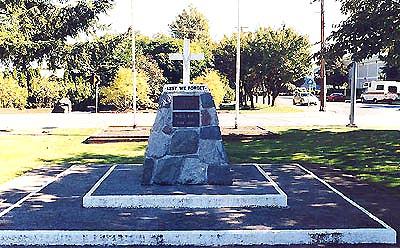
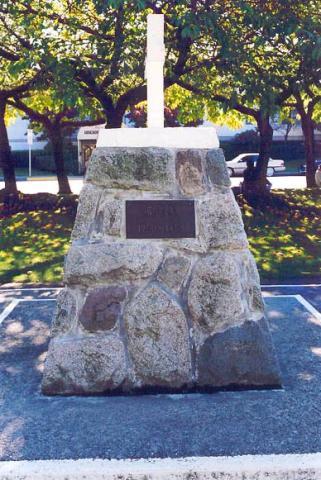
Ce mémorial est dédié à ceux de l'endroit qui sont morts durant les Première et Seconde Guerres mondiales et la guerre de Corée. Il était situé à l’intersection de la 56e avenue et du croissant Eastleigh, mais il a été démantelé en 2011 et entreposé par la filiale 21 de la Légion royale canadienne. Depuis la fermeture de la filiale en 2018, un ancien membre de la Légion l’entrepose chez lui.


City
Langley
Country
Type Description
Cairn, wooden cross
Memorial CF Legacy ID
1278
City/Municipality
Langley
Memorial Number
59023-002
Type
Address
22051, autoroute Fraser
Location
Hôpital mémorial Langley
in Canada
Oui
GPS Coordinates
49.0955025, -122.6118426
Inscription

(needs further research/recherche incomplète)

Image
1 sur 2 images
Image
1 sur 2 images
!4v1621607322131!6m8!1m7!1stkIn1u8n96c2RW1ScEc_VA!2m2!1d49.09550249725891!2d-122.6118426058439!3f262.49849655792667!4f4.58775921018831!5f0.8121616929217912
Body Content

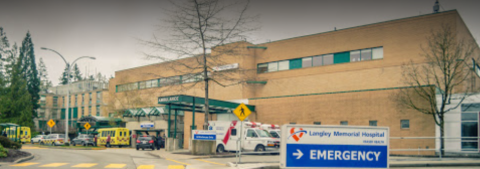
Langley Memorial Hospital provides a range of primary, secondary and some specialty services, including 24/7 emergency, general and internal medicine, general surgery, select surgical specialties, and maternity and nursery specialties.

On July 14, 1948, the Cottage Hospital, a one-storey building with 35 beds, opened on Fraser Highway, two miles east of the town of Langley Prairie on a site that would become known as Hospital Hill. After the closing of the cottage hospital, the 1965 building that is now called the south tower was opened.  Doris Riedweg, a member of the Langley Memorial Hospital Heritage Committee, wrote "The hospital on the hill : a history of Langley Memorial Hospital 1948-1998" to celebrate the 70th anniversary of the hospital in 2017.  

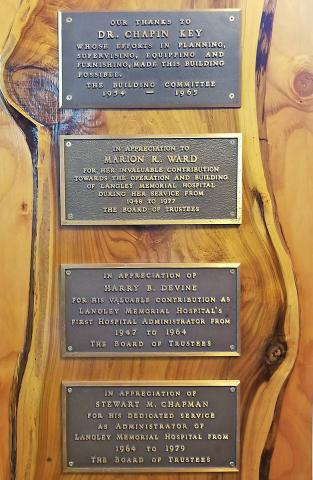
Four heritage plaques, which were taken down in 2003 during renovations to the hospital entrance are currently a standing exhibit in Michaud House, which houses the LMH archive collection. There are four names on the plaques: Dr. Chapin Key, "whose efforts in planning, supervising equipping and furnishing, made this building possible," Marion R. Ward for her contribution toward the operation and building of the hospital, Harry B. Devine, the first hospital administrator from 1947 to 1964 and Stewart M. Chapman, who was administrator from 1964 to 1979.

City
Langley
Country
Type Description
Building and plaques
Memorial CF Legacy ID
2691
City/Municipality
Prince Rupert
Memorial Number
59022-024
Type
Address
111 rue Wellington, K1A 0A9
Location
Parlement du Canada, Chambre des communes
in Canada
Oui
GPS Coordinates
45.4251521, -75.6998396
Inscription

(needs further research/recherche incomplète)

Image
Légende
plaque
Body Content

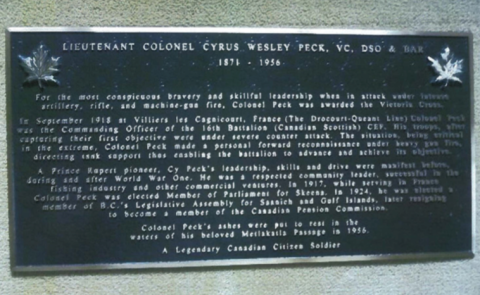
Cette plaque est dédiée au Lieutenant-Colonel Cyrus Wesley Peck V.C.

City
Prince Rupert
Country
Type Description
plaque
Memorial CF Legacy ID
7377
City/Municipality
Sandspit
Memorial Number
59022-023
Type
Address
1, chemin Airport
Location
Aéroport de Sandspit
in Canada
Oui
GPS Coordinates
53.25066, -131.81387
Inscription

RCAF STATION SANDSPIT

FEBRUARY 1944 - AUGUST 1 1946

Sandspit traces its history back to the ancient Haida Village of KIL located east of Haans Creek on Moresby Island, which was part of the Queen Charlotte Islands and is now called Haida Gwaii. The Haida lived in this region for 10,000 years before the first Europeans arrived around 1900, establishing farms and ranches near the grassy flats of the spit. The next development was construction of a dogfish oilery in 1910, and then a fish cannery in 1913. The first known flight to the Queen Charlotte Islands occurred in the summer of 1922, when Major George A. “Tommy” Thompson flew a 1920 model Junkers-Larson JL-6, G-CADP-christened “The Vic”-from Prince Rupert and scouted the island for potential business ventures for the Railway Employees Investment & Industrial Association of Hazelton, BC.

The flight was just the first of many that focused attention on the potential for an airport at Sandspit. On May 1, 1935, No. 4 (FB) Flying Boat Squadron at Jericho Beach made an extensive survey flight of Moresby Island in Vickers Vancouver #905. This was followed up in April 1936 when S/L L.F. Stevenson and F/Sgt Winney carried out a survey flight of the Queen Charlotte Islands. Their purpose was to located sites for potential airports and flying boat stations in preparation for the defence of the west coast in the event of war. The airport site selected was at Sandspit on the Matthers family farm. This location was secured by the Canadian Government on September 15, 1937. The initial plans for the airport called for a steel-mat strip runway to accommodate fighter aircraft for the defence of the nearby Alliford Bay flying boat station but this was soon changed to a standard asphalt runway. On Aug 11, 1943, the initial contingent of airmen was dispatched to Sandspit to start runway construction. It took a month less a day to lay the 4,800 foot runway. The runway was reported completed towards the end of September but it was not officially handed over until early 1944. It was then modified and made an emergency field and staging base for Alaska bound aircraft. The RCAF unit at Sandspit was very small as there was no Army defence contingent. The unit was comprised of only twenty personnel and six buildings – a dining room, kitchen, lounge, canteen, and sleeping quarters. This was the last airport project for Western Air Command and No. 9 (CMU) Construction Maintenance Unit.

Effective April 1, 1944, RCAF Secret Organization Order #183 stated that RCAF Station Sandspit was to be re-organized as No. 23 Staging Unit. RCAF Sandspit served in this capacity until the spring of 1946, when F/L Inglis turned over the station to Department of Transport representative, Mr. Austin. An airport licence was issued in the name of the Department of Transport on June 16, 1947, and a terminal building was constructed in 1951 followed by a runway improvement in 1960.

There was only one major accident at the Sandspit airport. The evening of January 18, 1952, was just another quiet Friday at Sandspit. It was a cool 34° F evening with occasional snow showers and a light wind.. There was an accumulation of snow on the ground but the runway was clear. At 21:11 that same evening Northwest Airlines Flight 324, a Douglas DC-4, lifted off the runway at Elmendorf Air Force Base, Anchorage bound for McChord Air Force Base, Washington, with three crew members and 40 military personal on their way home from Japan. Just after midnight, the captain declared an emergency as he had to shut down number one engine and he diverted to Sandspit which was the closest suitable airfield. The approach seemed normal but the touchdown was long and the captain elected to do a go-around. Not long after the aircraft disappeared into the snow, the controller heard shouting so a boat was launched and about 1 ½ hours later, seven survivors were found alive on the left wing tip. The remaining thirty three passengers and the three crew members had died of exposure or drowning, not from injuries.

May 2016

Image
Légende
plaque
Body Content

Cette plaque fut dévoilée le 28 mai 2016 pour commémorer la station de l’Aviation royale canadienne (ARC) à Sandspit qui avait été établie durant la Seconde Guerre mondiale. La plaque fut installée dans le cadre du programme du 101e escadron de l’Association de l’Aviation royale canadienne visant à commémorer les stations de l’Aviation royale canadienne de North Island, Central Coast et Haida Gwaii.

City
Sandspit
Country
Type Description
Plaque
Memorial CF Legacy ID
10512