
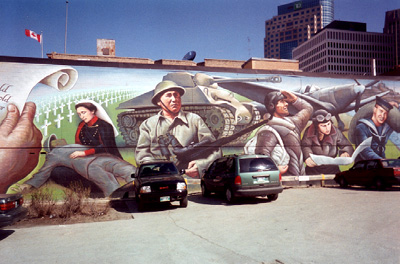
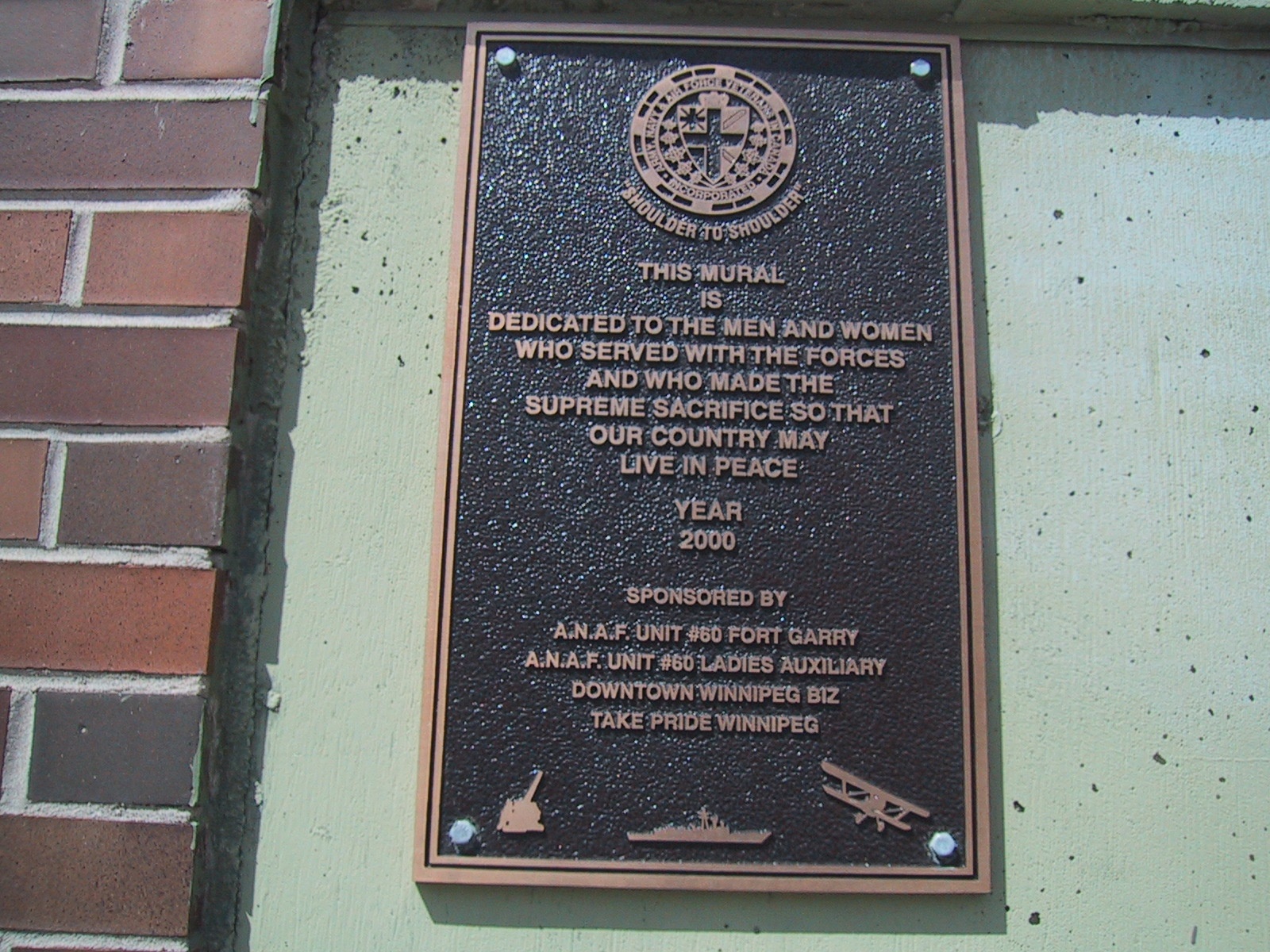
The Shoulder to Shoulder mural was created by artist Charlie Johnston in 2000 and dedicated to all those who served their country in war and paid the supreme sacrifice. His mural begins with the poem For the Fallen by Lawrence Binyon. It symbolizes someone reading and reflecting on the Veterans.
The first figure in the mural is of Edith Anderson Monture holding a faceless fallen soldier, in the background is Flanders Fields. Edith was born and raised in Six Nations of the Grand River and was the first Indigenous woman to become a registered nurse in Canada. Most Canadian nursing programs excluded Indigenous women so Edith attended New Rochelle School of Nursing in New York and completed her degree in 1914. Edith was the first Indigenous woman from Canada to serve in the United States military. She worked as a public health nurse in New York until the United States entered the First World War in 1917. She then volunteered as a nursing sister with the American Expeditionary Force and spent more than a year at Base Hospital 23 in Vittel, France, treating injured soldiers.
Next to Edith is an image of Sergeant Tommy Prince, a highly decorated Indigenous Veteran who served in both the Second World War and Korean War. Behind Tommy the is an image of an Army tank. Sergeant Tommy Prince was a prominent Anishinaabe activist and Veteran whose brave and tragic life has long held popular resonance. His story is one of the most widely known examples of the wartime contributions of Indigenous soldiers in the mid-20th century, and the poor treatment they received upon their return to civilian life in Canada. His accomplishments attracted national media attention during his lifetime and earned him a great many posthumous tributes. Tommy and Edith both represent the army.
The next image is of Air Force pilot Russ Bannock who received the Distinguished Flying Cross in the Second World War and was the Royal Canadian Air Force’s second highest-scoring ace. When the war broke out he joined the Royal Canadian Air Force and was posted in 1940 as a flying instructor to the Central Flying School in Trenton, Ontario. By September 1942, he was chief instructor at No. 3 Flying School in Arnprior, Ontario. In total, he delivered more than 2,000 hours of instruction to student pilots enrolled in the British Commonwealth Air Training Plan.
In 1944, he went overseas and joined the No. 418 Squadron in June, flying de Havilland Mosquitos on intruder missions over Europe. His success prompted his appointment as a flight commander and he was soon promoted to the rank of wing commander and given command of 418 Squadron in October 1944. Shortly thereafter, he was posted to 406 Squadron as commanding officer and was awarded the Distinguished Service Order for outstanding leadership in that command. During this period, Russ teamed up with navigator Flying Officer Robert Bruce. Together, they waged war on Germany’s V-1 jet-powered “flying bombs” or “buzz bombs,” at one point destroying four in just one hour. By April 1945, Russ had accounted for the destruction of 11 enemy aircraft and 19 V-1 ‘flying bombs,’ had earned himself the title ‘The Saviour of London,’ and the distinction of becoming the Royal Canadian Air Force's leading night fighter of the Second World War.
Next to Russ is a Second World War female pilot followed by Robert Hampton Gray, a naval pilot who received the Victoria Cross when he gave his life saving the aircraft carrier HMS Formidable from being sunk by a Japanese destroyer. Behind the the two Air Force pilots is an image of a Spitfire and the HMS Formidable is behind Robert Hampton Gray.
The last image is of a Canadian WREN (Women's Royal Canadian Naval Service) carrying a flag with the colours of the Army, Navy & Air Force Veterans in Canada, Fort Garry Unit #60.