
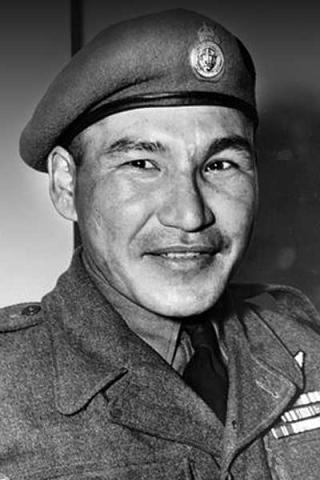
Young Tommy Prince
Thomas George "Tommy" Prince was one of 11 children born to Henry and Arabella Prince of the Brokenhead Band at Scanterbury, Manitoba. He was a descendant of Peguis, the Saulteaux Chief who led his band of 200 Ojibwa from the Sault Ste. Marie region to the Red River in the 1790s, and of Chief William Prince, who headed the Ojibwa-Manitoba team of Nile Voyageurs.

Tommy Prince (right) with a brother at Buckingham Palace, where he was awarded two gallantry medals. (C.J. Woods / Department of National Defence / Library and Archives Canada / PA-142289)
Enlisting in the army
Prince enlisted in June 1940, at the age of 24, and began his wartime service as a sapper with the Royal Canadian Engineers. After two years with the RCE, he answered a call for paratrooper volunteers, and by late 1942, was training with the 1st Canadian Special Service Battalion.
As soon as I put on my uniform, I felt a better man.
Soon after Prince joined this select battalion, it merged with an elite American unit, forming a spearhead of 1,600 men who possessed an assortment of specialist skills. Officially called the 1st Special Service Force, it would become known to German soldiers as the Devil's Brigade. Originally, this force was intended to be a parachute unit that would land behind enemy lines and sabotage their installations. Instead, it became a versatile assault group with a reputation for specialized reconnaissance and raiding. Prince was well-suited to be a member.
Reconnaissance missions
On 8 February 1944, near Littoria, Italy, Reconnaissance Sergeant Prince was spying on the Germans. An abandoned farmhouse some 200 metres from the enemy served as his observation post, and 1,400 metres of telephone wire connected him to the force. He had a clear view of the enemy's artillery emplacements and promptly reported them.
A clever escape
During what would become a 24-hour solo watch, Prince's communication line was severed by shelling. Unfazed, the sergeant donned civilian clothing, grabbed a hoe and, in full view of German soldiers, acted like a farmer weeding his crops. He slowly inched his way along the line until he found where it was damaged, then, pretending to tie his shoelaces, quickly rejoined the wires. His reporting continued and so did the damage to enemy artillery posts. In all, four German positions were destroyed, and Prince had earned the Military Medal. As his citation explains, "Sergeant Prince's courage and utter disregard for personal safety were an inspiration to his fellows and a marked credit to his unit."

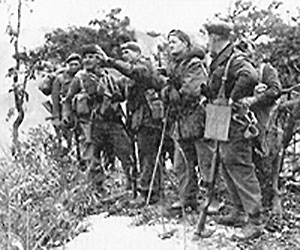
In Italy, a patrol of the Devil's Brigade undergoes a last-minute briefing before setting out. (Lt. Nye / Department of National Defence / Library and Archives Canada / PA-128986)
Critical intelligence
Six months later, the Devil's Brigade entered southern France. On September 1st, Sergeant Prince and a private, scouting deep behind German lines near L'Escarène, located the gun sites and encampment area of an enemy reserve battalion. Prince walked 70 kilometres across the rugged, mountainous terrain to report the information and led the brigade to the encampment. He then joined in the battle.
Medals and honours
Afterward, Prince was recommended for the Silver Star, an American army decoration for gallantry in action. His citation was glowing:
So accurate was the report rendered by the patrol that Sergeant Prince's regiment moved forward on 5 September 1944, occupied new heights and successfully wiped out the enemy bivouac [encampment] area. The keen sense of responsibility and devotion to duty displayed by Sergeant Prince is in keeping with the highest traditions of the military service and reflects great credit upon himself and the Armed Forces of the Allied Nations.
When the fighting in southern France was over, Prince was summoned to Buckingham Palace, where King George VI decorated him with both the Military Medal and, on behalf of the president of the United States, the Silver Star with ribbon. Tommy Prince was one of 59 Canadians who were awarded the Silver Star during the Second World War. Only three of this group also possessed the Military Medal.
In December 1944, the Devil's Brigade was disbanded, and its members were scattered among other battalions. The war in Europe ended while Prince was back in England.
Back in Canada
Prince had a strong sense of civic duty and a fierce pride in his people. He dedicated himself to attaining increased educational and economic opportunities for Indigenous peoples.
"All my life I had wanted to do something to help my people recover their good name. I wanted to show they were as good as any white man.""
After the war, he agreed to serve as spokesperson and vice-president of the Manitoba Indian Association and appeared on its behalf before a Special Joint Committee of the Senate and House of Commons, tasked with studying the Indian Act. During his testimony in 1947, he advocated for the abolition of the Indian Act and respect for existing treaties, and presented submissions from First Nations in Manitoba, which called for improved schools, better living conditions, and expanded hunting, trapping, and fishing rights.
Prince returns to action
Prince (second from left) with the Second Battalion, Princess Patricia’s Canadian Light Infantry in Korea in 1951. Library and Archives Canada/PA-114890.
Three of the 11 medals Tommy Prince earned during his military career—the Korea Medal, the United Nations Service Medal and the Canadian Volunteer Service Medal for Korea—were for service during the United Nations' operations in Korea. In August 1950, one week after the government announced its decision to form the Special Force, 34-year-old Tom Prince volunteered. He joined the 2nd Battalion, Princess Patricia's Canadian Light Infantry (PPCLI), the first Canadian Army unit to arrive in the region.
Prince was in action quickly. In February 1951, the Patricias joined the 27th Commonwealth Brigade on the battlefield. Soon after arriving in the war zone, the sergeant, who was second in command of a rifle platoon, led an evening "snatch patrol" of eight men into an enemy camp. The raid was a success; the group returned before dawn with two captured machine-guns. More raids followed. However, according to the authors of a biography of Prince, he was eventually assigned fewer patrols, because his commanding officer thought Prince took too many chances that might risk the lives of the soldiers under his command.
Kapyong
Prince was with 2 PPCLI when, together with the 3rd Royal Australian Regiment, it was awarded the United States Presidential Unit Citation for distinguished service in the Kapyong valley April 24 and 25, 1951, during one of the toughest actions of the war. The Patricias were to hold a defensive position at Hill 677 so that a South Korean division could withdraw during an attack by Chinese and North Korean forces. Although at one point the battalion was surrounded and resupply of ammunition and emergency rations could only be accomplished by air, the Patricias held their ground. The enemy withdrew. Ten PPCLI men were killed and 23 were wounded during the two-day battle. The award was a first for a Canadian unit.
The war took its toll
Prince's time at the front was intense but brief. His knees were subject to painful swelling and premature arthritis. It was a struggle for him to endure the constant, steep climbing demanded by the Korean landscape. After a medical examination in May 1951, he was hospitalized and then assigned administrative duties. In August he returned to Canada.
Prince remained on active service as an administrative sergeant at Camp Borden in Ontario. Here his knees responded to the added rest and in March 1952, he volunteered for a second tour of duty. He sailed for Korea that October with the 3rd Battalion PPCLI.
The Hook
In November 1952, the training of the 3rd PPCLI in Korea was interrupted by fighting on "the Hook," a key position west of the Sami-chon River that overlooked much of the rear areas of the U.N. forces. When a Chinese battalion gained a foothold on the forward positions of another UN unit on November 18, the 3rd PPCLI was ordered to help defend the sector. By dawn of the 19th, the UN unit, with assistance from the Patricias, had recaptured the post. Five Patricias were killed on the Hook and nine were wounded, one of whom was Sergeant Prince.
Prince recovered from the injury but began to have continual difficulties with his arthritic knees. Between January and April, he spent several weeks in hospital. In July 1953, the Korea Armistice was signed, and the following November, Prince returned to Canada. He remained in the army, stationed at a personnel depot in Winnipeg, until September 1954.
Saying goodbye to a hero
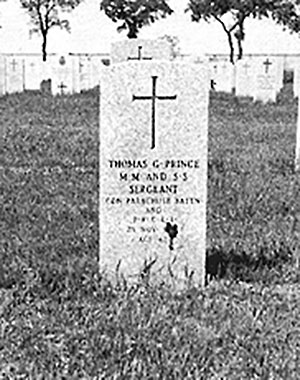
Tommy Prince’s headstone in the Field of Honour section of Brookside Cemetery. Photo: Veterans Affairs Canada
Tommy Prince died at Winnipeg's Deer Lodge Hospital in November 1977, at the age of 62. At his funeral, a delegation of the Princess Patricias served as pallbearers and draped a Canadian flag over his coffin for the memorial service. It was an impressive tribute:
As the trumpeter finished, five young men from the Brokenhead Indian Reserve began to chant the melancholy "Death of a Warrior" song, as drummers beat a sad lament...the crowd of over 500 included people from all walks of life: active soldiers, Veterans, Manitoba's Lieutenant Governor Jobin, consuls representing France, Italy and the United States, farmers, fishermen, trappers, businessmen and many others.
Tommy Prince is buried in the Field of Honour section of Brookside Cemetery in Winnipeg, Manitoba. It is one of the largest and oldest military interment sites in Canada. More than 10,000 veterans, service members and war heroes have been laid to rest there.
With courage, integrity and loyalty, Tommy Prince left his mark. He is one of our Canadian Veterans. Discover more stories.
Places of interest
Sergeant Tommy Prince Memorial
Sergeant Tommy Prince Veteran's Park
Related information
In 2019, Tommy Prince was designated as a national historic person.