
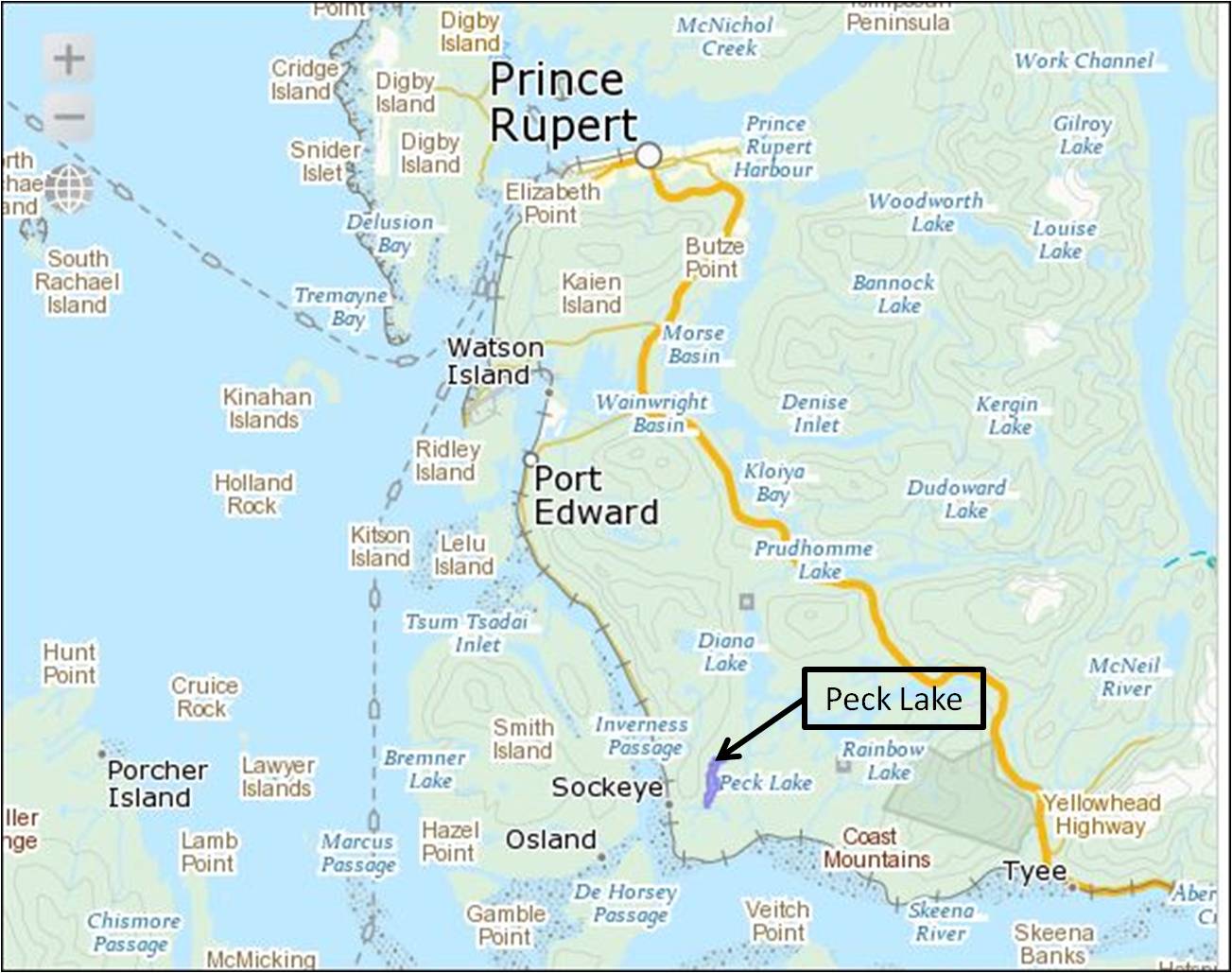
Peck Lake is named in honour of Lieutenant-Colonel Cyrus Wesley Peck, VC, DSO and bar.
Cyrus Wesley Peck was born in April 1871 in Hopewell Hill, NB. In 1887, he moved to New Westminster, BC with his family. At a young age, he attempted to join the British Army and volunteered for the Boer War however his eagerness for the military went unfulfilled. He eventually found himself in Northern Canada and later in Prince Rupert when WW I broke out. He enlisted as a captain in November 1914 and went overseas with the 30th Battalion, CEF. In April 1915, he was promoted to major and transferred shortly afterwards to the 16th Battalion, Canadian Scottish Regiment. In January 1916, he was appointed Commanding Officer of the 16th Battalion. During his service overseas, LCol Peck was awarded the DSO and bar, was Mentioned in Dispatches five times and wounded twice. But he is best remembered for his actions of 2 September 1918 at Cagnicourt, France (Drocourt- Queant Line) where his leadership and courage under fire, led to the success of the brigade attack and the awarding of the Victoria Cross (see citation below). Having been elected Member of Parliament for Skeena in 1917, as a soldier candidate, Peck embarked on his federal political career upon the cessation of WW I. He was later elected to the BC legislature in 1924 and 1928. Following his political career, he was appointed to the Canadian Pension Commission. Cyrus Wesley Peck died in September 1956 and his ashes were scattered off the coast of Prince Rupert.
“For most conspicuous bravery and skilful leading when in attack under intense fire.
His command quickly captured the first objective, but progress to the further objective was held up by enemy machine-gun fire on his right flank.
The situation being critical in the extreme, Colonel Peck pushed forward and made a personal reconnaissance under heavy machine-gun and sniping fire, across a stretch of ground which was heavily swept by fire.
Having reconnoitred the position he returned, reorganised his battalion, and, acting upon the knowledge personally gained, pushed them forward and arranged to protect his flanks. He then went out under the most intense artillery and machine-gun fire, intercepted the Tanks, gave them the necessary directions, pointing out where they were to make for, and thus pave the way for a Canadian Infantry battalion to push forward. To this battalion he subsequently gave requisite support.
His magnificent display of courage and fine qualities of leadership enabled the advance to be continued, although always under heavy artillery and machine-gun fire, and contributed largely to the success of the brigade attack.”
(London Gazette, no.31012, 15 November 1918)