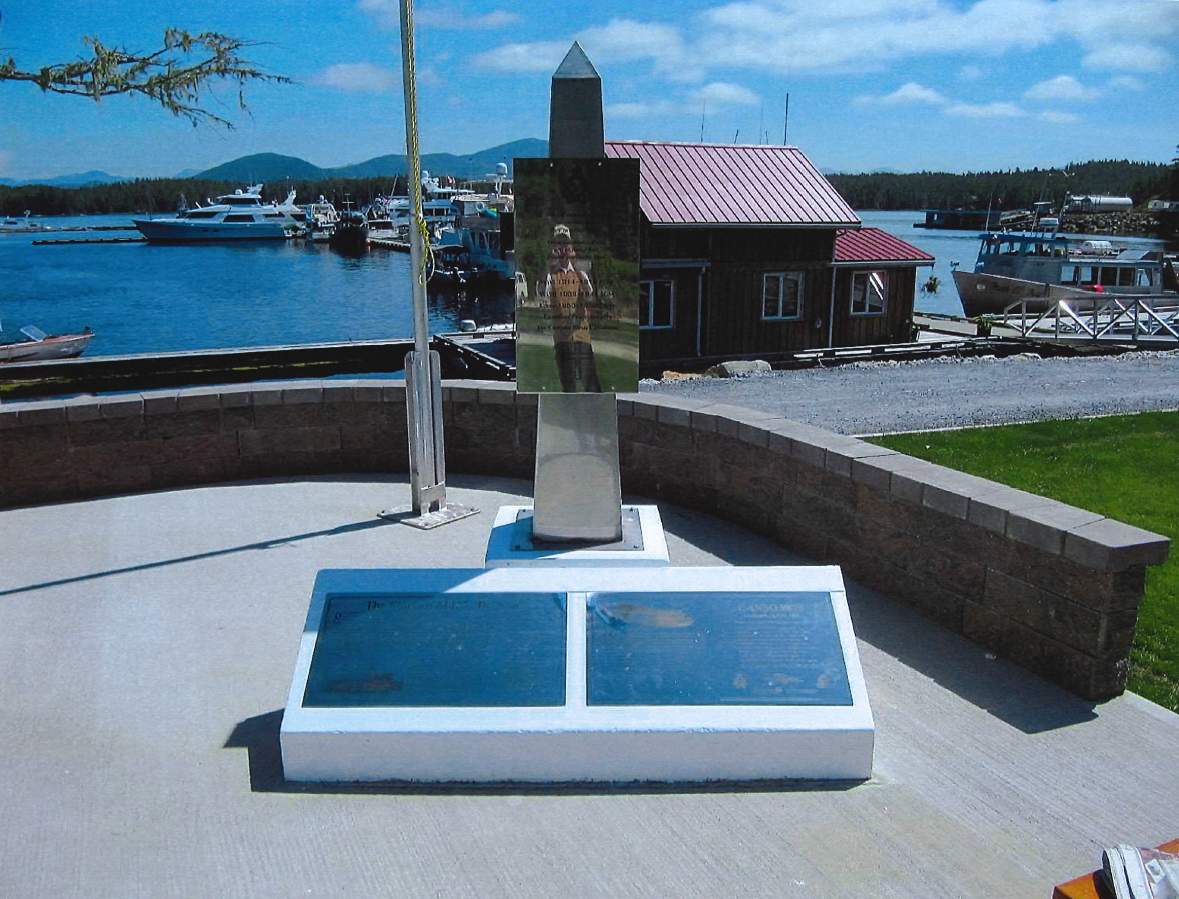
[plaque]
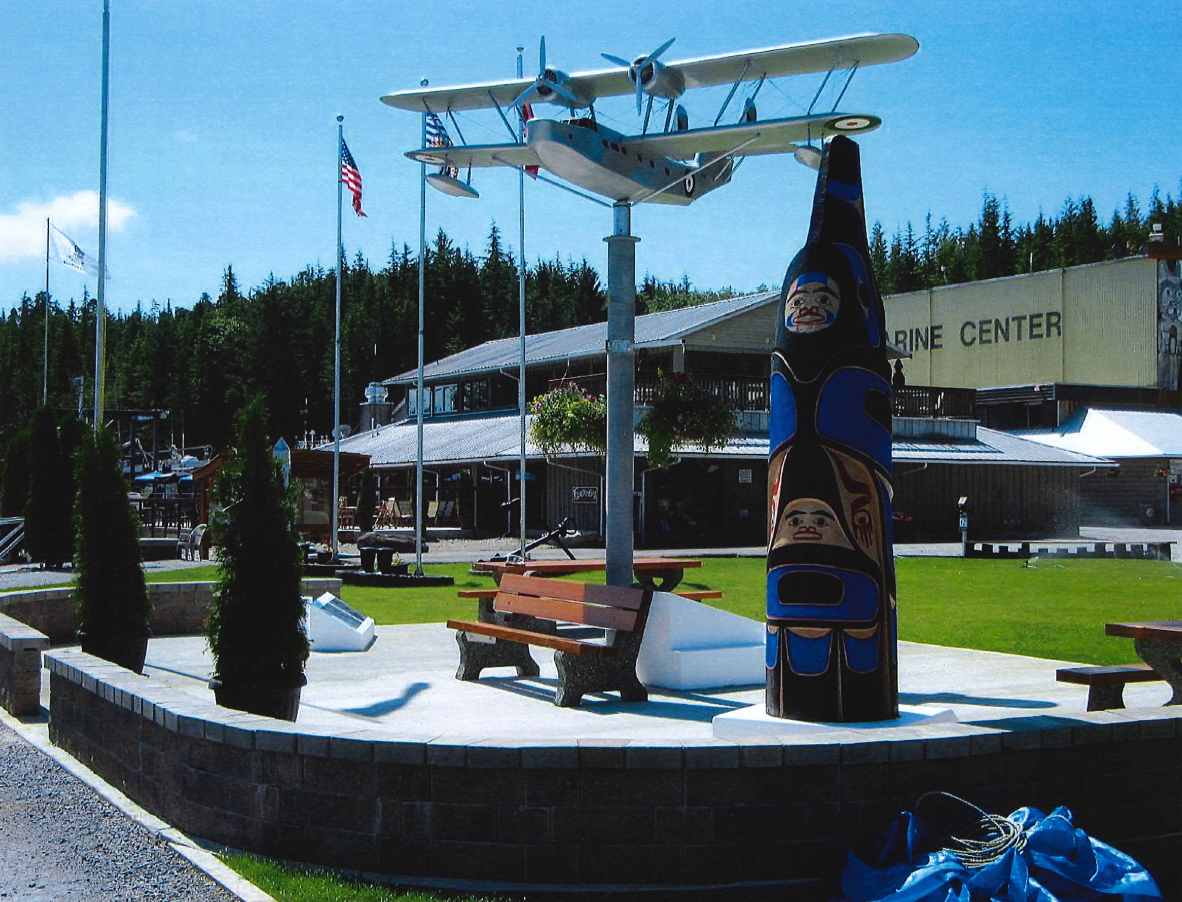
Warriors' Pole
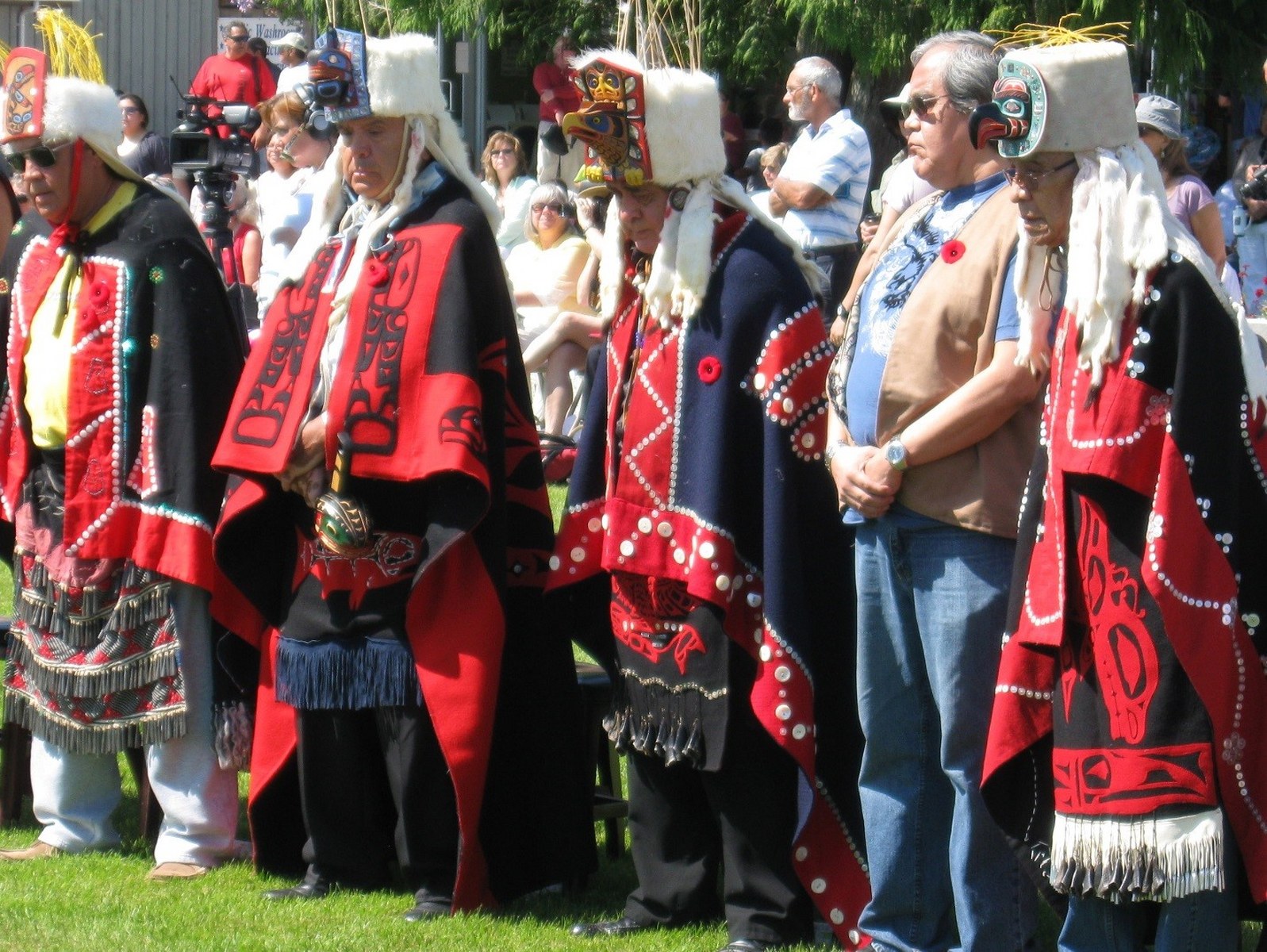
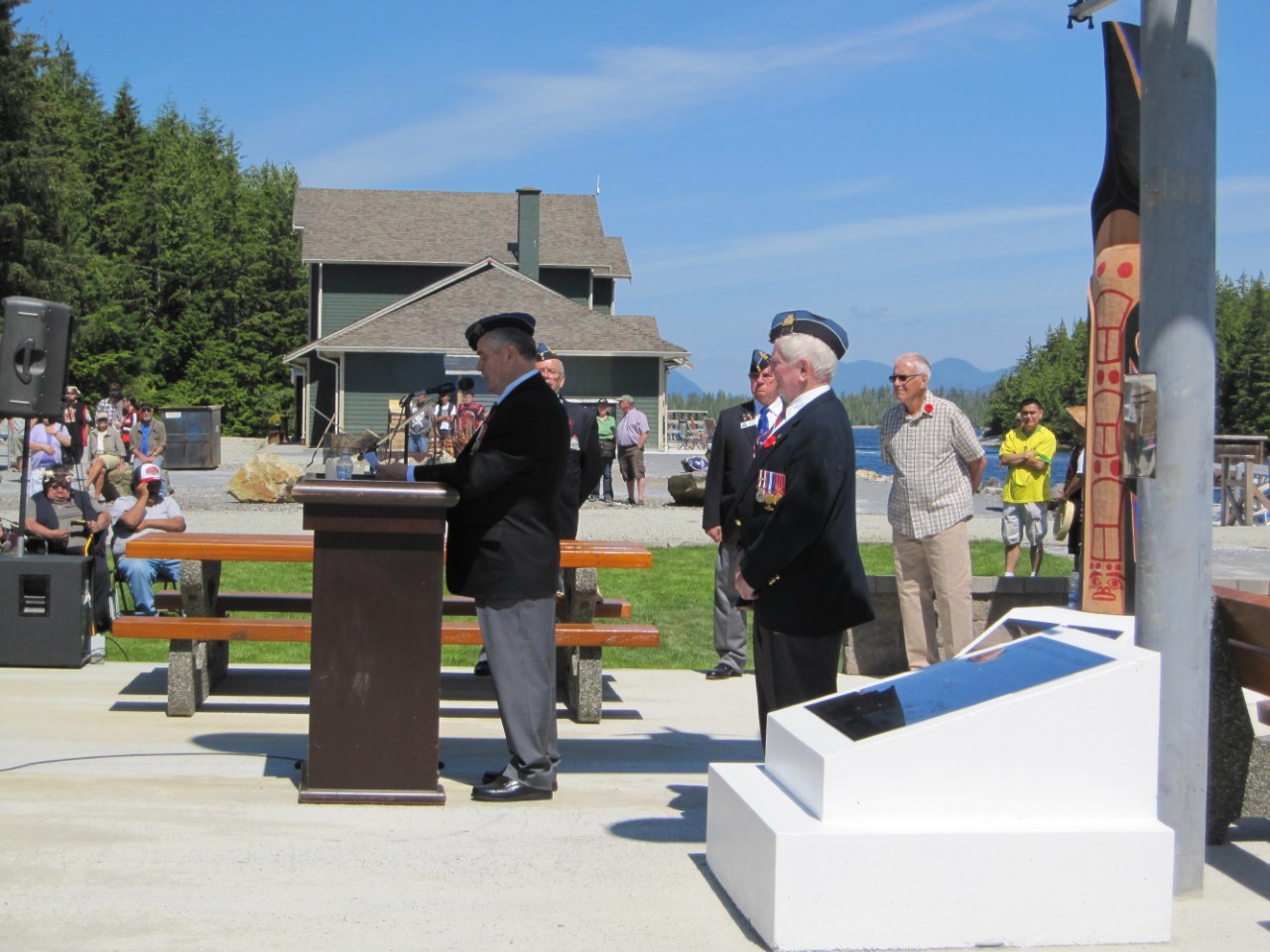
This pole is dedicated to the memory of the Pacific Coast Militia Rangers and the First Nation War Veterans who served in the First, Second and Korean Wars, and on Peacekeeping operations. It was carved by Yagvudlas, Ian ‘Nusi Reid in June 2013 and installed by the descendants of those who went to war who reside in the Central Coast to this day. It stands here to remind the generations to come of the sacrifices of our people who fell protecting our country and our freedom. Their courage and honour will not be forgotten.
Raven, the hero in our origin stories, is known to be mischievous and is always getting into trouble - but he is also very intelligent, just as we know him to be today. He met the Chief of Heaven and stole the sun, the moon, and the stars to give us their light. He is the great teacher and the crest of our head chief and represents the Heiltsuk and all those from here who fought in Canada’s conflicts. The human faces inside the wings of the raven represent the warriors who put their lives in danger fighting for our country.
[plaque]
We will remember them,
for our tomorrow
they gave their today.
On se souviendra d’eux,
ils ont donné leur
présent pour notre futur.
WWI 1914-1918 PGM
WWII 1939-1945 SGM
Korea 1950-1953 Corée
Canadian PeaceKeepers
Les Casques Bleus Canadiens
[plaque]
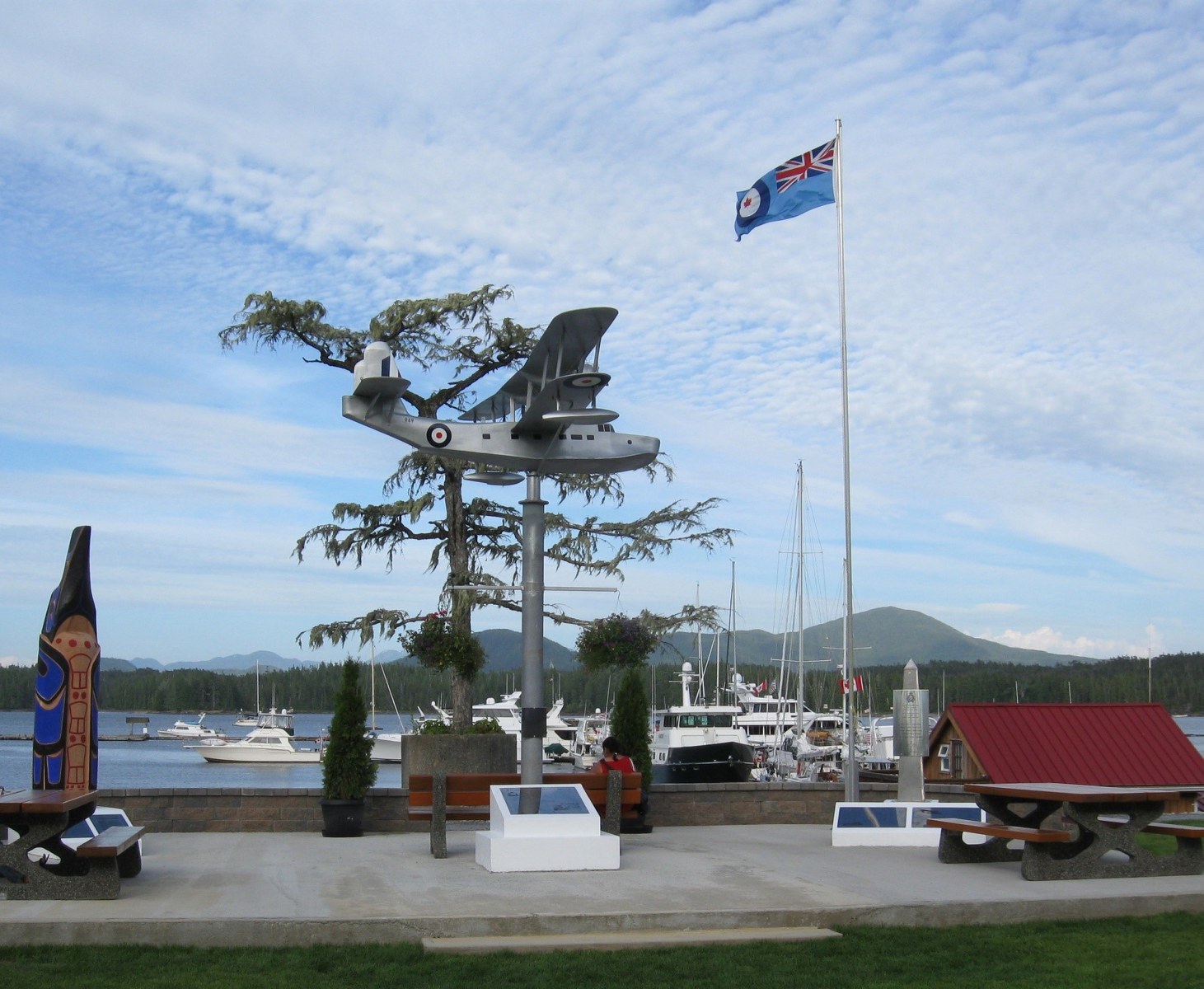
RCAF STATION BELLA BELLA
Bella Bella has a long history of aviation and was an early air force presence on the Central B.C. Coast. In July of 1923 Squadron Leader Earl Godfrey arrived and landed to refuel a Canadian Air Force Curtiss HSR2L flying boat. He was on his way from Jericho Beach at Vancouver to Prince Rupert, the first successful Canadian flight along the west coast. Previously in 1920 Lieutenant Harry Brown had attempted the first flight up the coast in his Curtis JN-4 seaplane, landing short of Bella Bella at Nalau Island with an engine failure. in July 1922 US Air Service pilot Lieutenant Roy Jones made the first successful flight up the coast from Seattle to Alaska, with a refuelling stop at Bella Bella.
There were no airports on the BC coast until almost the end of World War Two, hence the need for the five Flying Boat Stations to protect the western entrance to North America. The Royal Canadian Air Force determined quite early that the community of Bella Bella was strategic to its needs, and with war clouds on the horizon it established a detachment here in 1938. It was soon decided that the best location of the station would be on Denny Island adjacent to Klik-Tso Atli Harbour with the station to be constructed behind Shearwaterlsland.
In June 1940 construction began on a full sized RCAF Station including two full size flying boat hangars with ramps for beaching aircraft, as well as accommodations for up to 1,000 men, a hospital, and administration and messing facilities. By November 1941 twenty-one buildings were ready for use. The Coast Construction Company of Vancouver accomplished the actual construction with considerable help from native Hetltsuk workers, including the future chief, Vivian Wilson.
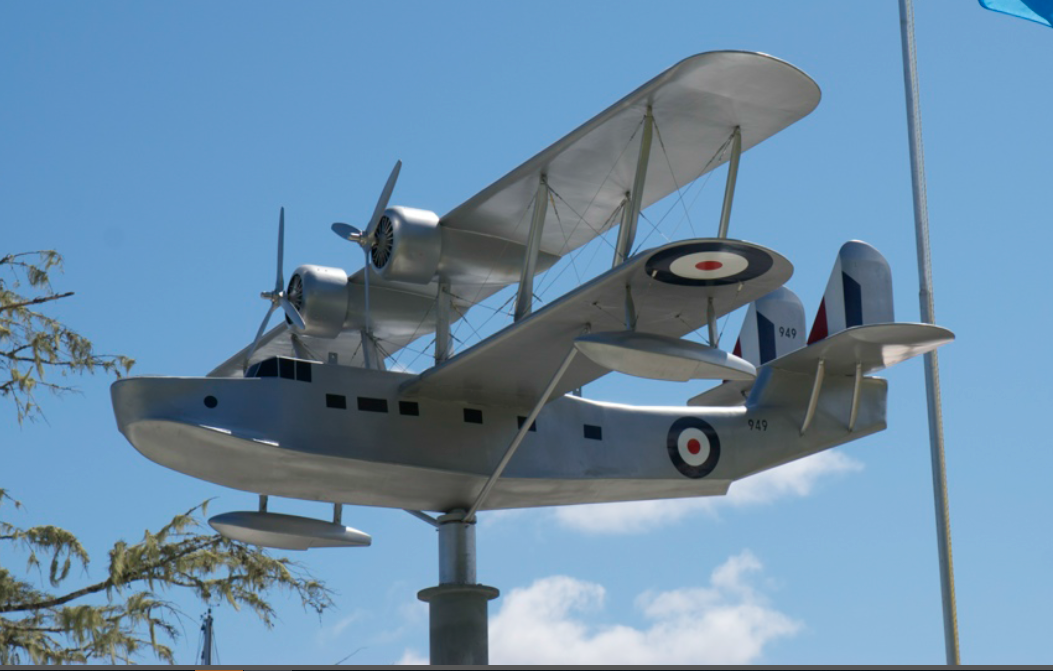
On December 7, 1941 the station received notification that a state of war existed with Japan after that country had attacked Pearl Harbor in the Hawaiian Islands. On December 8, 1941 Squadron Leader Fred. S. Carpenter arrived at the station with two Supermarine Stranraerflying boats from Patricia Bay at Victoria, #949 and #936. Carpenter immediately assumed command of No9 (BR) Bomber Reconnaissance Squadron. Operational patrols commenced immediately with the two Stranraer flying boats responding to the sighting of a Japanese submarine in Queen Charlotte Strait north of Vancouver Island. On their return they were both refuelled to capacity from a tender carrying 45- gallon drums. Aircraft patrols continued from the station day and night in most weather conditions searching for the nine enemy submarines that were sinking boats travelling the coast.
By February 1942 455 personnel crowded into the unfinished barrack buildings. The off-duty airmen used their time efficiently, building the Santa Bella Trail from the RCAF station to the B.C Packers store and post office on the opposite side of Denny Island. In December 1942 the station received its first Consolidated PBY-5A Canso aircraft, which allowed 9BR Squadron to extend its patrols out over the Pacific for up to 28 hours.
In April 1943 the station Commanding Officer S/L Galloway ordered a control tower be built on Shearwater Island but the tower operators found that the island's trees obscured their view. Galloway responding by ordering his Armaments Officer to top the trees with machine gun fire. That worked fine but an army detachment across the bay had to take cover as their position was being peppered by the gunfire!
By the end of July 1944 the station's strength including army personnel was 750. The Japanese had suffered major defeats by then and the threat of an invasion on the west coast of North America had diminished. For economic reasons as well as the difficulty of supplying these remote stations a decision was made to disband No 9 (BR) Squadron. RCAF Station Bella Bella was closed effective September 1, 1944. The last entry in the Station's diary sums up the unsung heroism on the Bella Bella Station:
"The reports of the presence of enemy craft in our waters are investigated thoroughly and, no matter how inaccurate the report may seem to be, the squadron personnel embark on the searches with enthusiasm and keenness. The fact that the West Coast stations saw little action is in part due to their unceasing vigilance. They made the waters of the Pacific adjacent to the coast a most unhealthy and unproductive locality for the enemy. Theirs was not a glamorous job. They received no applause from the people and none from the Service. They had a dirty, dangerous, monotonous job to do and they did it. That was their reward"
[plaque]
During the buildup of the war effort on the West Coast many new remote early warning radar units were built and maintained. The RCAF requisitioned tugs and fishing craft that were then attached to the Marine Section to service these otherwise inaccessible stations. These vessels were the "work horses" that plied back and forth on their unscheduled runs moving construction crews, material, and heavy equipment up and down the coast of British Columbia. To help keep these radar units existence and location secret radio silence was enforced on these runs and all information regarding the movement of this type of marine vessel was classified adn all communications were coded.
On 23 July, 1943, M 427 BC Star was scheduled for one ofthese runs. She departed Bella Bella with her 10 man crew five No. 9 CMU personnel assigned to the construction project and a cargo of 43 tons of gravel and cement. They were bound for the new radar site at Cape St. James in the Queen Charlotte Islands. No. 28 (RU) Cape St James had no way of knowing that the supply boat was on its way as they had not yet received the necessary cypher equipment to decode the movement message. Radio silence was enforced on the ship and no one missed her until 3 August when construction crews queried when their supplies were to arrive.
On 4 August a Stranraer from 9 BR Squadron Bella Bella started the search. On 5 August Norseman #2470 was sent from Bella Bella to search the area and on 8 August a search was carried out by the M 536 SKEENA MAID. An intense sea and air search covered a wide area for several weeks with two bodies and some wreckage to being found. On 3 September an unidentified air man's body was found on Price Island. A tombstone was erected at the Meadow Island Cemetery, Bella Bella, BC to remember the unknown airman.
Rumours circulated about the vessel being attacked by a Japanese submarine, and this information was enhanced by crewmembers aboard another RCAF marine vessel inbound to Alliford Bay. They reported that they were listening to a Ketchikan Alaska radio station when its program was interrupted by a strange and unidentified transmission "Star out of bread and water. Alliford repeat message. Thank you. Good Afternoon" However, no conclusive evidence ever came to light that explained why the Star went down. Possibly the hull had simply opened up under the weight of her cargo and M-427 sank so quickly that no life boats were launched and no distress signals were sent. This mission resulted in the largest loss of life in the history of the RCAF Marine Branch. After the loss, marine craft procedures were revised to ensure prompt reporting of arrivals and departures.
The men are commemorated on panel two of the Commonwealth Air Froces Ottawa Memorial dedicated to air force personnel lost without trace in Canada,the U.S. and neighbouring lands and seas during the Second World War.
The crew/passenger list for the BC Star on the 23 July 1943 listed the following personnel;
+ R128864 Cpl Charles Gordon Glover
+ R186865 LAC Harold Fredrick Dakenfold
+ R173910 LAC George Thornton Stead
+ R213870 ACl Titus Vollhoffer
+ R220368 AC2 Maurice Daniel Onuski
+ R58625 Sgt Philip Eric Olsen
+ R87823 LAC Clarence James Sherlock
+ P4319 FSgt Roy Henry Drouillard
+ R146033 Sgt Jack Douglas Hearfield
+ R220720 AC2 Gilbert Campbell McFadyen
+ R151826 FSgt William Ernest Mitchell
+ R128695 Sgt Jonathan Charles Slater
+ R255739 AC2 Arthur Garnet Davies
+ R124630 Sgt William Murray MacNeill
+ R56918 Cpl Tadeusz Ledwig Polee
[plaque]
On the 30 July 1943 a sub had been sighted earlier and Canso 9879 was sent on an urgent patrol. The weather was 800’ and three miles with light drizzle , the sea was calm. The aircraft became airborne at 0552 after an abnormally long run and circled while climbing to 700’. Seaforth Channel to the west was closed so they headed south via Lama Passage. The ceiling lowered and they descended to stay under cloud, but fog closed in and the pilot attempted to return to base on a reciprocal course. Altitude could not be maintained in the 35 degree turn. The aircraft was leveled off after turning through 120 degrees and put into a steep climbing position. The speed had dropped to 70 kts when the pilot saw a wooded ridge and was down to 50kts on impact, 100’ short of 800’ ridge. They had been airborne five minutes. On impact the a/c caught fire. The crew escaped from the aircraft but could not find Sgt Cowman. They headed down the hill to Alarm Cove where they saw a Fire Ranger in a rowboat which three of them took and set off for Bella Bella. A fishing boat picked them up and dropped them off at Bella Bella store to the station. The search crew found Sgt Cowman’s body. He had been killed in a crash.
CANSO 9879
Crashed ~ 30 July, 1943
Flight Crew of 9879 9 BR Squardon Bella Bella
Pilot - PO JA Joseph J23027 - slight injury
2nd Pilot - Fsgt KL Brown R122924- slight injury
1st Nav WO1 - LR Travis R91892 - slight injury
2nd Nav PO - JL Jones 27441 - serious burns
1st WAG FO - RB Shirra J13152 - serious burns
2nd WAG - Sgt HAS Rawlinson R140236 - uninjured
WM SGT - EA Kershsaw R72192 - slight injury
1st FE Sgt - JA Cowman R75569 - killed
2nd FE LAC - WJ Johnston R118425 - serious burns
REQIESCAT EN PACE FRATRES
Veterans Affairs Canada
The Denny Island Community Development Association