
Service militaire
Lieu de l’enterrement/commemoration
Fils de Lewis Henry Thibideau et d’Amelia Kay d’Ontario. Époux de Rose Lilian Thibideau de Toronto, Ontario.
Frère du soldat Henry Clinton Kaye Thibideau, matricule 3145, de l’Armée américaine, et du soldat Albert Earle Thibideau, matricule 704132, du 102e Bataillon (Comox-Atlin) du Corps expéditionnaire canadien, qui a combattu en France et a été blessé trois fois au combat. Ils ont survécu au combat de la Première Guerre mondiale.
Le 5 novembre 1940, le Beaverford, membre du convoi HX-84, est ciblé par le cuirassé allemand Admiral Scheer et est coulé au canon à 755 milles nautiques (869 milles/1 398 km) au sud-sud-ouest de Reykjavik, Islande, position 52°26’N/32°34’O. Le capitaine et 76 membres de l’équipage 000ont perdu la vie.
Dans les livres du souvenir
Inscription commémorative sur la :
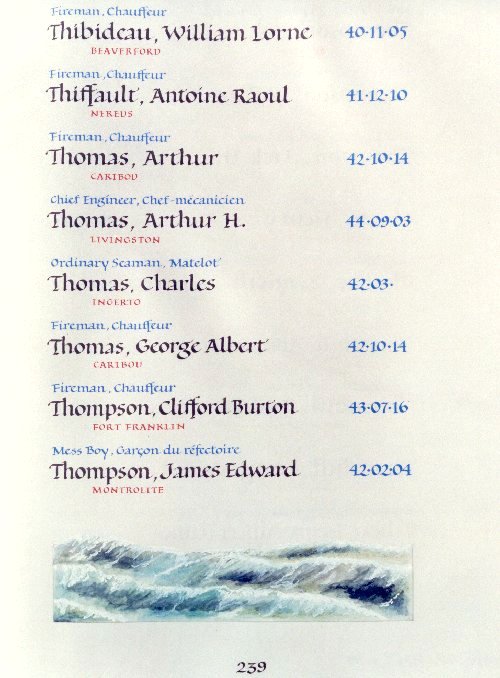
Page 239 du Livre du Souvenir de la Marine marchande.
Commander cette page
Télécharger cette page
MONUMENT COMMÉMORATIF DE HALIFAX Nova Scotia, Canada
Ce Monument commémoratif, érigé au parc de Point Pleasant dans la capitale de la Nouvelle-Écosse, est l'un des rares hommages concrets aux hommes disparus en mer. Pendant la Seconde Guerre mondiale, la Marine royale du Canada perdit vingt-quatre navires et près de deux mille membres de ses effectifs.
Le Monument fut érigé par la Commonwealth War Graves Commission et inauguré en novembre 1967 selon les traditions navales, par M. H.P. MacKeen, lieutenant-gouverneur de la Nouvelle-Écosse, en présence de M. R. Teillet, alors ministre des Affaires des anciens combattants.
Le Monument est formé d'une grande croix du Sacrifice en granit, de douze mètres de haut, que peuvent facilement voir tous les navires qui approchent du port de Halifax. La croix est montée sur une grande plate-forme de granit portant 23 panneaux de bronze sur lesquels sont gravés les noms de plus de trois mille hommes et femmes qui périrent en mer.
L'inscription, en français et en anglais, se lit ainsi :
1918-1945
À LA MEMOIRE
DES HOMMES ET DES FEMMES
DE LA MARINE DE GUERRE
DE L'ARMÉE ET DE LA
MARINE MARCHANDE
DU CANADA
DONT LES NOMS SONT
INSCRITS ICI
LEURS TOMBES SONT
INCONNUES MAIS LEUR
SOUVENIR VIVRA.
Le 19 juin 2003, le gouvernement du Canada a désigné le 3 septembre de chaque année comme étant une journée de reconnaissance de la contribution des anciens combattants de la marine marchande.
Pour plus d’informations, visitez la Commission des sépultures de guerre du Commonwealth (site disponible en anglais seulement).
L’image du coquelicot est une marque déposée de la Légion royale canadienne (Direction nationale) et est utilisée avec sa permission. Cliquez ici pour en savoir plus sur le coquelicot.
Avons-nous oublié quelque chose ?
Contribuer à cette page commémorative
Avez-vous des photos, des informations ou une correction concernant la page commémorative de cet individu? Apprenez-en plus sur le MVGC et les informations que nous collectons.