
Service militaire
Lieu de l’enterrement/commemoration
En décembre 1941, le Donerail quitte Suva, îles Fidji, pour Vancouver, Colombie-Britannique. Le 9 décembre, il passe prêt d’éperonner accidentellement le sous-marin japonais I-10 à 700 milles nautiques (810 milles/1 300 km) au sud-est de Hawaii, position 08°00’N/152°00’O. Après avoir plongé, le I-10 lance une torpille qui rate le Donerail. Il fait surface et tire vingt obus avec son canon de pont. Il détruit un canot de sauvetage contenant 2 femmes, 4 hommes et un bébé de 18 mois. Sur les 36 marins et 7 passagers, seuls 24 marins ont pu rejoindre un canot de sauvetage. Après 38 jours de dérive sur 2 500 milles (4 023 km), ils ont atteint l’île de Tarawa, dans les îles Gilbert, mais huit seulement étaient encore vivants et ont été fait prisonniers de guerre par les Japonais.
Dans les livres du souvenir
Inscription commémorative sur la :
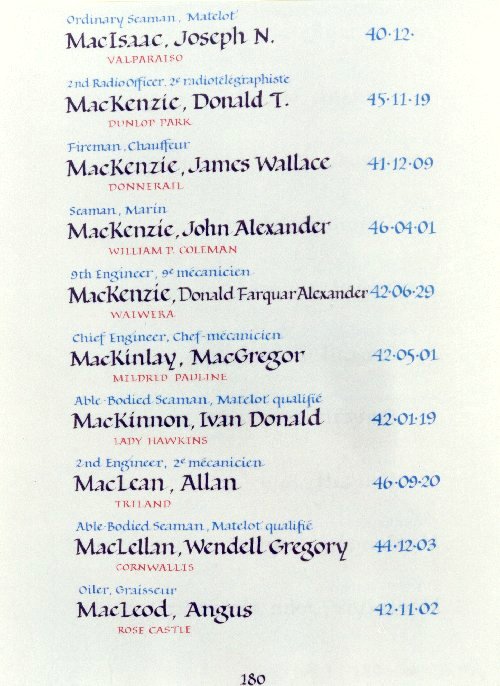
Page 180 du Livre du Souvenir de la Marine marchande.
Commander cette page
Télécharger cette page
L’image du coquelicot est une marque déposée de la Légion royale canadienne (Direction nationale) et est utilisée avec sa permission. Cliquez ici pour en savoir plus sur le coquelicot.
Avons-nous oublié quelque chose ?
Contribuer à cette page commémorative
Avez-vous des photos, des informations ou une correction concernant la page commémorative de cet individu? Apprenez-en plus sur le MVGC et les informations que nous collectons.