
Service militaire
Lieu de l’enterrement/commemoration
Le 21 novembre 1942, l’Empire Sailor navigue avec le convoi ON-145 transportant dans ses cales des gaz toxiques et du cyanure, tous dans des barils. À 4 h 16, l’U-518 décoche deux torpilles vers les navires, à 4 h 24, une autre et à 4 h 25, deux autres à 200 milles (322 km) au sud-est de Sydney, Nouvelle-Écosse. L’une d’elles touche l’Empire Sailor et fait exploser une partie de la cargaison. Les gaz se répandent et affectent des marins sans protection. Le HMCS Minas (J165) recueille des naufragés, dont le capitaine. Le HMCS Timmins (K-223) en prend également à son bord. Le médecin du HMS Wanderer (D74) monte à bord du HMCS Minas et constate son impuissance. En raison des gaz qui ont été respirés, 17 membres de l’équipage et 3 artilleurs meurent. L’attaque elle-même avait coûté la vie à trois marins. Le navire a coulé lors de son remorquage, position 43°53’N/55°02’O.
Dans les livres du souvenir
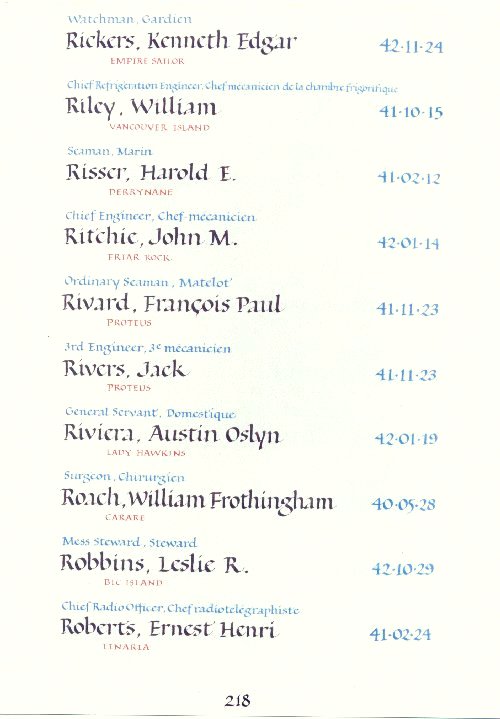
Inscription commémorative sur la :
Page 218 du Livre du Souvenir de la Marine marchande.
Commander cette page
Télécharger cette page
L’image du coquelicot est une marque déposée de la Légion royale canadienne (Direction nationale) et est utilisée avec sa permission. Cliquez ici pour en savoir plus sur le coquelicot.
Avons-nous oublié quelque chose ?
Contribuer à cette page commémorative
Avez-vous des photos, des informations ou une correction concernant la page commémorative de cet individu? Apprenez-en plus sur le MVGC et les informations que nous collectons.