Québec

Province Code
PQ
City/Municipality
Montreal
Memorial Number
24075-099
Type
Address
5400 ave Westbury
in Canada
Oui
GPS Coordinates
0, 0
Image
Crédit photo
kishkushim.blogspot.com
Légende
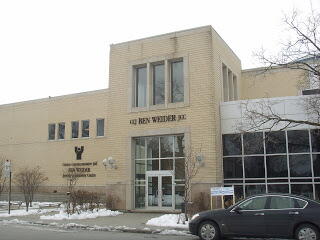
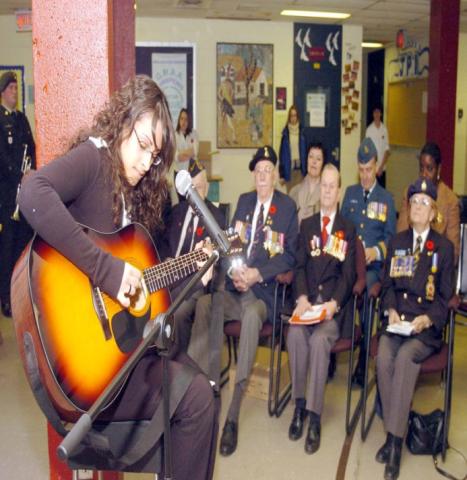
Ben Weider Jewish Community Centre
Province
Body Content

La réinauguration du vitrail commémoratif de guerre a eu lieu au centre communautaire juif Ben Weider le dimanche 5 juin 2005. L’évènement commémoratif spécial marquait le 60e anniversaire du jour de la Victoire en Europe. Les vitraux sont en l’honneur des Canadiens juifs qui ont servi pour le maintien et la défense des principes canadiens. Officiellement renommé le centre communautaire juif Ben Weider en 2000, en hommage au soutien financier du gourou du conditionnement physique, le YMCA-YWCA est un centre populaire pour le sport.


City
Montreal
Country
Type Description
Stained Glass Window
Memorial CF Legacy ID
10398
City/Municipality
Montreal
Memorial Number
24075-098
Address
3030 Villeray H2A1E7
in Canada
Oui
GPS Coordinates
0, 0
Inscription

THIS COLUMN MARKS THE BATTLEFIELD WHERE 18,000 CANADIANS ON THE BRITISH LEFT WITHSTOOD THE FIRST GERMAN GAS ATTACKS THE 22ND-24TH OF APRIL 1915. 2,000 FELL AND HERE LIE BURIED 

Image
Crédit photo
R Speranza
Légende
Monument
1 sur 5 images
Image
Crédit photo
R Speranza
1 sur 5 images
Image
Crédit photo
R Speranza
1 sur 5 images
Image
Crédit photo
R Speranza
1 sur 5 images
Image
Crédit photo
R Speranza
1 sur 5 images
Province
Body Content

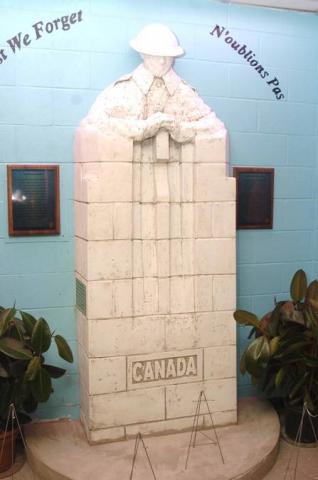
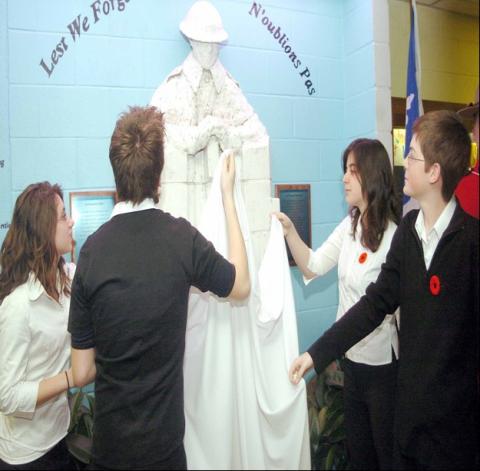
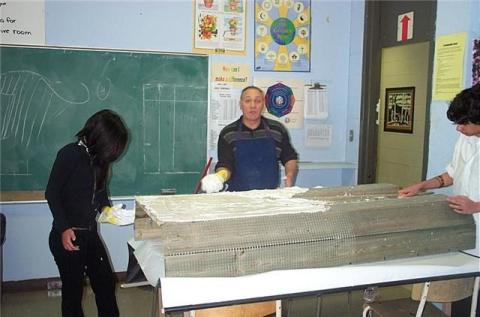
En 2007, une réplique intérieure du monument du Soldat en méditation a été construite pour marquer le 90e anniversaire de la bataille de la crête de Vimy.

Il a été planifié, financé et réalisé par M. Speranza.

Des élèves et des enseignants ont participé au processus.


. 

City
Montreal
Country
Type Description
Monument
Memorial CF Legacy ID
10396
City/Municipality
Montreal
Memorial Number
24075-097
Type
Address
475 Avenue des Pins
Location
Gymnase commémoratif Sir Arthur Currie, Université de McGill
in Canada
Oui
GPS Coordinates
45.5098316, -73.5790979
Inscription

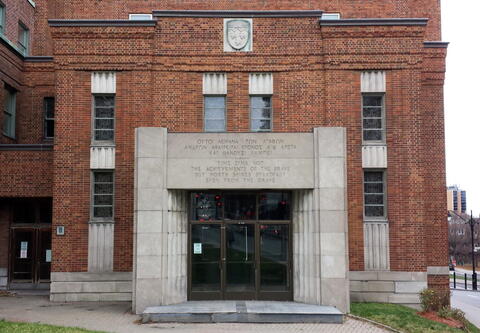
TIME DIMS NOT
THE ACHIEVEMENT OF THE
BRAVE BUT WORTH SHINES STEADFAST
EVEN FROM THE GRAVE

Image
Crédit photo
mcgillremembers.mcgill.ca
Légende
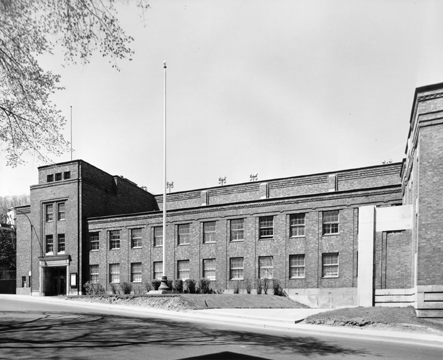
McGill Memorial Hall
1 sur 4 images
Image
Crédit photo
mcgillremembers.mcgill.ca
Légende
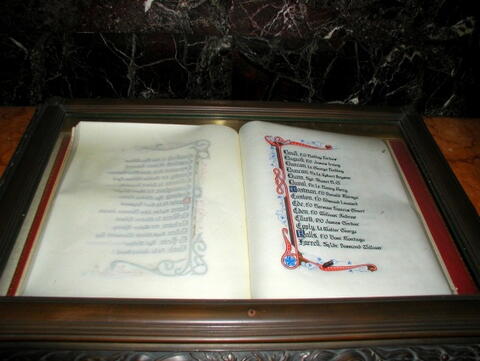
McGill illuminated Book of Remembrance World War I & II honour roll
1 sur 4 images
Image
Crédit photo
mcgillremembers.mcgill.ca
Légende
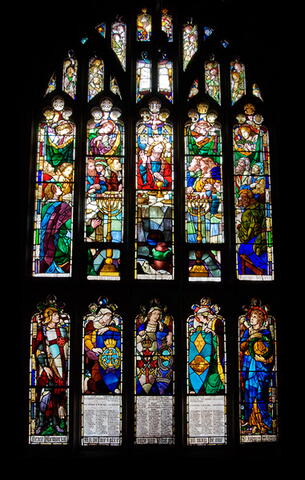
McGill Memorial Hall interior stained glass
1 sur 4 images
Image
Légende
McGill Memorial Hall entrance
1 sur 4 images
Province
!4v1695663364415!6m8!1m7!1s5v74rDcbHsKD09KRcwm3Ew!2m2!1d45.5098316116671!2d-73.57909794910746!3f319.58197997632845!4f4.293206961241523!5f1.752757222286157
Body Content

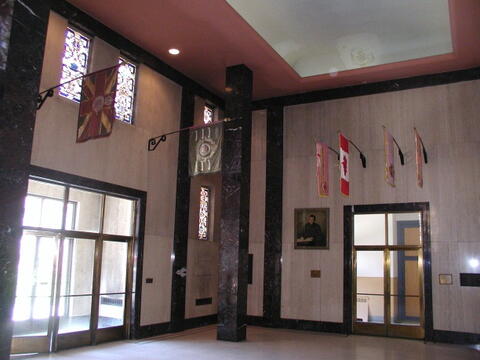
Memorial Hall was erected in recognition of the important contribution made by members of the McGill community in the service of their country. Dedicated on October 6, 1946, the Memorial Hall and adjoining Memorial Pool were the most substantial gestures of remembrance on the McGill University campus. The project was approved by the Board of Governors on October 23, 1944. Four years after the end of the Second World War, the Sir Arthur Currie Memorial Gymnasium-Armoury building was expanded to include Memorial Hall. With its marble and terrazzo finishes, bronze doors, stained glass windows, and commemorative artwork and plaques, the Hall became the central point of the McGill community’s collective memory of the World Wars.

By the time of the official opening of the new additions by the Governor General of Canada  on November 26, 1950 a number of memorial plaques and battalion flags were moved from other locations into the new Memorial Hall and a Roll of Honour containing the names of both Great War and World War II McGill fatalities in a single book. The illuminated Book of Remembrance records the names of the nearly 700 students, staff and faculty who lost their lives in World War I and World War II.  Each name is handwritten in calligraphy and the parchment pages are illuminated with vibrant reds, blues or greens, as well as silver and gold.  The Book is bound in red leather with the McGill University emblem emblazoned with silver and gold on the cover. The Book was first unveiled during the official opening of Memorial Hall, now part of the Currie Gymnasium Complex, on November 26, 1950. In February 2014, the Book of Remembrance was removed from its original casing in Memorial Hall to be restored and digitized.  As a result of this project, a replica of the Book was made and will be housed in a special display case in the pedway connecting the McLennan and Redpath Library Buildings. A digitized version will be launched on the McGill Remembers website, and the original will be made accessible for viewing in the Rare Books and Special Collections, and Archives Reading Room on the fourth floor of the McLennan Library Building.

In addition the painting of the Quebec City conference, the Unknown Soldier portrait and other elements were added.  

The interior of the Hall was clad in black marble from Normandy and travertine from the Monte Cassino quarry in Italy. Major campaigns of both wars were inscribed on the wall nearest the Honour Roll, and the Hall was lit with indirect lighting to allow emphasis of the stained glass windows. A war memorial window (1950) by Charles William Kelsey in the McGill University War Memorial Hall depicts St. Michael and the dragon, c.1950.  The opening was attended by 1,200 family relatives and friends of the people listed in the Roll.  

From that point on, the Memorial Hall became the focal point of remembrance activities. Similarly, a memorial archway in the Raymond Building at Macdonald Campus was constructed, and a funds left over from the project were designated for the maintenance of the Hall and pool as well as for an annual lecture at Macdonald.

While ceremonies continued to be held at Memorial Hall for many years, a number of factors led to its eclipse. Among those was the aging of the veterans who organized the annual ceremony, the reduction of the size of the site due to the widening of Pine Avenue, the disbandment of the COTC in 1968, and the assignment of the balance of the Memorial Fund to the library for the purchase of books. As a result, the last known McGill remembrance event was held at the Hall in the mid 1980s, and the concept of a Remembrance Day function at McGill was lost until resumed by McGill students in 1994.

Since the mid-1980s Memorial Hall had become, in effect, an orphaned structure. Without a specific active vocation, shorn of its funding for upkeep and encroached upon by city streets it now sits unused. In recent years the brass doors have ceased to function, the front steps have been barricaded and the roof leaked.  Beginning in 2005, with the formation of the McGill Remembers project, some rehabilitation is under way. The roof has been replaced, damage to the stained glass windows,  one of  the paintings and the recuperation of the battalion colours  placed in the Hall have been completed. Larger plans to re-incorporate the Hall into the day to day life of the university continue to be developed. However, it is unlikely due to developments since the original plans were unveiled that Memorial Hall will ever be suitable for large scale events due to its limited size and the loss of surrounding space. However it still holds the central collection of commemorative  objects at McGill, perhaps the most important being the Roll of Honour.

New memorials to the Hall, honour the McGill women who made the ultimate sacrifice while serving as battlefield nurses, as well as the Canadian soldiers who lost their lives outside the two World Wars.

City
Montreal
Country
Type Description
Building - hall
Memorial CF Legacy ID
10264
City/Municipality
Westmount
Memorial Number
24075-096
Type
Address
10 avenue Church Hill
Location
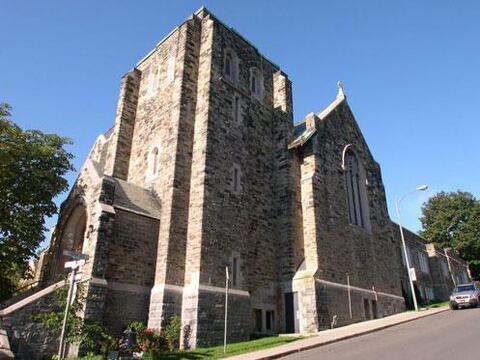
Église anglicane Saint-Matthias
in Canada
Oui
GPS Coordinates
45.4851981, -73.598805
Inscription

"To the Glory of God and in memory of Herbert James Rosevear, 3rd Canadian Siege Battery, Killed in Action at Vimy France, 16th day of June, 1918. Buried in Cabaret Rouge Cemetery on the Arras-Bethune Road. This window is given by his comrades-in-arms Wilred Gray, Harold John Inns, Eric Stanley Bushell. If any man would come after me let him deny himself and take up his cross and follow me."

"To the Glory of God and in Loving memory of Gordon Hamilton Fowler, September 4th, 1916." This window is given by his comrades-in-arms Wilfred Gray, Harold John Inns, Eric Stanley Bushell. If any man would come after me let him deny himself and take up his cross and follow me."


Image
Crédit photo
www.patrimoine-culturel.gouv.qc.ca
War or Conflict Term
Province
!4v1663765947598!6m8!1m7!1sxjbgZwiVENvhc3gCjyRkhw!2m2!1d45.48519814972103!2d-73.59880501387077!3f282.3384401408362!4f16.046029627173326!5f1.552152757813162"
Body Content

Charles William Kelsey (1877-1975) trained in England and emigrated to Montreal in 1922. His stained glass designs can be found in England, Australia, the United States and in over sixty-eight churches in Canada. His war memorial windows were commissioned between 1921 and 1956 including ten memorials for World War I, twenty-two memorials for World War II and ten memorials for both World Wars.

The World War I Baptistry poppy cross window is dedicated to Gunner Herbert James Rosevear of the Canadian Garrison Artillery. He was the son of James J. and Pearl E. Rosevear, of 63, Chesterfield Avenue, Westmount, P.Q., Canada. The window includes the Black Watch badge in the dedication panel. The window was commissioned in May 1923 for $45.

A World War I memorial window in the nave area depicting Christ enthroned in Majesty (1923) is dedicated to Gordon Hamilton Fowler. The window includes the Black Watch badge in the dedication panel. The window was commissioned in 1924 for $200.

City
Westmount
Country
Type Description
Window - stained glass
Memorial CF Legacy ID
10253
City/Municipality
Westmount
Memorial Number
24075-095
Type
Address
4695, boulevard de Maisonneuve Ouest
Location
Église unie de Westmount Park
in Canada
Oui
GPS Coordinates
45.4797499, -73.5977757
Inscription

"Holy, Holy, Holy, Lord God of Hosts"

"My peace I give to you that ye may be one. St John's Gospel Chapters 14, 15 and 16."

"In honour of those who offered their lives for and made supreme sacrifice"

Image
War or Conflict Term
Province
!4v1663771187448!6m8!1m7!1sZoTJUiudYqztIILpmC8JXA!2m2!1d45.47974992865638!2d-73.5977757001945!3f294.2766963606671!4f15.632012641854857!5f0.4006594133419563"
Body Content

Charles William Kelsey (1877-1975) trained in England and emigrated to Montreal in 1922. His stained glass designs can be found in England, Australia, the United States and in over sixty-eight churches in Canada. His war memorial windows were commissioned between 1921 and 1956 including ten memorials for World War I, twenty-two memorials for World War II and ten memorials for both World Wars.

A World War II congregational memorial window in the east transept was commissioned by Westmount Park United Church in January 1948 for $2000. The subject is the Last Supper of Our Lord. Above the main subject are angels holding up Dossal - emblems of the Passion foretelling the crucifiction - sponge, nails, cross and crown of thorns. Tracery at the top depicts the Lamb of God with a Chalice, Angels in white robes, and an open Book. In the circles at the top of the lights are religious symbols of crowns, rose, fleur-de-lys, stanrs and triangle. Three inscribed panels list the names of those who made the supreme sacrifice and those who served in the war of 1939-1945.

The central three panels show symbolic figures holding shields with the insignia of the Navy, Army

City
Westmount
Country
Type Description
Window - stained glass
Memorial CF Legacy ID
10252
City/Municipality
Montreal
Memorial Number
24075-094
Type
Address
6550, rue Hochelaga
Location
34e Régiment du génie de combat, bâtiment 232 de la garnison de Longue-Pointe
in Canada
Oui
GPS Coordinates
45.5786747, -73.5324694
Inscription
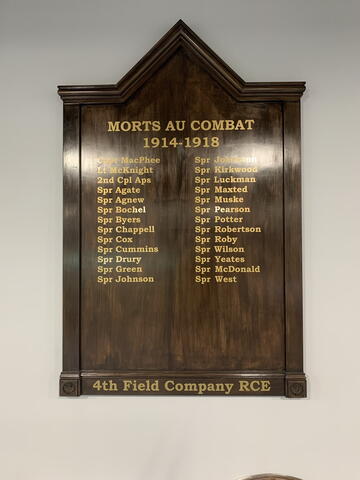
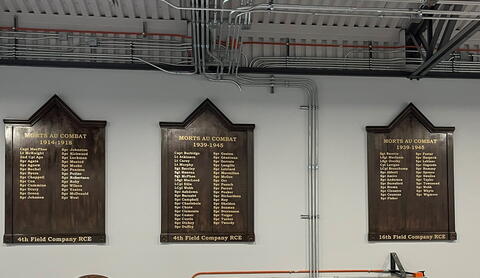
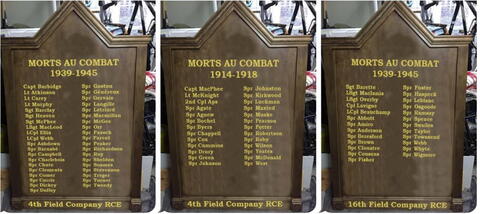
MORTS AU COMBAT
1914 - 1918
 
Capt MacPhee Spr Johnston
Lt McKnight Spr Kirkwood
2nd Cpl Aps Spr Luckman
Spr Agate Spr Maxted
Spr Agnew Spr Muske
Spr Bochel Spr Pearson
Spr Byers Spr Potter
Spr Chappell Spr Robertson
Spr Cox Spr Roby
Spr Cummins Spr Wilson
Spr Drury Spr Yeates
Spr Green SprMcDonald
Spr Johnson Spr West
 
4th Field Company RCE


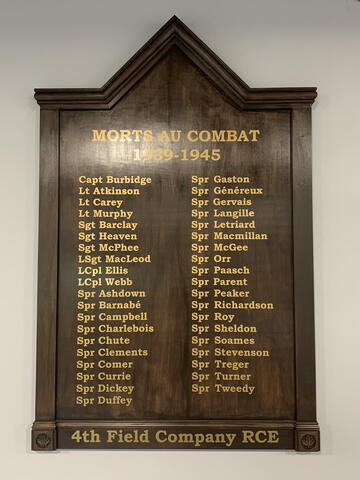
MORTS AU COMBAT
1939 - 1945
 
Capt Burbidge Spr Gaston
Lt Atkinson Spr Généreux
Lt Carey Spr Gervais
Lt Murphy Spr Langille
Sgt Barclay Spr Letriard
Sgt Heaven Spr MacMillan
Sgt McPhee Spr McGee
LSgt MacLeod Spr Orr
LCpl Ellis Spr Paasch
LCpl Webb Spr Parent
Spr Ashdown Spr Peaker
Spr Barnabé Spr Richardson
Spr Campbell Spr Roy
Spr Charlebois Spr Sheldon
Spr Chute Spr Soames
Spr Clements Spr Stvenson
Spr Comer Spr Treger
Spr Currie Spr Turner
Spr Dickey Spr Tweedy
Spr Duffey  
 
4th Field Company RCE


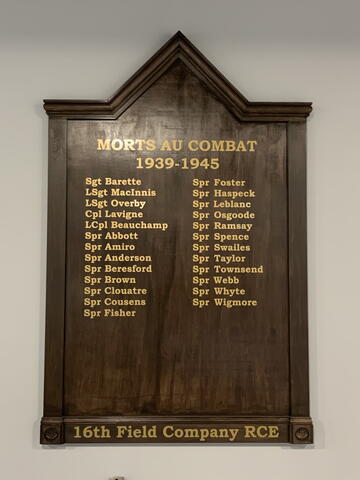
MORTS AU COMBAT
1939 - 1945
 
Sgt Barette Spr Foster
LSgt MacInnis Spr Haspech
LSgt Overby Spr Leblanc
Cpl Lavigne Spr Osgoode
LCpl Beauchamp Spr Ramsay
Spr Abbott Spr Spence
Spr Amiro Spr Swailes
Spr Anderson Spr Taylor
Spr Beresford Spr Townsend
Spr Brown Spr Webb
Spr Clouatre Spr Whyte
Spr Cousens Spr Wigmore
Spr Fisher  
 
16th Field Company RCE
Image
Crédit photo
Canadian Armed Forces
Légende
4th Field Company RCE First World War Plaque
1 sur 6 images
Image
Crédit photo
Canadian Armed Forces
Légende
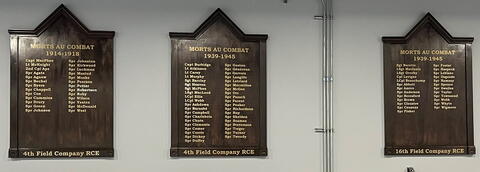
plaques
1 sur 6 images
Image
Crédit photo
Canadian Armed Forces
Légende
16th Field Company RCE Second World War Plaque
1 sur 6 images
Image
Crédit photo
Canadian Armed Forces
Légende
4th Field Company RCE Second World War Plaque
1 sur 6 images
Image
Crédit photo
Canadian Armed Forces
Légende
surroundings
1 sur 6 images
Image
Crédit photo
Jean-François Bégin
Légende
plaques
1 sur 6 images
War or Conflict Term
Province
!4v1656422089754!6m8!1m7!1sezkZb2_Pkf3-bAKgEswQhg!2m2!1d45.57867474648577!2d-73.53246940090234!3f118.35038612149586!4f-8.249458983872287!5f0.7820865974627469
Body Content

Ce monument commémoratif honore la mémoire des membres du 34e Régiment du génie de combat qui ont consenti le sacrifice ultime en servant pendant les Première et  Seconde guerres mondiales. Les plaques ont été fabriquées en 2019 par le caporal-chef Bégin, et l’inauguration a eu lieu en août 2021

En 2006, le 34e Régiment du génie de combat (34 RGC) est né de la fusion du 3e Régiment du génie de campagne (3 RGC) et du 9e Escadron du génie, à Rouyn-Noranda. À cette époque, le 3 RGC était composé du 4e Escadron de campagne et du 16e Escadron de campagne. Tous les escadrons de campagne du 34 RGC ont servi outre-mer pendant la Seconde Guerre mondiale, tandis que le 4e Escadron de campagne et le 16e Escadron de campagne ont également servi pendant la Première Guerre mondiale.

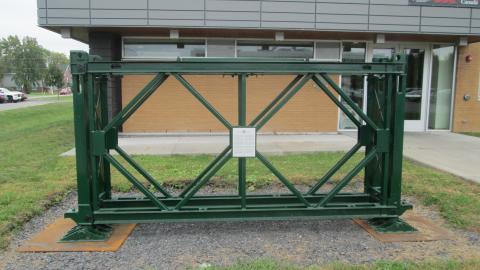
Le 4e Escadron de campagne et le 16e Escadron de campagne étaient auparavant connus sous le nom de compagnies de campagne. Le monument du 34e Régiment du génie de combat, installé sur un pont Bailey, en révèle davantage sur l’histoire du régiment.

City
Montreal
Country
Type Description
Plaques
Memorial CF Legacy ID
10925
City/Municipality
Montréal
Memorial Number
24075-093
Address
5015, rue De La Savane
Location
Cimetière Baron de Hirsch
in Canada
Oui
GPS Coordinates
45.5016417, -73.6527622
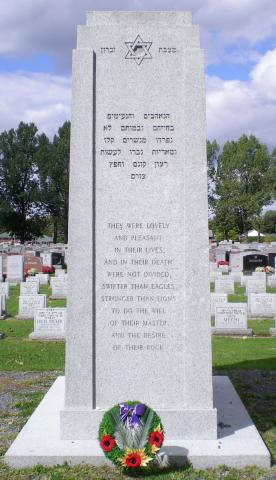
Inscription

[front/devant]

THEY WERE LOVELY
AND PLEASANT
IN THEIR LIVES
AND IN THEIR DEATH
WERE NOT DIVIDED
SWIFTER THAN EAGLES
STRONGER THAN LIONS
TO DO THE WILL
OF THEIR MASTER
AND THE DESIRE
OF THEIR ROCK

[main monument, right side]

ROLL OF HONOUR

[main monument, left side]

ROLL OF HONOUR

[left wall]

[right wall]

Image
Légende
War Monument
1 sur 2 images
Image
Légende
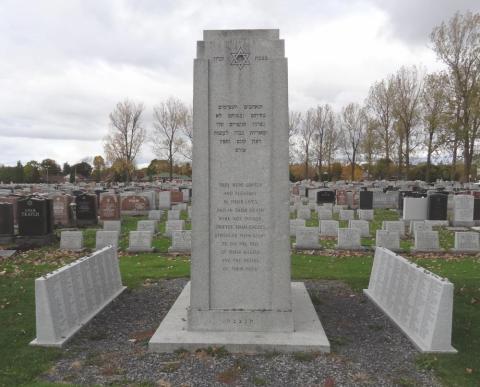
surroundings
1 sur 2 images
Province
!4v1646846089108!6m8!1m7!1sbWduxoADqdyZOm87p__c1g!2m2!1d45.50164169885731!2d-73.65276221834351!3f355.58139092800553!4f0.36772479573470207!5f3.173669940468319"
Body Content

Le Monument commémoratif de guerre juif dans le cimetière Baron de Hirsch à Montréal a été érigé en 2014. Situé dans le champ du Souvenir des vétérans du cimetière, il s’agit du plus gros monument commémorant le service militaire de la communauté juive du Canada. 

Les noms de 579 Juifs canadiens ayant perdu la vie au service de notre pays sont inscrits en noir sur la pierre gris pâle du monument. Parmi ces héros tombés au combat se trouvent ceux qui ont perdu la vie pendant la Première Guerre mondiale, la Seconde Guerre mondiale et la guerre de Corée. 

L’initiative pour la construction d’un ajout au cénotaphe de guerre juif dans le cimetière Baron de Hirsch a été entreprise par Larry Rosenthal, dont le grand frère, Willie, a perdu la vie en Sicile au cours de la Seconde Guerre mondiale. M. Rosenthal a recueilli les noms de ceux qui sont à l’honneur sur ce monument et a également organisé de nombreuses activités commémoratives pour toute la communauté. 

Les noms de ceux qui ont perdu la vie sont inscrits sur deux côtés de la colonne centrale et sur les deux bas murets de chaque côté. Le devant du Monument commémoratif est doté d’une étoile de David et le texte suivant y est inscrit, en anglais et en hébreux :

City
Montréal
Country
Type Description
Monument
Photo Credit
Gary Perlman
Memorial CF Legacy ID
10190
City/Municipality
Montreal
Memorial Number
24075-092
Type
Address
3640, rue University
Location
Université Mcgill University, Pavillon d'Anatomie et de Médecine Dentaire Strathcona
in Canada
Oui
GPS Coordinates
45.5078797, -73.5793966
Inscription

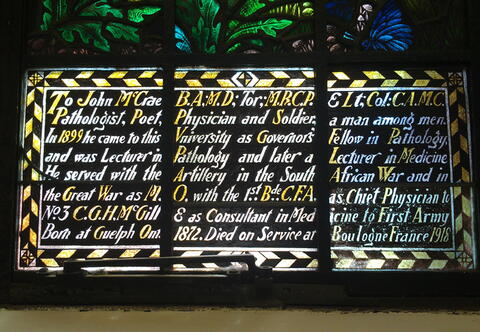
Lt. Col. Roland Playfair Campbell

Lt. Col. Henry Brydges Yates

Lt. Col. John McCrae


In Flanders Fields John McCrae, May 1915

In Flanders fields the poppies blow
Between the crosses, row on row,
That mark our place; and in the sky
The larks, still bravely singing, fly
Scarce heard amid the guns below.

We are the Dead. Short days ago
We lived, felt dawn, saw sunset glow,
Loved and were loved, and now we lie
In Flanders fields.

Take up our quarrel with the foe:
To you from failing hands we throw
The torch; be yours to hold it high.
If ye break faith with us who die
We shall not sleep, though poppies grow
In Flanders fields.

Image
Crédit photo
Dennis Cleary/CBC
Légende
Stained Glass windows to 3 McGill doctors
1 sur 2 images
Image
1 sur 2 images
War or Conflict Term
Province
!4v1644850685147!6m8!1m7!1s5rLi6E3WfDrL8x3WY37KCA!2m2!1d45.50787971722038!2d-73.57939656605343!3f223.8452396704694!4f17.594143578340777!5f0.7820865974627469"
Body Content

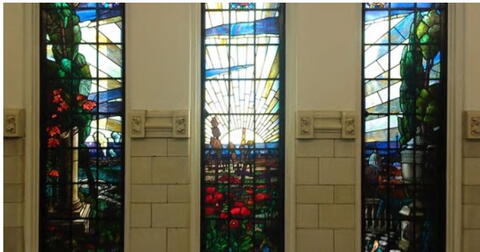
En 1919, trois vitraux réunis en forme de triptyque ont été installés dans l’entrée principale de ce qui était alors l’édifice médical Strathcona à l’Université McGill (c’est aujourd’hui le département d’anatomie et de médecine dentaire). Chacun des trois vitraux rend hommage à un médecin de McGill tué à la guerre.

Le vitrail de gauche est dédié au lieutenant-colonel Roland Playfair Campbell, qui servait dans la 6e Ambulance de campagne, au sein du Corps médical de l’Armée canadienne, quand il a été tué le 16 septembre 1916. Le vitrail illustre le front de Thiepval, où il a été tué, ainsi que le scalpel d’un chirurgien, des ciseaux et des bandages.

Le vitrail de droite est dédié au lieutenant-colonel Henry Brydges Yates, qui s’est porté volontaire pour servir à l’âge de 47 ans et qui est mort d’une bronchite le 22 janvier 1916. Le vitrail illustre Boulogne (France), où le lieutenant-colonel Yates a servi au sein du Corps médical de l’Armée canadienne, dans un hôpital militaire.

Le vitrail du centre, orné de coquelicots rouge vif, est dédié au lieutenant-colonel John McCrae. La section du bas illustre son poème « In Flanders Fields » (Au champ d’honneur). Le 28 janvier 1918, après avoir été malade pendant cinq jours, le lieutenant-colonel McCrae succomba d’une pneumonie et d’une méningite. Le jour où il tomba malade, il avait appris qu’il avait été nommé médecin?conseil auprès de la Première Armée britannique : c’était le premier Canadien à recevoir un tel honneur.

City
Montreal
Country
Type Description
Window - stained glass
Memorial CF Legacy ID
10124
City/Municipality
Montreal
Memorial Number
24075-091
Type
Address
rue Salaberry
Location
La rue va de l'ouest à l'est, du boulevard Marcel-Laurin jusqu’au boulevard Gouin.
in Canada
Oui
GPS Coordinates
45.5259935, -73.714691
Inscription

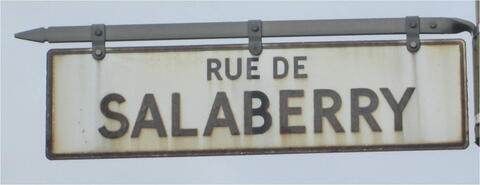
rue de Salaberry

Image
Crédit photo
Richard Turcotte
Légende
Photo- Street sign (photo by R. Turcotte)
Province
!4v1616599843656!6m8!1m7!1svPzmqxUP79EjtSJb7NwxPw!2m2!1d45.52599347080287!2d-73.71469095411793!3f291.63192734862633!4f16.781779928063756!5f2.299968626952992"
Body Content

La rue de Salaberry porte le nom du lieutenant-colonel Charles-Michel d’Irumberry de Salaberry, Colombie-Britannique; celui-ci vécut de novembre 1778 à février 1829 .

Charles-Michel d’Irumberry de Salaberry est né à Beauport, près de la ville de Québec, au mois de novembre 1778. Il s’enrôla dans l’Armée britannique en 1792 à l’âge de 14 ans et il combattit au sein des rangs du 60e Régiment dans les Antilles et aux Pays-Bas. En 1803, on lui confia le commandement d’une compagnie et il poursuivit alors sa carrière en Europe et dans les Antilles. En 1810, Salaberry fut rappelé au Canada avec le grade de lieutenant-colonel. Il fut nommé aide de camp du major?général Francis Rottenburg, mais en 1812, il fut nommé commandant d’un nouveau corps de volontaires d’infanterie légère, les Voltigeurs canadiens. Les Voltigeurs sont essentiellement des miliciens, mais de Salaberry les entraîna comme des soldats de la Force régulière de la même manière que les unités de Territoriaux mobilisées dans le Haut?Canada. En novembre 1812, de Salaberry dirigea l’avant-garde de la force qui repoussa une attaque américaine au moulin de Lacolle. Par la suite, certains des Voltigeurs prirent part à la bataille décisive de la ferme de Crysler. En octobre 1813, il affronta les Américains qui menaçaient Montréal. Le colonel de Salaberry, à la tête de 300 Voltigeurs et bénévoles canadiens et amérindiens, repoussa plusieurs milliers de soldats américains. En 1817, il fut nommé compagnon de l’ordre du Bain. Il deviendra par la suite membre du Conseil législatif du Bas-Canada, poste qu’il occupera jusqu’à sa mort en février 1829.


City
Montreal
Country
Type Description
Street sign
Memorial CF Legacy ID
10094
City/Municipality
Montreal
Memorial Number
24075-090
Address
6530 rue Hochelaga
Location
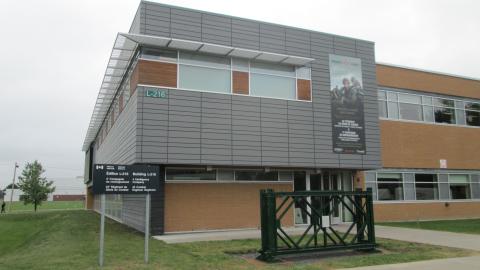
Devant le bâtiment L-216 au quartier général du Groupe de soutien de la 2e Division du Canada
in Canada
Oui
GPS Coordinates
45.57845, -73.53094
Inscription

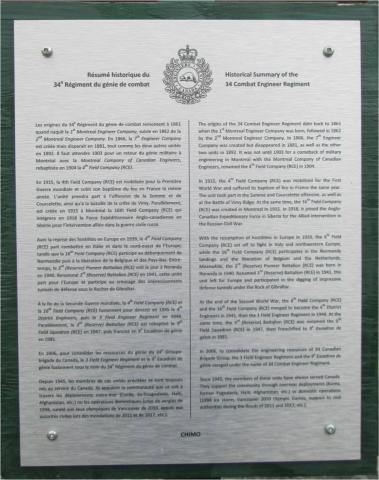
Les origines du 34e Régiment du génie de combat remontent à 1861 quand naquit la 1st Montreal Engineer Company, suivie en 1862 de la 2nd Montreal Engineer Company. En 1866, la 7th Engineer Company est créé mais disparait en 1881, tout comme les deux autres unités en 1892. Il faut attendre 1903 pour un retour du génie militaire à Montréal avec la Montreal Company of Canadian Engineers, rebaptisée en 1904 la 4th Field Company (RCE). 

En 1915, la 4th Field Company (RCE) est mobilisée pour la Première Guerre mondiale et subit son baptême de feu en France la même année. L’unité prendra part à l’offensive de la Somme et de Courcelette, ainsi qu’à la bataille de la crête de Vimy. Parallèlement, est crée en 1915 à Montréal la 16th Field Company (RCE) qui intégrera en 1918 la Force Expéditionnaire Anglo-Canadienne en Sibérie pour l’intervention allié dans la guerre civile russe. 

Avec la reprise des hostilités en Europe en 1939, la 4th Field Company (RCE) part combattre en Italie et dans le nord-ouest de l’Europe tandis que la 16th Field Company (RCE) participera au débarquement de Normandie puis à la libération de la Belgique et des Pays-Bas. Entre temps, le 3rd (Reserve) Pioneer Battalion (RCE) voit le jour à Noranda en 1940. Renommé 3rd (Reserve) Battalion (RCE) en 1941, cette unité part pour l’Europe et participe a creusage des impressionnants tunnels de défense sous le Rocher de Gilbraltar. 

À la fin de la Seconde Guerre mondiale, la 4th Field Company (RCE) et la 16th Field Company (RCE) fusionnent pour devenir en 1945 le 4th District Engineers, puis le 3 Field Engineer Regiment en 1948. Parallèlement, le 3rd (Reserve) Battalion (RCE) est rebaptisé le 9th Field Squadron (RCE) en 1947, puis francisé en 9e Escadron de génie en 1981. 

En 2006, pour consolider les ressources du génie du 34e Groupe-Brigade du Canada, le 3 Field Engineer Regiment et le 9e Escadron de génie fusionnent sous le nom du 34e Régiment du génie de combat. 

Depuis 1945, les membres de ces unités précitées se sont toujours mis au service du Canada. Ils appuient la communauté que ce soit à travers les déploiements outre-mer (Corée, Ex-Yougoslavie, Haïti, Afghanistan, etc) ou les opérations domestiques (crise de verglas de 1998, sureté aux Jeux Olympiques de Vancouver de 2010, appuis aux autorités civiles lors des inondations de 2011 et de 2017, etc)

CHIMO


The origins of the 34 Combat Engineer Regiment date back to 1861 when the 1st Montreal Engineer Company was born, followed in 1862 by the 2nd Montreal Engineer Company. In 1866, the 7th Engineer Company was created but disappeared in 1881, as well as the two other units in 1892. It was not until 1903 for a comeback of military engineering in Montreal with the Montreal Company of Canadian Engineers, renamed the 4th Field Company (RCE) in 1904. 

In 1915, the 4th Field Company (RCE) was mobilized for the First World War and suffered its baptism of fire in France the same year. The unit took part in the Somme and Courcelette offensive, as well as the Battle of Vimy Ridge. At the same time, the 16th Field Company (RCE) was created in Montreal in 1915. In 1918, it joined the Anglo-Canadian Expeditionary Force in Siberia for the Allied intervention in the Russian Civil War. 

With the resumption of hostilities in Europe in 1939, the 4th Field Company (RCE) set off to fight in Italy and northwestern Rurope, while the 16th Field Company (RCE) participates in the Normandy landings and the liberation of Belgium and the Netherlands. Meanwhile, the 3rd (Reserve) Pioneer Battalion (RCE) was born in Noranda in 1940. Renamed the 3rd (Reserve) Battalion (RCE) in 1941, this unit left for Europe and participated in the digging of the impressive defence tunnels under the Rock of Gibraltar. 

At the end of the Second World War, the 4th Field Company (RCE) and the 16th Field Company (RCE) merged to become the 4th District Engineers in 1945, then 3 Field Engineer Regiment in 1948. At the same time, the 3rd (Reserve) Battalion (RCE) was renamed the 9th Field Squadron (RCE) in 1947, then Frenchified to 9e Escadron de génie in 1981. 

In 2006, to consolidate the engineering ressources of 34 Canadian Brigade Group, the 3 Field Engineer Regiment and the 9e Escadron de génie merged under the name 34 Combat Engineer Regiment. 

Since 1945, the members of these units have always served Canada. They supprt the community through overseas deployments (Korea, former Yugoslavia, Haiti, Afghanistan, etc) or domestic operations (1998 ice storm, Vancouver 2010 Olympic Games, support to civil authorities during the floods of 2011 and 2017, etc)

CHIMO

Image
Crédit photo
Richard Turcotte
Légende
Photo 1- Monument (photo by R. Turcotte)
1 sur 3 images
Image
Crédit photo
Richard Turcotte
Légende
Photo 2- Close up of plaque (photo by R. Turcotte)
1 sur 3 images
Image
Crédit photo
Richard Turcotte
Légende
Photo 3- Surroundings (photo by R. Turcotte)
1 sur 3 images
Province
Body Content

This monument, based on a Bailey Bridge panel, is a tribute to 34 Combat Engineer Regiment and its predecessor units.

City
Montreal
Country
Type Description
Monument
Memorial CF Legacy ID
10092