
From the Minister
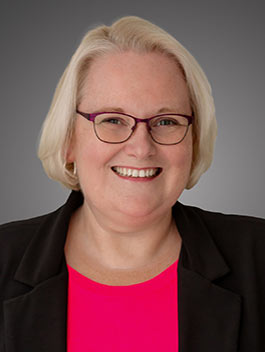
The Honourable Jill McKnight, P.C., M.P.
Minister of Veterans Affairs and Associate Minister of National Defence
Veterans have served our country with pride and dedication, and they, along with their families, are at the heart of our Department’s mandate. So many brave Canadians have made enormous sacrifices for our peace and security; we owe it to them, and to those who supported them from home, to make sure they have what they need and deserve to lead healthy and productive post-service lives.
The 2025–26 Departmental Plan for Veterans Affairs Canada (VAC) outlines our path to support Canada’s Veterans and their families. The Plan details the programs, services, and benefits that Veterans received from our Department in the 2024–25 fiscal year, and shows how we intend to improve these supports in the future.
Since 2016, we have invested over $11 billion, including 123 initiatives via the Veterans and Family Well-being Fund (VFWF), to provide new supports for Veterans and their families, reflecting our unwavering commitment to their well-being. Moving forward, we will continue prioritizing initiatives that enhance their quality of life, including peer support, mental health services, and the strengthening of rehabilitation programs. Additionally, we are introducing innovative approaches like social prescribing, which connects clients to a variety of non-clinical community services aimed at improving their health and overall well-being.
Investing in these services and tools will help Veterans and their families access comprehensive and timely support that can enhance their well-being, financial security and independence. We are also enhancing several of our financial assistance benefits and modernizing VAC systems so that Veterans with disabilities who are struggling to work, or those experiencing a financial crisis, can get the urgent help they need.
Transitioning from a military career to post-service life can be challenging. To this end, during the past fiscal year we continued to focus our work to improve the experience of applying for disability benefits, ensuring that women, Indigenous, and equity-deserving Veterans receive targeted supports that are tailored to align with their specific needs. This work has been informed through consultation with various departments, community groups and Indigenous and equity-deserving Veterans. We look forward to building on this work through discussions at the upcoming VAC 2025 Women’s Forum.
Our new National Veterans Employment Strategy, launched in June 2024, and the Veteran Homelessness Program that was introduced in 2023, are two examples of projects that we have brought forward in recent years to ensure that we are taking a proactive approach to helping Veterans address the challenges they face when transitioning to post-service life.
Finally, commemoration remains one of our most important and public-facing responsibilities. In 2025–26, we will mark significant milestones: 100 years since the unveiling of the Beaumont-Hamel Newfoundland Memorial; 80 years since the end of the Second World War, including the Liberation of the Netherlands and Victory over Japan; and 25 years since the repatriation of Canada’s Unknown Soldier.
These anniversaries remind us of the courage and sacrifices of Veterans who served in these operations and many others, both here at home and abroad.
The experiences of Veterans highlight the importance of our mandate every day. We remain dedicated to ensuring their service and sacrifices are honoured and remembered.
Sincerely,
The Honourable Jill McKnight, P.C., M.P.
Minister of Veterans Affairs and
Associate Minister of National Defence
Plans to deliver on core responsibilities and internal services
Core responsibilities and internal services:
Core Responsibility 1: Benefits, Services and Support
Description
Support the care and well-being of Veterans and their dependents or survivors through a range of benefits, services, research, partnerships, and advocacy.
Quality of life impacts
The work we do to fulfil this core responsibility has a positive impact on the following Quality of life (QoL) domains and indicators:
- Health: Self-rated mental health, Self-rated health
- Prosperity: Financial well-being, Employment, Housing needs
- Society: Sense of belonging to local community
- Life satisfaction
Indicators, results, and targets
This section presents details on our indicators, the actual results from the three most recently reported fiscal years, the targets and target dates approved in 2025–26 for Benefits, Services and Support. Details are presented by departmental result.
Table 1: Veterans are physically and mentally well
Table 1 provides a summary of the target and actual results for each indicator associated with the results under Benefits, Services and Support.
Table 2: Veterans and their families are financially secure
Table 2 provides a summary of the target and actual results for each indicator associated with the results under Benefits, Services and Support.
Table 3: Veterans have a sense of purpose
Table 3 provides a summary of the target and actual results for each indicator associated with the results under Benefits, Services and Support.
Table 4: Veterans are able to adapt, manage, and cope within post-service life
Table 4 provides a summary of the target and actual results for each indicator associated with the results under Benefits, Services and Support.
Table 5: Veterans are living in safe and adequate housing
Table 5 provides a summary of the target and actual results for each indicator associated with the results under Benefits, Services and Support.
Table 6: Veterans are socially supported
Table 6 provides a summary of the target and actual results for each indicator associated with the results under Benefits, Services and Support.
Table 7: Veterans are satisfied with the services they receive
Table 7 provides a summary of the target and actual results for each indicator associated with the results under Benefits, Services and Support.
Additional information on the detailed results and performance information for our program inventory is available on GC InfoBase.
Plans to achieve results
The following section describes the planned results for Benefits, Services and Support in 2025–26.
Departmental Result: Veterans are physically and mentally well.
We are committed to improving services, comprehensive support, and access for equity-deserving Veterans. Our efforts include mental health services like e-therapy and post-traumatic stress disorder (PTSD) support, tracking progress in rehabilitation, and addressing gaps in benefits and services. We will also enhance services specifically for Indigenous Veterans and improve healthcare provider systems. These initiatives will strengthen services and ensure Veterans receive timely, effective care.
Mental health services
- We will continue to partner with Health Canada to provide psychological support to Veterans and their families through the VAC Assistance Service line. This free service offers short-term psychological support with a mental health professional.
- We will also work to improve access to mental health services, including a variety of telehealth options such as Therapy-Assisted Internet Cognitive Behavioural Therapy (TA iCBT), as well as mental health applications such as PTSD Coach Canada. These two offerings serve in part to improve access to mental health services and address a gap in our continuum of mental health services and treatments:
- TA iCBT may address ongoing barriers to treatment such as geography, stigma, and lack of readiness for face-to-face psychotherapy.
- PTSD Coach Canada mobile app can help users learn about and manage symptoms that can occur after trauma.
- Keeping with our mandate letter commitments, we will focus on supporting the mental health of Veterans and their families affected by substance use disorders. This includes developing guidelines for frontline staff on when to refer clients to alcohol or drug treatment programs that put special emphasis on addressing the unique needs and experiences of Veterans.
Comprehensive supports
- The Veteran and Family Well-being Fund (VFWF) will support organizations offering innovative initiatives that help Veterans and their families with holistic, comprehensive services. By the end of 2025–26, we aim to assess three completed projects.
- Veterans and their families will receive timely, personalized medical and psychosocial rehabilitation services to help them overcome barriers and adjust to life after service.
- We will continue tracking the percentage of Operational Stress Injury (OSI) clinic clients reporting improved mental health through the Client Reported Outcomes Monitoring Information System (CROMIS). It will also support the OSI Clinic Network by promoting the use of CROMIS 2.0 to monitor outcomes. This will be done with help from the VAC OSI National Network team and local CROMIS champions. We will offer in-person meetings and make improvements to local OSI clinic processes.
- We will develop guidelines for providing occupational therapy services to family members. We will also implement new training, a mentorship program, and a quality assurance process for fee-for-service occupational therapists who assess and treat Veterans.
Equity-deserving Veterans
- We will continue efforts to support equity-deserving Veterans by addressing gaps in turnaround times for certain groups. We will focus on monitoring the processing times for French and female disability benefit applications. This work ensures we maintain our current progress, recognizing that processing times may fluctuate in the future. We have established a dedicated team to process applications from these groups to ensure turnaround times are in line with other groups. Additionally, about 30% of our decision-making staff are bilingual or French-speaking, which helps provide better service in both official languages.
- In partnership with Indigenous Services Canada, we aim to increase awareness of, and access to, programming for Indigenous Veterans. We will also try to find ways to improve access to culturally appropriate services by collaborating with other departments and Indigenous organizations. Access to tailored programs can help Indigenous Veterans better address their physical and mental health needs in ways that also align with their cultural values and practices.
- Efforts will be made to engage respectfully with Indigenous Veterans to better understand their needs and gather their feedback on services that respect the unique cultural practices of First Nations, Inuit, and Métis communities.
- Via the VFWF, we are committed to supporting organizations that develop impactful programs designed to improve the well-being of Veterans and their families. This will help to promote mental health, employment and retraining, and research opportunities, with a strong emphasis on equity-deserving groups, such as Indigenous, women, and 2SLGBTQI+ Veterans.
Benefit gaps
- We will address gaps identified in a review comparing the VAC Health Care Benefits Program with the Public Service Health Care Plan and the Canadian Armed Forces (CAF) Spectrum of Care. The review highlights opportunities to improve equity for Veterans by aligning VAC benefits more closely with other health care plans. Many gaps have already been addressed, but the analysis is ongoing, and changes will continue to provide Veterans with the best treatment, benefits, and services.
Health care providers
- We will develop and implement a system to track escalation issues and continue to improve the provider recredentialing process. These steps aim to ensure that Veterans receive safe and effective treatment from registered healthcare providers who meet registration requirements.
- We will also update the provider communications guidelines. The current guidelines were developed when most communications occurred through traditional media like newspapers, TV, and radio. To reflect the widespread use of digital platforms , these guidelines need to evolve. For example, direct recruitment through private social media groups is not covered under the existing guidelines.
- We will communicate clearly with providers and educate them to be able to recognize and prevent recurrent issues. By creating a document that clearly outlines our expectations for providers, we can simplify the process for everyone.
Actions in response to audits
- Work on the 2022 Cannabis for Medical Purposes (CMP) Audit recommendations will continue, including the implementation of a new authorization form, enhancement of program monitoring, and advancement of automated, real-time decision-making for CMP claims.
- We will continue to address concerns from the 2019 Audit of Multi-Disciplinary Clinics and work towards an accountable, evidence-based model. Our next steps are to:
- document the current state of multi-disciplinary clinics;
- identify issues and gather more information;
- form a working group with Departmental experts to develop options and recommendations;
- focus on improving how we report our progress;
- ensure credentials are maintained;
- update the Interdisciplinary Clinic Review Committee’s Terms of Reference and application form; and
- enhance communication, especially regarding approval criteria.
Departmental Result: Veterans and their families are financially secure.
The following efforts will help ensure Veterans and their families are financially secure by providing faster emergency support through the Veterans Emergency Fund (VEF), improving the Income Replacement Benefit (IRB) eligibility and payment processes, and upgrading our systems for faster service. We are also using automation to reduce backlogs and reviewing financial policies to better meet the diverse needs of Veterans, ensuring they get the support they need.
Timely emergency assistance for Veterans
- We will continue to provide quick financial support to Veterans and their families through the VEF program so they can manage unexpected financial emergencies. We decide on applications within two business days, and funds are disbursed to applicants within two business days of being approved. This system ensures Veterans can quickly meet their essential needs and get support for their financial security, health, and well-being.
Improving financial support
- Last year, we evaluated the IRB, and Rehabilitation Services and Vocational Assistance Program. This evaluation allowed us to gain key insights about where we can improve the structure and outcomes of these programs. In 2025–26, we will use those insights to explore how we might:
- assess Veterans’ needs for accurate eligibility decisions;
- support Veterans with service-related health issues or terminal illnesses that prevent workforce reentry;
- measure earnings capacity effectively; and
- ensure consistent and fair IRB calculations.
- We will develop an Annual Income Verification process which will allow us to enhance IRB payment accuracy, modernize information technology (IT) systems, and improve data sharing with other government departments. These efforts will support Veterans’ financial security.
Gender-based Analysis Plus review
In 2025–26, we will continue to review and update our Financial Benefit policies with a Gender-based Analysis (GBA) Plus lens to ensure they meet the diverse needs of Veterans and their families. By considering various factors (i.e., sex, gender, age, family status, language, etc.), we’ll make our policies more inclusive and more effective. This helps ensure all Veterans receive the support they need to stay financially secure.
Departmental Result: Veterans have a sense of purpose.
We are committed to helping Veterans recover from their illnesses or injuries, build their independence, and connect with their communities. By supporting initiatives that foster growth through volunteerism, employment, and education, we help Veterans thrive. Tailored rehabilitation and vocational services empower Veterans to regain their health, achieve their goals, and find renewed purpose in civilian life.
Empowering Veterans through support
- We will continue delivering case management services, rehabilitation programs, and vocational assistance to ensure clients receive timely and appropriate resources to support their recovery and enhance their independence. These services are tailored to address the unique challenges and needs of Veterans and their families, while also leveraging their strengths and capacities to promote meaningful and positive outcomes.
- We will fund projects through the VFWF that support volunteerism, employment, and educational opportunities, helping Veterans engage in activities that promote personal growth and community connection.
- The Rehabilitation Services and Vocational Assistance Program helps participants improve their well-being at home, work, and in their communities by providing personalized, consistent, and culturally sensitive rehabilitation approaches. We continue to provide these programs and services because these tailored supports foster a renewed sense of purpose and direction, empowering participants to rebuild their lives and achieve meaningful goals.
Departmental Result: Veterans are able to adapt, manage, and cope within post-service life.
To improve care, employment, and transition services we will simplify access to programs, enhance support for women Veterans, and collaborate with provinces to align services with local systems. Initiatives like the National Veterans Employment Strategy and Enhanced Transition Services (ETS) aim to help Veterans find meaningful work and adjust to civilian life, while the VFWF supports projects that promote mental health and retraining opportunities.
Continuum of care
- We will work to better support aging Veterans across the continuum of care by consulting with provinces and territories to identify opportunities to align and integrate our services with local care systems. This work will be based on research and expert advice, including insights from the National Institute of Aging’s report, Addressing the Coming of Age and Its Related Complexities Among Canada’s Veterans. Consultations with provinces have already started, and a draft policy is expected by the fall of 2025.
Enhancing supports and services
- We will implement the National Veterans Employment Strategy (launched in June 2024) and improve the support offered to Veterans transitioning to civilian life by providing extra resources on job searching and self-employment. A recognition system will highlight Canadian employers who hire Veterans and meet the standards of being Veteran Friendly or Veteran Ready. In addition, we will work with all levels of government and the federal public service to lead by example in employing Veterans.
- The ETS Renewal is a joint effort with the CAF to create a new service delivery model to support medically releasing CAF members and their families during transition. A pilot of this model will begin in Fall 2025, and if successful, we will roll it out nationwide. Throughout the process, we will continue working with Veterans and members to identify their needs, set goals, and connect them to programs and services that improve their post-service quality of life.
- To improve access to the Rehabilitation Services and Vocational Assistance Program, we will simplify the eligibility process by using technology to enhance information collection and reporting. This will make decision-making more transparent and timely, ensuring Veterans can easily access the support they need. Additionally, by using insights from this improved data, we will provide a high-quality program that adapts to the needs of participants, making it more responsive and effective.
- Through the VFWF, we will actively support organizations that create meaningful initiatives aimed at enhancing the well-being of Veterans and their families. These efforts will focus on advancing mental health, employment/re-training, and research opportunities, with particular attention to equity-deserving groups, including Indigenous, women, and 2SLGBTQI+ Veterans.
Supporting women Veterans
- We will continue to track our progress on recommendations made by Standing Committee on Veterans Affairs (ACVA) in their report titled Invisible No More. One example of our ongoing efforts is advancing research on Women Veterans. We will continue to engage the Women Veterans Council in our research plans and share the results of our studies on Women Veterans’ health via the new Women Veterans research page on our website.
- We will use the findings from the Community Health Needs Assessment (CHNA) to better support women Veterans during their transition to civilian life. This will help us identify the areas where they need the most support and determine how to provide it. We will use the CHNA results to guide outreach activities, including nursing assessments and visits, to connect with Veterans individually and collectively. These efforts, planned for 2025–26 and beyond, will ensure women Veterans get the support they need to adjust and thrive after their service.
Departmental Result: Veterans are living in safe and adequate housing.
We are working to end homelessness for Veterans by providing housing support and services. This includes funding programs to help Veterans find stable homes and receive the care they need. We are also improving the Home Adaptation Program to make homes safer and more accessible, helping Veterans live independently and comfortably while fostering lasting stability.
Ending Veteran homelessness
- We will continue to work with Housing, Infrastructure and Communities Canada on the Veteran Homelessness Program to support Veterans who are homeless or at risk of becoming homeless. The program provides funding to third-party organizations for rent supplements and support services. In 2025–26, Veterans will keep receiving assistance through these organizations, and the program will continue to fund research and build capacity to address Veteran homelessness.
- Case Managers will continue to build and strengthen our relationship and work collaboratively with local community organizations in order to identify Veterans who are at risk or experiencing homelessness, to ensure supports are in place and their needs are met. These supports include a Housing First approach by assisting Veterans in finding suitable housing, as well as other wraparound supports related to the seven domains of well-being, including physical and mental health, social integration, finances, life skills and addiction issues.
- Through the VFWF, we will provide support to organizations helping Veterans who are homeless or at risk of homelessness. This includes funding to strengthen services, expand crisis support, and remove barriers to accessing safe, stable housing.
Improving home adaptations
- We will implement improvements to the Home Adaptation Program for Veterans based on lessons from the ongoing Home Adaptation Pilot Project. While the pilot is still underway and final recommendations are not yet ready, we’re already seeing positive results. Veterans are getting the right construction for their home adaptations. The Accessibility Construction Expert (ACE) ensures the adaptations are safe, helps Veterans find qualified contractors, and makes sure contractors are bidding on the same design. This speeds up the process for reviewing requests. The ACE also supports our staff with construction knowledge, allowing them to focus on helping more Veterans. These changes aim to improve the program and make it more effective as we move forward
Departmental Result: Veterans are socially supported.
This year we will expand social prescribing and peer support to improve Veterans’ well-being. This includes training health professionals, developing a National Veterans Resources Directory, and enhancing programs like Operational Stress Injury Social Support Program (OSISS). We will also strengthen support for those affected by military sexual trauma and use the VFWF to expand networks and foster community engagement for underserved groups.
Social prescribing
- By the end of fiscal year 2025–26, we plan to incorporate social prescribing into key areas of our operations, using the Veterans’ Well-being CHNA’s resources. Social prescribing links Veterans to social support services, while health professionals—including those in Nursing, Occupational Therapy, Mental Health, and Senior Area Medical roles—will receive training to provide this support. The VAC Resource Directory will also be improved to make it easier for both staff and Veterans to use. A new National Veterans Resources Directory Tool will be developed with input from Veterans and partnerships with organizations already using social prescribing. These efforts aim to ensure Veterans are satisfied with the services they receive.
Building peer support
- We will continue to offer Peer Support to Veterans and their families through the OSISS. This program helps connect individuals within a diverse community of shared experiences, provides valuable resources, reduces stigma, and normalizes the need for mental health support.
- We will continue to collaborate with the Sexual Misconduct Support and Resource Centre (SMSRC) to support individuals impacted by military sexual trauma. We will work together on shared priorities and raise awareness of each other’s programs. Our joint efforts will focus on providing a Peer Support Program for those affected by sexual misconduct during their CAF service.
- Through the VFWF, we will support initiatives focused on underserved Veteran groups, with the goal of strengthening community engagement. This includes expanding peer support networks, organizing social events, and providing other services to enhance the well-being of Veterans and their families within their communities.
Departmental Result: Veterans are satisfied with the services they receive.
We are focused on improving Veterans’ satisfaction by addressing processing times, system upgrades, and feedback collection. Our main priority continues to be reducing disability benefits processing times. We will update our systems to better reflect Veterans’ identities, enhance platforms like Benefits and Health Services Online (BHSOL) and My VAC Account, and ensure continuous healthcare claims processing. We will also use surveys, including the 2024 VAC National Client Survey, to identify improvement areas and enhance stakeholder education on programs like Rehabilitation Services and Vocational Assistance. These efforts aim to provide better, more accessible services to Veterans.
Processing times
- On 3 November 2023, the Government announced $164.4 million in additional funding to reduce disability benefit processing times, which allows us to retain trained temporary employees until March 2026.
- We will continue to explore long-term staffing solutions to meet future demand for benefits.
- We will strive to achieve service standards for disability benefits, building on a 72% backlog reduction since 2020.
- We will streamline consultations with medical advisors and improve decision-maker training to reduce processing times.
- We are also leveraging automation to improve certain data entry and administrative processes, enabling our staff to focus on more complex decision-making. This approach will help us improve processing times and provide timely, efficient decisions for Veterans.
- Work will continue on the multi-year modernization of two primary tools used to support decision making. We are reviewing the Entitlement Eligibility Guidelines (EEGs) and Table of Disabilities (TOD) to ensure they are evidence-based, consistent, and efficient. The TOD review and implementation are set to finish by Fall 2025, while EEG updates will continue through 2025–26. A Gender-Based Analysis Plus approach ensures the tools reflect the diverse, and often underrepresented, Veterans’ health-related experiences.
- We will incorporate available research on conditions such as cancers and hazardous exposures as part of the available information for consideration to the disability adjudication process, with a goal of alleviating the burden of proof on Veterans where possible.
System enhancements and modernization
- We will update various systems to better reflect Veterans’ identities by adding fields for chosen name and pronouns. We will also explore ways to make our letters more accessible and gender-neutral.
- We will improve the user experience on BHSOL. While extensive research has been conducted, implementation was delayed due to a necessary technical upgrade to the framework used. Now that this upgrade is complete, we can focus on implementing user-researched improvements and addressing urgent issues. The team will prioritize user experience improvements in the next fiscal year.
- We will support VAC systems for the next Federal Health Claims Processing Services (FHCPS) contract, ensuring continuous healthcare authorization and claims reimbursement for Veterans.
- We will enhance the My VAC Account platform to make it more accessible and user-friendly. This includes acting on findings from the 2024 public opinion research, updating status tracking, and digitizing Virtual Medical Assessments. We will also gather user feedback to guide our future improvements and enhance the Veteran experience
Learning, evaluating, analyzing
- We will do a secondary analysis of the results of the 2024 VAC National Client Survey (VNCS) to identify more areas to improve services and share these findings with program and service leads.
- We will also begin to plan for the 2026 VNCS by updating survey questions and selecting a contractor from the Public Opinion Research standing offer list. The survey will be conducted in the 2026–27 fiscal year.
- We will improve and simplify the way rehabilitation participants provide feedback on their experiences with the Rehabilitation Services and Vocational Assistance Program, ensuring the program is consistent, relevant, and accessible.
- An evaluation of the Veterans Independence Program (VIP), scheduled to launch in 2025–26, will give us valuable insights to help improve our benefits and services for Veterans.
Working with partners and stakeholders
- We will build on the 2024 Women Veterans Forum and the 2024 2SLGBTQI+ Veterans Forum, using annual events like these to hear from these communities and identify any gaps in our services and policies. By engaging Veterans, partners, and experts, we can improve fairness, equality, and programs for all Veterans and their families.
- We aim to increase stakeholder knowledge and understanding of the Rehabilitation Services and Vocational Assistance Program through consistent, concise, and clear communication and training.
Planned resources to achieve results
Table 8: Planned resources to achieve results for Benefits, Services and Support
Table 8 provides a summary of the planned spending and full-time equivalents required to achieve results.
Complete financial and human resources information for our program inventory is available on GC InfoBase.
Related government priorities
Gender-based analysis plus (GBA Plus)
To learn about our departmental plans related to GBA Plus, please refer to our GBA Plus Supplementary Information Table.
Innovation
- We continue our efforts to improve turnaround times for Veterans. To support this, we are expanding the use of automation for routine tasks such as requesting service records, obtaining medical information, and generating initial correspondence. We are also exploring AI to assist with labour-intensive claim preparation so that staff can remain focused on rendering decisions. These efforts will streamline processes, reduce processing times, and enhance the disability benefits decision-making system.
- With temporary funding from Budget 2023, Bureau of Pensions Advocates (BPA) will advance Phase 2 of the Digital Age Renewal (DARE) initiative, building on the Early Resolution System (ERS) established in Phase 1. In collaboration with the Veterans Review and Appeal Board (VRAB), the ERS significantly improved claim processing. By identifying simpler cases and preparing concise, targeted submissions, BPA enabled VRAB to adopt a streamlined decision format, reducing the turnaround time from submission to decision from months to just five weeks.
- This collaboration doubled processing capacity, making it faster to handle simple claims and freeing up resources to focus on complex cases that need formal hearings. BPA continues to work closely with VRAB and across the Department to identify further efficiencies and is exploring technologies like AI to streamline processes, reduce processing times, and improve service delivery. These advancements ensure Veterans receive faster decisions, better access to benefits, and enhanced support for their well-being and quality of life.
- In 2024–25, we are conducting an intersectional analysis of our 2021 program participant data, using 2021 Statistics Canada census and other survey data on Veterans. Conducting this analysis means looking at the relationship between various factors, like a Veteran’s gender, ethnicity, or disability, and their access to our programs and services. This will help us better understand how our programs and services may impact different groups of Veterans, identify any inequities, and adjust where needed. We are planning for this work to be ongoing with each stage building on the results of the previous analysis to continually improve our services for all Veterans. This includes program by program comparisons starting in 2025–26.
Program inventory
Benefits, Services and Support is supported by the following programs:
- Caregiver Recognition Benefit
- Disability Benefits
- Health Care Benefits
- Income Support
- Long Term Care
- Research and Innovation
- Transition Services
- Veterans Emergency Fund
- Veterans Independence Program
- War Veterans Allowance
Additional information related to our program inventory for Benefits, Services and Support is available on GC Infobase.
Core Responsibility 2: Commemoration
Description
Pay tribute to the sacrifices and achievements of those who served in Canada’s military efforts.
Quality of life impacts
The work we do to fulfil this core responsibility has a positive impact on the following QoL domains and indicators.
- Society: Sense of pride/belonging to Canada; Participation in cultural or religious practices, recreation or sport; Sense of belonging to local community
- Sense of meaning and purpose
- Environment: Conserved areas
Indicators, results, and targets
This section presents details on our indicators, the actual results from the three most recently reported fiscal years, the targets and target dates approved in 2025–26 for Commemoration. Details are presented by departmental result.
Table 9: Veterans and those who died in service are honoured
Table 9 provides a summary of the target and actual results for each indicator associated with the results under Commemoration.
Table 10: Canadians remember and appreciate Veterans and those who died in service
Table 10 provides a summary of the target and actual results for each indicator associated with the results under Commemoration.
Additional information on the detailed results and performance information for our program inventory is available on GC InfoBase.
Plans to achieve results
The following section describes the planned results for Commemoration in 2025–26.
Departmental Result: Veterans and those who died in service are honoured.
We will lead commemorations for key anniversaries, including the 80th of the Second World War’s end, the Liberation of the Netherlands, and Victory over Japan, as well as the 25th anniversary of Canada’s Unknown Soldier and the 100th anniversary of the Beaumont-Hamel Newfoundland Memorial. We will continue to honour all Veterans, with a focus on diversity, including modern day, women, Indigenous, racialized, and 2SLGBTQI+ Veterans. In 2025, a special initiative will highlight Canadian military service in the Americas. The 10-year Strategic Plan for Commemoration will be advanced, emphasizing recognition for Veteran well-being.
Leadership in commemorative efforts
- We will lead and support commemorative efforts in Canada and internationally, marking key anniversaries such as:
- The 80th anniversary of the end of the Second World War
- The 80th anniversary of the Liberation of the Netherlands (V-E Day)
- The 80th anniversary of Victory over Japan (V-J Day)
- The 25th anniversary of the repatriation of Canada’s Unknown Soldier
- The 100th anniversary of the unveiling of the Beaumont-Hamel Newfoundland Memorial in Somme, France
Honouring the diversity of Veterans
- We will recognize and commemorate all Veterans—modern Veterans, women, Indigenous, racialized, and 2SLGBTQI+ Veterans. By ensuring that our commemorative programming, ceremonies, and events reflect the diversity of Canada’s Veteran community, we will honour their achievements and contributions.
Celebrating Canadian military service globally
- We will continue our geographically themed CAF Around the World approach, which in 2025 will spotlight Canadian military service in the Americas. This includes contributions to domestic operations such as wildfire, ice storm, and flood responses. This theme will shape events, learning resources, and digital engagement strategies.
Implementing the strategic plan for Commemoration
- The continued implementation of our 2020-2030 Strategic Plan for Commemoration will guide us to enhance our leadership in military commemoration. A key focus will be to raise awareness of the role of recognition in supporting Veteran well-being.
Departmental Result: Canadians remember and appreciate Veterans and those who died in service.
We will focus on maintaining and improving key memorial sites like Vimy and Beaumont-Hamel, including upgrades and better visitor experiences. The National Monument to Canada’s Mission in Afghanistan will begin construction in 2025. We will modernize the Canadian Virtual War Memorial (CVWM) to improve access to information. We will also preserve First World War memorials, update exhibits, and support community projects that honour all Veterans, including modern day, women, Indigenous, racialized, and 2SLGBTQI+ Veterans.
Preservation and improvement of memorial sites
- We will dedicate ourselves to the stewardship and presentation of international memorial sites, ensuring the maintenance of monuments, improvement of infrastructure, and enhancement of visitor experiences at key locations like the Canadian National Vimy Memorial and Beaumont-Hamel Newfoundland Memorial.
- This will include addressing critical infrastructure work including completion of the redevelopment of the Vimy parking lot, modernizing septic and watermain systems, and carrying out ongoing conservation work at the Vimy Monument and other First World War commemorative sites.
- We will preserve First World War memorials while enhancing the visitor experience by:
- Conserving aging memorials and upgrading site infrastructure with an emphasis on sustainability and minimizing environmental impacts.
- Enhancing visitor services and interpretation at both the Canadian National Vimy Memorial and Beaumont-Hamel Newfoundland Memorial through updated exhibits, digital technology, and immersive storytelling.
- Revamping the permanent exhibit at Beaumont-Hamel with individual stories and innovative digital tools.
- Continuing to inspire future generations and international visitors through the Student Guide Program.
- We will continue to manage and replant wooded areas and forests at the Canadian National Vimy Memorial and Beaumont-Hamel Newfoundland Memorial. This includes collaborating with the Office National des Forêts (ONF) on a multi-year Forest Management Plan.
Development of new commemorative initiatives
- The construction of the National Monument to Canada’s Mission in Afghanistan is a priority for the Department.
Modernization of commemorative tools
- We will modernize commemoration by leveraging new technologies and virtual engagement tools, including undertaking the long-overdue modernization of the CVWM, which will include:
- Highlighting underrepresented groups.
- Improving search functionality.
- Integrating with other databases.
- Linking directly to educational resources and relevant VAC website sections to provide enriched insights.
- Offering detailed information on gravesites and memorials.
Community engagement and support
- Through the Commemorative Partnership Program, we support community organizations with funding for projects that engage Canadians and honour Veterans. This includes initiatives for modern Veterans, women, Indigenous peoples, racialized groups, and 2SLGBTQI+ Veterans, as well as including dedicated funding for initiatives to commemorate the legacy of No. 2 Construction Battalion.
Planned resources to achieve results
Table 11: Planned resources to achieve results for Commemoration
Table 11 provides a summary of the planned spending and full-time equivalents required to achieve results.
Complete financial and human resources information for our program inventory is available on GC InfoBase.
Related government priorities
Gender-based Analysis Plus (GBA Plus)
To learn about our departmental plans related to GBA Plus, please refer to our GBA Plus Supplementary Information Table.
Program inventory
Commemoration is supported by the following programs:
- Canada Remembers
- Funeral and Burial Program
Additional information related to our program inventory for Commemoration is available on GC Infobase.
Core Responsibility 3: Veterans Ombudsperson
Description
Provide an independent and impartial review of complaints and issues related to programs and services delivered by the Veterans Affairs Portfolio and uphold the Veterans Bill of Rights.
Quality of life impacts
The work we do to fulfil this core responsibility has a positive impact on the following QoL domains and indicators.
- Good governance: Discrimination and unfair treatment; Confidence in institutions
Indicators, results, and targets
This section presents details on indicators, the actual results from the three most recently reported fiscal years, the targets and target dates approved in 2025–26 for Veterans Ombudsperson. Details are presented by departmental result.
Table 12: Veterans and their families have access to a timely review of complaints about the programs, services and support delivered by the Veterans Affairs Portfolio
Table 12 provides a summary of the target and actual results for each indicator associated with the results under Veterans Ombudsperson.
Table 13: Issues about the programs, services and support provided to Veterans and their families by the Veterans Affairs Portfolio identified by the Office of the Veterans Ombudsperson are addressed
Table 13 provides a summary of the target and actual results for each indicator associated with the results under Veterans Ombudsperson.
Additional information on the detailed results and performance information for the program inventory is available on GC InfoBase.
Plans to achieve results
The following section describes the planned results for Veterans Ombudsperson in 2025–26.
Departmental Result: Veterans and their families have access to a timely review of complaints about the programs, services and support delivered by the Veterans Affairs Portfolio.
In 2025–26, the Office of the Veterans Ombudsperson (OVO) will improve processes to resolve complaints more quickly, strengthen quality checks for better feedback, and expand innovative outreach efforts to raise awareness. This includes connecting with Veterans and their families through town halls, events, and social media to ensure they understand available services and feel supported.
Commitment to fair and prompt resolution
- The Office will address complaints in a timely and fair manner. By reviewing client files and collaborating directly with Veterans Affairs, the OVO will work to find practical solutions that effectively address Veterans’ concerns. Ensuring that Veterans and their families feel heard and respected will remain a core priority, regardless of the outcome of individual complaints.
Focus areas for 2025–26
- Improving internal processes: The OVO will enhance its onboarding, training, and business procedures to resolve fairness concerns more quickly and effectively. These improvements will streamline decision-making, reduce delays, and lead to faster resolutions.
- Strengthening quality assurance: By refining quality assurance practices, the OVO will provide more accurate and useful feedback, fostering continuous improvement in timely complaint resolution.
- Outreach and accessibility innovation: The OVO will engage with Veterans and their families through virtual town halls, in-person events, and social media. These efforts aim to raise awareness of the OVO and VAC services, help Veterans better understand available programs and benefits, and underscore the OVO’s role in advocating for fairness.
Departmental Result: Issues about the programs, services and support provided to Veterans and their families by the Veterans Affairs Portfolio identified by the Office of the Veterans Ombudsperson are addressed.
The OVO will continue to address complaints from Veterans and their families, making recommendations to VAC when needed. The OVO will also review VAC programs to identify issues and suggest improvements. This year, the OVO will work more closely with VAC to update recommendations and ensure fairness in services.
Handling fairness complaints
- The OVO will address fairness complaints from Veterans and their families by assessing whether the complaints are valid—considering factors like treatment, process, and outcomes—and ensuring they fall within the Office’s mandate. When appropriate, the Office submits complaints along with recommendations to the Veterans Affairs Portfolio for resolution.
Systemic reviews and program evaluation
- In addition to individual complaints, the OVO will investigate systemic issues within VAC programs and services. These reviews will help identify gaps and fairness concerns, leading to recommendations aimed at addressing these challenges and providing guidance to the Minister of Veterans Affairs.
Tracking and enhancing recommendations
- Since 2017, the OVO has tracked its recommendations through the annual Spotlight publication (formerly known as the Report Card). In 2025–26, we will improve this process by:
- Increasing consultations with VAC to explore alternative ways to address outstanding recommendations;
- Validating existing recommendations to ensure they remain relevant; and
- Revising or retiring recommendations as necessary.
Continued commitment to systemic reviews
- The OVO will continue to conduct systemic reviews and make recommendations that advance fairness in VAC programs and services.
Planned resources to achieve results
Table 14: Planned resources to achieve results for Veterans Ombudsperson
Table 14 provides a summary of the planned spending and full-time equivalents required to achieve results.
Complete financial and human resources information for the program inventory is available on GC InfoBase.
Related government priorities
Gender-based Analysis Plus (GBA Plus)
To learn about departmental plans related to GBA Plus, please refer to the GBA Plus Supplementary Information Table.
Program inventory
Veterans Ombudsperson is supported by the following programs:
- Veterans Ombudsperson
Additional information related to the program inventory for Veterans Ombudsperson is available on GC Infobase.
Internal services
Description
Internal services are the services that are provided within a department so that it can meet its corporate obligations and deliver its programs. There are 10 categories of internal services:
- management and oversight services
- communications services
- legal services
- human resources management services
- financial management services
- information management services
- information technology services
- real property management services
- materiel management services
- acquisition management services
Plans to achieve results
This section presents details on how we plan to achieve results and meet targets for internal services.
In 2025–26, we will make significant efforts to meet our goals, enhance services, and manage resources efficiently across several key areas – ensuring that we provide high-quality support to Veterans and their families while fostering a productive, inclusive, and sustainable work environment.
Improving technology and tools
- We plan to create clear guidelines and processes for using AI responsibly while finding ways to improve internal operations and client services. It is our intention to test generative AI to summarize client documents, such as medical records, to provide adjudicators with concise evidence bundles for disability claims. Additionally, we hope to pilot AI tools to speed up and simplify software development and maintenance.
- We aim to enhance Access to Information and Privacy (ATIP) services with digital tools like automated redaction software, and modernizing office environments, devices, and software to support a secure hybrid workforce.
- We will continue to enhance IT systems used to provide services to Veterans and their families to simplify the user experience, leverage available data and reduce risk
Strengthening processes and operations
- We will finalize the Information Governance Framework to clarify roles, promote training, and implement performance measures for better monitoring and gap identification.
- We will strengthen governance and oversight in materiel management to improve program delivery and ensure value for money. We intend to implement and maintain a department-wide material framework that supports programs and services for Canadians while maximizing value. Our strategy includes creating a materiel management plan that aligns with departmental and government priorities, addresses risks, meets program needs, and considers internal and external environments, while also integrating materiel management planning into our departmental investment planning processes.
Focusing on sustainability and security
- We will update processes to align with the new Directive on Security Screening, enhancing protection of sensitive information while upholding equity, diversity, and inclusion principles.
Work will progress on the Departmental Sustainable Development Strategy (DSDS) to meet environmental targets and improve accountability through measurable goals using a whole-of-government approach. At VAC, we focus on integrating three of the 17 Sustainable Development Goals (SDGs) from the United Nations 2030 Agenda for Sustainable Development into our operations. We bring together representatives from all branches in a working group to drive these efforts while we continuously integrate sustainability into our operations to make it a core part of what we do. In 2025–26, our plans are to:
For SDG 10 (Reduced Inequalities):- recruit more Indigenous employees through targeted initiatives;
- create an Indigenous Veterans Team for consultation; and
- implement the United Nations Declaration on the Rights of Indigenous Peoples Act.
For SDG 12 (Responsible Consumption and Production):- implement a real property strategy including a reporting framework identifying initiatives and opportunities for future operational planning and reporting;
- divert operational and construction waste from landfills;
- transition to net-zero carbon operations; and
- strengthen green procurement criteria.
For SDG 13 (Climate Action):- apply greenhouse gas reduction life-cycle cost analysis;
- look at purchasing of additional Electric Vehicles (EVs) to support our International Operations; and
- develop climate-resilient operations and risk reduction plans.
More comprehensive information is available in our 2023 to 2027 DSDS.
Strengthening our people and workplace culture
- Recognizing that our employees play a key role in delivering the best service to Veterans, we will build and maintain a modern, people-focused organization. To meet the changing needs of the work environment and ensure our employees have the support they need, we will focus on attracting, developing, and keeping the talent required for the future.
- We will develop a Veteran Recruitment and Retention Strategy (2025-2028) focused on attracting and supporting Veterans through tailored recruitment efforts, career development, and fostering a workplace culture that values their contributions. Initiatives will include webinars, partnerships, enhanced advertising, and outreach efforts.
Employee experience and development
- We will implement initiatives to support our People and Culture Strategy, focusing on creating a positive workplace through excellent employee experiences, skill development for the future, fostering a coaching culture, and enhancing decision-making with people analytics and data insights.
Values and ethics
- We will strengthen the Department’s values and ethics framework by continuing to implement the values and ethics engagement plan. This includes updating our Code of Conduct, to be completed in 2025–26, and promoting ethical decision-making throughout the organization.
Tools, processes, and staffing modernization
- We will update staffing services and processes to improve the experience for both clients and candidates, ensuring that tools and practices are streamlined, inclusive, and easy to use. We will also introduce digital tools and technologies to boost efficiency, improve decision-making, and ensure that our operations can adapt to changing needs.
Diversity, inclusion, accessibility, and well-being
- We will build a diverse and inclusive workplace through the We All Belong Diversity and Inclusion action plan. This includes improving key processes like onboarding, expanding training and awareness, and enhancing mentoring activities. In 2025 we will publish a new 3-year Accessibility Action Plan which will build on lessons learned to improve accessibility for our clients, employees, and other partners. Additionally, we will focus on employee well-being, promoting a workplace culture that supports mental health awareness and wellness. Through these initiatives, we will build a modern and supportive workplace that meets the changing needs of our employees and the Veterans we serve.
Strengthening communications
- Recognizing the importance of clear and accessible information, we will improve how Veterans, their families, and former Royal Canadian Mounted Police (RCMP) members access details about our services and benefits. By modernizing and digitizing our service delivery, as well as adopting innovative communication strategies, we ensure our programs are responsive to their needs and available in both official languages.
Veteran recognition and storytelling
- We will continue to take a proactive role in commemorating and recognizing all Veterans, including equity-deserving groups and modern-day Veterans. By sharing their diverse stories and contributions, we will aim to foster a more inclusive understanding of the sacrifices and achievements of Canada’s Veterans.
Key communication initiatives
- We will better serve Veterans and Canadians by:
- Expanding the use of digital platforms, such as our website, social media, and advertising, to provide timely and culturally inclusive information.
- Sharing regular updates on disability benefits and other enhancements using evidence-based communication.
- Using advanced analytics and stakeholder feedback to refine and tailor our communication strategies.
- Supporting our Minister as the primary spokesperson to raise awareness of Veterans’ issues and priorities.
By focusing on modernization and using data-driven approaches, we will build a communication system that is not only responsive but also anticipates the evolving needs of Veterans and their families. This forward-looking approach will ensure we remain a leader in providing trusted, inclusive, and innovative communication to all Canadians.
Community engagement and stakeholder collaboration
- We will engage with diverse stakeholders and Veteran communities to ensure that our programs and services meet their changing needs. By working closely with these groups, we aim to better support all Veterans, with special attention to those facing barriers.
- We will continue to have meaningful conversations with key groups to improve support for Veterans. Through platforms like Let’s Talk Veterans, Advisory Groups, and the Women’s Council, we will gather input from the Veteran community and specific groups, including Indigenous, women, and 2SLGBTQI+ Veterans, to better address their unique needs.
Women, peace, and security collaboration
- We will continue to work with Global Affairs Canada on the National Action Plan on Women, Peace and Security (WPS). In 2023–24, we developed our 6-year WPS implementation plan, building on our experience supporting diverse women Veterans. This plan will help us strengthen our work with other government departments and civil organizations to improve services for women Veterans.
Annual forums for equity-deserving communities
- We will build on the 2024 Women Veterans Forum and the 2024 2SLGBTQI+ Veterans Forum. These annual forums allow us to listen to these communities and identify any challenges or gaps in our services and policies. By holding these forums each year, we will be able to work together with Veterans, partners, and experts to improve fairness and equality for all Veterans. These engagements will help us better understand the needs of the Veteran community and guide the development of new and existing programs and services for Veterans and their families.
Planned resources to achieve results
Table 15: Planned resources to achieve results for Internal Services
Table 15 provides a summary of the planned spending and full-time equivalents required to achieve results.
Complete financial and human resources information for our program inventory is available on GC InfoBase.
Planning for contracts awarded to Indigenous businesses
Government of Canada departments are to meet a target of awarding at least 5% of the total value of contracts to Indigenous businesses each year. This commitment was to be fully implemented by the end of 2024–25.
We have set targets for procurement with Indigenous businesses since 1996. Given the implementation of mandatory minimum targets (of at least 5%), we have applied a more strategic approach to achieving and exceeding targets.
For 2025–26, we anticipate procuring goods and services from Indigenous businesses in the following areas:
- License/maintenance fees for client software related to distributed computing environment (DCE);
- Computer equipment related to production and operations environment—all servers, storage, printers, etc. (includes all related parts and peripherals);
- Office furniture and furnishings, including parts;
- Business services; and
- Image/video communications equipment (includes telepresence/video conferencing equipment, cabling, parts and peripherals).
Deputy Minister approval will be sought for any requests to grant an exception and exclude the value of a contract from the calculation of the mandatory minimum target.
Table 16: Percentage of contracts planned and awarded to Indigenous businesses
Table 16 presents the current, actual results with forecasted and planned results for the total percentage of contracts the Department awarded to Indigenous businesses.
Notes:
- Fiscal Year 2024–25 forecast results are based on an estimated total annual contract value of $33 million.
- Fiscal Year 2025–26 planned results are based on an estimated total annual contract value of $31.4 million, which reflects the results of our efforts to refocus government spending.
Planned spending and human resources
This section provides an overview of our planned spending and human resources for the next three fiscal years and compares planned spending for 2025–26 with actual spending from previous years.
Spending
This section presents an overview of our planned expenditures from 2022–23 to 2027–28.
Budgetary performance summary
Table 17: Three-year spending summary for core responsibilities and internal services (dollars)
Table 17 presents how much money we spent over the past three years to carry out our core responsibilities and for internal services. Amounts for the current fiscal year are forecasted based on spending to date.
Analysis of the past three years of spending
As shown in the table, our expenditures amounted to approximately $5.4 billion in fiscal year 2022–23 and $6.1 billion in fiscal year 2023–24. Projections for fiscal year 2024–25 anticipate an additional rise in expenditures compared to the preceding two fiscal years, nearing $7.8 billion. This increasing trend in expenditures is driven by increasing demand by Veterans and through our continued efforts to improve disability benefits processing times and support case management as well as the continued growth in demand in many of our programs and service. Over 90% of expenditures represent payments to Veterans, their families, and other program recipients. More financial information from previous years is available on the Finances section of GC InfoBase.
Table 18: Planned three-year spending on core responsibilities and internal services (dollars)
Table 18 presents how much money we plan to spend over the next three years to carry out our core responsibilities and for internal services.
Analysis of the next three years of spending
Although the table above indicates a decline in planned spending for the coming years, this is based on forecasts developed well in advance of the reporting period due to the nature of the budgeting process. More recent forecast models suggest an increase in demand for many programs and services in the coming years, consistent with past trends. Planned spending for 2026-27 and 2027-28 will be updated in future years to incorporate the latest projections, bringing them more in line with 2025-26 levels. Veterans' benefits remain unaffected.
More detailed financial information on our planned spending is available on the Finances section of GC Infobase.
Funding
This section provides an overview of our voted and statutory funding for our core responsibilities and for internal services. For further information on funding authorities, consult the Government of Canada budgets and expenditures.
Graph 1 summarizes our approved voted and statutory funding from 2022–23 to 2027–28.
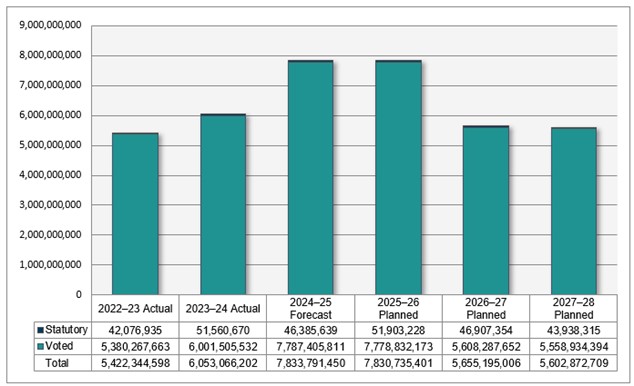
Text description of graph 1
Analysis of statutory and voted funding over a six-year period
Our budget changes each year because of the demand-driven nature of our programs and services, which are based on the supports and services for which Veterans come forward. Annually, we update our client and expenditure forecasts to ensure that all Veterans who come forward receive the benefits and services to which they deserve.
While forecasting helps ensure enough funding is available, expenditures are only incurred for Veterans who in fact come forward to use the program or service. The design of the Government’s budget process accounts for these fluctuations, which is why there will be changes to both forecasted and actual spending from one year to the next. Fluctuations in spending are normal, given that initial forecasting is typically done many months in advance of the reporting period and adjusted throughout the year based on actual results. In addition, due to timing, any new spending announced in the upcoming Federal Budget, are not included in the planned spending figures.
Although the table above indicates a decline in planned spending for the coming years, this is based on forecasts developed well in advance of the reporting period due to the nature of the budgeting process. More recent forecast models suggest an increase in demand for many programs and services in the coming years, consistent with past trends. Planned spending for 2026-27 and 2027-28 will be updated in future years to incorporate the latest projections, bringing them more in line with 2025-26 levels. Veterans' benefits remain unaffected.
For further information on our departmental appropriations, consult the 2025–26 Main Estimates.
Future-oriented condensed statement of operations
The future-oriented condensed statement of operations provides an overview of our operations for 2024–25 to 2025–26.
Table 19: Future-oriented condensed statement of operations for the year ended 31 March 2026 (dollars)
Table 19 summarizes the expenses and revenues which net to the cost of operations before government funding and transfers for 2024–25 to 2025–26. The forecast and planned amounts in this statement of operations were prepared on an accrual basis. The forecast and planned amounts presented in other sections of the Departmental Plan were prepared on an expenditure basis. Amounts may therefore differ.
Analysis of forecasted and planned results
The estimated net cost of operations for fiscal year 2025–26 is $7.6 billion. Over 90% of the planned spending is paid directly to, or on behalf of, the people we serve, in the form of compensation, financial support, health care and commemoration. Fiscal year 2025–26 includes $174M less in accrued litigation expenses, accounting for the increased cost of operations.
A more detailed Future-oriented statement of operations and associated notes for 2025–26, including a reconciliation of the net cost of operations with the requested authorities, is available on our website.
Human resources
This section presents an overview of our actual and planned human resources from 2022–23 to 2027–28.
Table 20: Actual human resources for core responsibilities and internal services
Table 20 shows a summary of human resources, in full-time equivalents (FTEs), for our core responsibilities and for internal services for the previous three fiscal years. Human resources for the current fiscal year are forecasted based on year to date.
Analysis of human resources over the last three years
As part of the Service Excellence initiative, human resource levels increased in 2022-2023, 2023-2024 and 2024-2025. These temporary FTE resources were hired with the purpose of clearing the backlog of disability applications. The initiative will not only help us address the number of pending Disability Benefit applications, but also improve Case Management Services and improve Innovation across the Department.
Table 21: Human resources planning summary for core responsibilities and internal services
Table 21 shows information on human resources, in full-time equivalents, for each of our core responsibilities and for internal services planned for the next three years.
Analysis of human resources for the next three years
In 2025-2026, we will continue our work to reduce processing times for disability applications and to improve service to Veterans and their families. Funding was extended to the end of fiscal year 2025-2026 for Service Excellence initiatives, which was originally part of the Government’s Economic and Fiscal Snapshot in August 2020.
Corporate information
Departmental profile
Appropriate minister:
The Honourable Jill McKnight, PC, MP
Institutional head:
Paul Ledwell, Deputy Minister
Ministerial portfolio:
Veterans Affairs
Enabling instrument(s):
Department of Veterans Affairs Act; Veterans Well-being Act; Pension Act
Year of incorporation / commencement:
1923
Departmental contact information
Mailing address:
Veterans Affairs Canada
P.O. Box 7700
Charlottetown, PE
C1A 8M9
Telephone:
1-866-522-2122
TTY:
1-833-921-0071
Website:
Mailing address:
Veterans Ombud
P.O. Box 66
Charlottetown, PE
C1A 7K2
Telephone:
1-877-330-4343
TTY:
1-833-978-1639
Website:
Supplementary information tables
The following supplementary information tables are available on our website:
- Details on transfer payment programs
- Gender-based analysis plus
Information on our departmental sustainable development strategy can be found on our website.
Federal tax expenditures
Our Departmental Plan does not include information on tax expenditures.
The tax system can be used to achieve public policy objectives through the application of special measures such as low tax rates, exemptions, deductions, deferrals and credits. The Department of Finance Canada publishes cost estimates and projections for these measures each year in the Report on Federal Tax Expenditures.
This report also provides detailed background information on tax expenditures, including descriptions, objectives, historical information and references to related federal spending programs as well as evaluations and GBA Plus of tax expenditures.
Definitions
List of terms
appropriation (crédit):
Any authority of Parliament to pay money out of the Consolidated Revenue Fund.
budgetary expenditures (dépenses budgétaires):
Operating and capital expenditures; transfer payments to other levels of government, departments or individuals; and payments to Crown corporations.
core responsibility (responsabilité essentielle):
An enduring function or role performed by a department. The intentions of the department with respect to a core responsibility are reflected in one or more related departmental results that the department seeks to contribute to or influence.
Departmental Plan (plan ministériel):
A report on the plans and expected performance of an appropriated department over a 3year period. Departmental Plans are usually tabled in Parliament each spring.
departmental result (résultat ministériel):
A consequence or outcome that a department seeks to achieve. A departmental result is often outside departments’ immediate control, but it should be influenced by program-level outcomes.
departmental result indicator (indicateur de résultat ministériel):
A quantitative measure of progress on a departmental result.
departmental results framework (cadre ministériel des résultats):
A framework that connects the department’s core responsibilities to its departmental results and departmental result indicators.
Departmental Results Report (rapport sur les résultats ministériels):
A report on a department’s actual accomplishments against the plans, priorities and expected results set out in the corresponding Departmental Plan.
distributed computing environment (environnement d’informatique réparti):
The Distributed Computing Environment (DCE) is a suite of “enabling” software services that allow organizations to distribute processing and data across the enterprise.
full time equivalent (équivalent temps plein):
A measure of the extent to which an employee represents a full person-year charge against a departmental budget. For a particular position, the full-time equivalent figure is the ratio of number of hours the person actually works divided by the standard number of hours set out in the person’s collective agreement.
gender-based analysis plus (GBA Plus) (analyse comparative entre les sexes plus [ACS Plus]):
Is an analytical tool used to support the development of responsive and inclusive policies, programs, and other initiatives. GBA Plus is a process for understanding who is impacted by the issue or opportunity being addressed by the initiative; identifying how the initiative could be tailored to meet diverse needs of the people most impacted; and anticipating and mitigating any barriers to accessing or benefitting from the initiative. GBA Plus is an intersectional analysis that goes beyond biological (sex) and socio-cultural (gender) differences to consider other factors, such as age, disability, education, ethnicity, economic status, geography (including rurality), language, race, religion, and sexual orientation.
Using GBA Plus involves taking a gender- and diversity-sensitive approach to our work. Considering all intersecting identity factors as part of GBA Plus, not only sex and gender, is a Government of Canada commitment.government-wide priorities (priorités pangouvernementales):
For the purpose of the 2025–26 Departmental Plan, government priorities are the high-level themes outlining the government’s agenda in the most recent Speech from the Throne.
horizontal initiative (initiative horizontale):
An initiative where two or more federal departments are given funding to pursue a shared outcome, often linked to a government priority.
Indigenous business:
For the purpose of the Directive on the Management of Procurement Appendix E: Mandatory Procedures for Contracts Awarded to Indigenous Businesses and the Government of Canada’s commitment that a mandatory minimum target of 5% of the total value of contracts is awarded to Indigenous businesses, a department that meets the definition and requirements as defined by the Indigenous Business Directory.
non budgetary expenditures (dépenses non budgétaires):
Non-budgetary authorities that comprise assets and liabilities transactions for loans, investments and advances, or specified purpose accounts, that have been established under specific statutes or under non-statutory authorities in the Estimates and elsewhere. Non-budgetary transactions are those expenditures and receipts related to the government’s financial claims on, and obligations to, outside parties. These consist of transactions in loans, investments and advances; in cash and accounts receivable; in public money received or collected for specified purposes; and in all other assets and liabilities. Other assets and liabilities, not specifically defined in G to P authority codes are to be recorded to an R authority code, which is the residual authority code for all other assets and liabilities.
Outcome Questionnaire® (OQ®) (questionnaire sur les résultats (OQ®)):
The adult Outcome Questionnaire® (OQ®) has, for a number of years, been recognized as one of the leading outcome tracking tools for quantifying and evaluating client progress during mental health treatment. This outcome measure has been widely adopted by a variety of mental health care service organizations (e.g. small clinics, large heath care institutions, university counseling centers, the US and Canadian military) since its release in the early 1990s.
performance (rendement):
What a department did with its resources to achieve its results, how well those results compare to what the department intended to achieve, and how well lessons learned have been identified.
performance indicator (indicateur de rendement):
A qualitative or quantitative means of measuring an output or outcome, with the intention of gauging the performance of an department, program, policy or initiative respecting expected results.
plan (plan):
The articulation of strategic choices, which provides information on how a department intends to achieve its priorities and associated results. Generally, a plan will explain the logic behind the strategies chosen and tend to focus on actions that lead to the expected result.
planned spending (dépenses prévues):
For Departmental Plans and Departmental Results Reports, planned spending refers to those amounts presented in Main Estimates.
A department is expected to be aware of the authorities that it has sought and received. The determination of planned spending is a departmental responsibility, and departments must be able to defend the expenditure and accrual numbers presented in their Departmental Plans and Departmental Results Reports.program (programme):
Individual or groups of services, activities or combinations thereof that are managed together within a department and that focus on a specific set of outputs, outcomes or service levels.
program inventory (répertoire des programmes):
Identifies all the department’s programs and describes how resources are organized to contribute to the department’s core responsibilities and results.
result (résultat):
A consequence attributed, in part, to a department, policy, program or initiative. Results are not within the control of a single department, policy, program or initiative; instead they are within the area of the department’s influence.
social prescribing (prescription sociale):
Social prescribing is a means of connecting clients to a range of non-clinical services in the community to improve their health and well-being. It builds on the evidence that addressing social determinants of health such as socioeconomic status, social inclusion, housing, and education is key to improving health outcomes.
statutory expenditures (dépenses législatives):
Expenditures that Parliament has approved through legislation other than appropriation acts. The legislation sets out the purpose of the expenditures and the terms and conditions under which they may be made.
Therapy-Assisted Internet Cognitive Behavioral Therapy (TA iCBT) (thérapie comportementale cognitive par Internet (TCCI)):
Internet-based Cognitive Behaviour Therapy (iCBT) is an innovative, easily accessible, and evidence-based psychotherapy format whereby patients access structured cognitive and behavioural therapy (CBT) modules independently over the internet. In therapist-assisted iCBT (TA-iCBT), patients complete between-session homework assignments, and receive regular support, symptom monitoring and feedback on homework assignments from a regulated mental health professional.
target (cible):
A measurable performance or success level that a department, program or initiative plans to achieve within a specified time period. Targets can be either quantitative or qualitative.
voted expenditures (dépenses votées):
Expenditures that Parliament approves annually through an appropriation act. The vote wording becomes the governing conditions under which these expenditures may be made.