
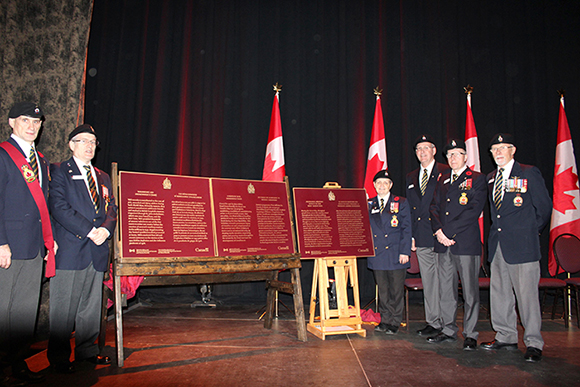

On March 2, 2017, the Department of National Defence supported Parks Canada and the Historic Sites and Monuments Board of Canada at an event commemorating Indigenous Military Service in First World War, Canadian War Memorials Fund, and Voluntary Aid Detachments. The event was held in the Barney Danson theatre at the Canadian War Museum. Joining Master of Ceremonies Dr. Brian Always, Chair of the Historic Sites and Monuments Board of Canada, in the unveiling of the three plaques were the Honourable Catherine McKenna, Minister of the Environment and Climate Change and Minister responsible for Parks Canada; Councillor Ron Bernard of the Algonquins of Pikwakanagan First Nation; Dr. Laura Brandon, former Historian, Art and War at the Canadian War Museum; and Dave Mowat, member of the Alderville First Nation of the Mississaugas.
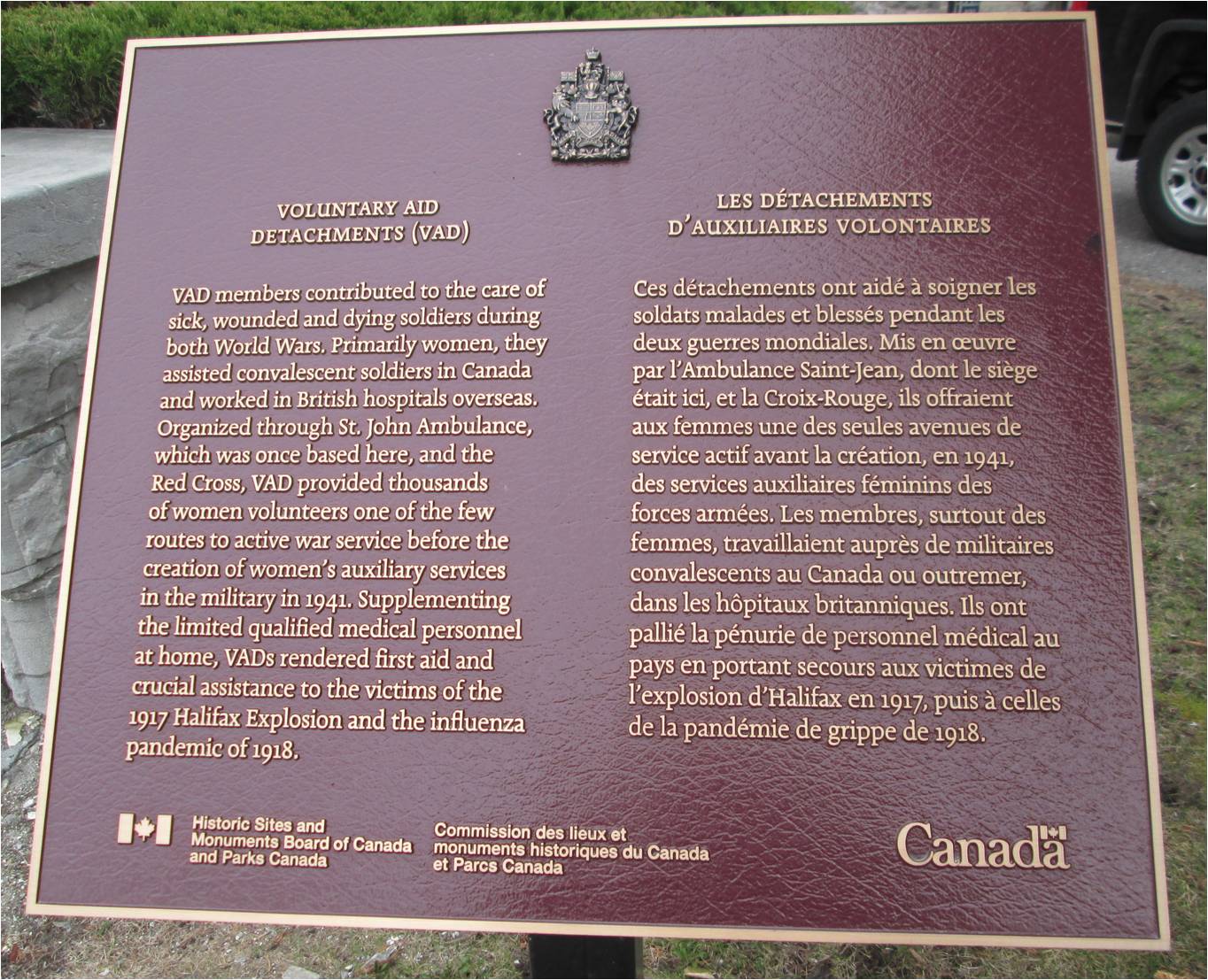
The plaque was subsequently installed at its current location in front of the building formerly housing the offices of the Saint John Ambulance.
Although unable to enlist, over 2,000 Canadian women volunteered and found a way to serve their country during the Great War and during two national emergencies at home -- the Halifax Explosion and the deadly Spanish Flu pandemic. Organized by the Canadian Red Cross and St. John Ambulance, Voluntary Aid Detachments worked as nurses’ aides, ambulance drivers, and clerical staff at convalescent hospitals in Canada and at some hospitals overseas. They assisted overworked medical and nursing staff in caring for thousands of injured and sick servicemen, some facing the same dangers and hardships as soldiers, nurses, and doctors working near the front lines.
Voluntary Aid Detachments first emerged in 1914 as Canada’s Militia Department made preparations at home, in anticipation of war in Europe. They were initially intended to create an emergency reserve of trained men and women who would support military medical services in case of invasion on Canadian soil. Later, following the outbreak of the First World War, the Voluntary Aid Detachments program developed into a female volunteer nursing corps, as male recruits were quickly drawn into the armed forces. Canadian Voluntary Aid Detachments units were modelled on a British system established in 1909, intended to supplement existing army nursing reserves. These reserves consisted of both professional nurses and civilian volunteers trained in first aid. While the British program utilized some 23,000 Voluntary Aid Detachments nurses during the Great War, the Canadian program was more modest. Still, the number of women who enrolled as Canadian Voluntary Aid Detachments members was considerable -- by the war’s end, some 2,000 had trained and qualified as Voluntary Aid Detachments nurses. While the majority were limited to working in military convalescent hospitals on the home front, an estimated 500 Canadian Voluntary Aid Detachments members served in British military hospitals overseas.
The first Canadian Voluntary Aid Detachments were formed in Halifax, Québec City, and Saint John, because these ports were expected to be the first to receive wounded soldiers returning from overseas. These were later followed by units in Montreal, Ottawa, and Victoria. Initially, Voluntary Aid Detachments members engaged in non-nursing activities distributing comforts such as chocolate bars and cigarettes to departing troops and wishing them a safe return home. As the war progressed, however, they helped to prepare, open, and staff military convalescent hospitals. This role became particularly important as increasing numbers of sick and wounded soldiers returned to Canada in early 1915.
Many were anxious to go overseas where the need was greatest, but it was not until September 1916 that the first contingent of Canadian Voluntary Aid Detachments members left in response to a request from the British Red Cross. Although the Canadian Army Medical Corps refused to use voluntary nurses in its overseas hospitals, Voluntary Aid Detachments nurses were welcomed into British military hospitals. Overall, St. John Ambulance in Canada supplied more than 360 volunteers for overseas postings, while many other Canadian Voluntary Aid Detachments members financed their own passages to England and applied directly to British Voluntary Aid Detachments headquarters in London. Working in the British military medical establishment, Canadian Voluntary Aid Detachments nurses served as probationers (trainees) who were supervised by professional nurses. As was the case in Canadian convalescent hospitals at home, they assisted with various nursing tasks, such as making beds, preparing diets for invalids, and ensuring the overall comfort of soldiers. In some instances, Voluntary Aid Detachments work approached that of trained nurses, as volunteers changed surgical dressings and performed night duty in charge of wards. Like the military nurses under whom they served, Canadian Voluntary Aid Detachments members posted in France, and more distant battle zones were exposed to frontline dangers and hardships. A number of volunteers were recognized for their bravery during enemy attacks.
Both at home and in overseas operations, Voluntary Aid Detachments work varied greatly depending on the location and hospital type. Detachment members performed any number of tasks, working as nurses’ aides, ambulance drivers, clerical staff, and in any other auxiliary capacity required of them during the war. Voluntary Aid Detachments nurses also demonstrated their training and skill in the aftermath of the Halifax explosion in December 1917 and during the "Spanish" influenza pandemic of 1918. They provided crucial medical and nursing assistance during these two national crises. Canadian Voluntary Aid Detachments nurses served for the duration of the Great War and beyond, helping to care for convalescent soldiers well after the Armistice in 1918, and were officially demobilized in October 1920.