
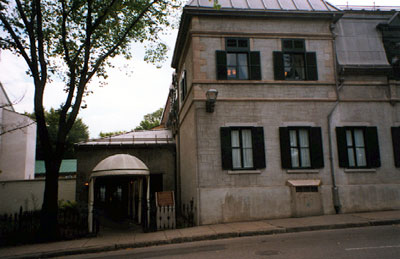
The Quebec Garrison Club was founded by militia officers in 1879 and is deeply rooted in the tradition of private clubs that began in 18th century England. In colonial times, British military officers posted to Canada kept alive their tradition of holding regular gatherings for rest and recreation, to discuss ideas and to celebrate various events. Following the departure of the British garrison in 1871, it seemed entirely normal to wish to preserve this tradition by having a social club for the Canadian military elite posted here. This led to the establishment of the Garrison Club. Initially, the Club’s membership was opened up to only a few members of the civilian elite; it was not until the 1890s that a larger number of civilians were admitted and allowed to sit on the board of directors. Throughout the twentieth century, the Québec Garrison Club maintained its interest in the military and continued to safeguard this tradition of social gatherings. It even expanded upon the concept by gathering into one club members of the military, political, economic and religious elite. When it was founded, the Garrison Club occupied the former office of the Royal Engineers in the old city, at the corner of Saint-Louis and Côte de la Citadelle streets. Built in 1816, this building was located in a predominantly military section of the city that included among its features the citadel, fortifications, the esplanade, and the Connaught and Saint-Louis barracks. It was given its present appearance in 1893 by architect Harry Stavely, working from a Château-style plan devised for the building in 1881 by Eugène-Étienne Taché. The Club still occupies the premises and continues to preserve their heritage value. In 1984, the Garrison Club merged with the Cercle universitaire de Québec. It has since preserved its military tradition, however, and still has a number of military personnel among its members. One of the oldest existing social clubs founded by the military in Canada, it continues to preserve the British tradition of military social gatherings. Furthermore, through its long association with the upper classes, it has transmitted to them the social club tradition; membership in the Club therefore constitutes a symbol of success and social status. A long-standing fixture of local society, the Club is a major contributor, because of the quality and finely preserved condition of the architectural and landscape complex it has occupied throughout its existence, to the heritage value of the Old City of Québec.
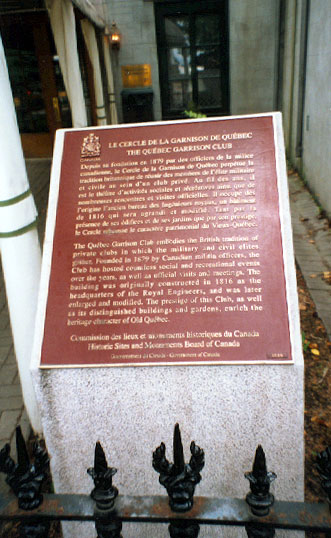
Quebec Garrison Club Memorial Plaque
Québec, Québec
Notice:
The National Inventory of Canadian Military Memorials is a public, crowd-sourced registry that helps Canadians learn about memorials in their communities. Inclusion in the Inventory does not imply VAC ownership or authority. Responsibility for the care, management, and any changes to a memorial rests with its owning or governing organization.
Inscription
LE CERCLE DE LA GARNISON DE QUÉBEC
THE QUÉBEC GARRISON CLUB
Depuis sa fondation en 1879 par des officiers de la milice
canadienne, le Cercle de la Garnison de Québec perpétue la
tradition britannique de réunir des membres de l'élite militaire
et civile au sein d'un club privé. Au fil des ans, il
est le théâtre d'activités sociales et récréatives ainsi que de
nombreuses rencontres et visites officielles. Il occupe dès
l'origine l'ancien bureau des Ingénieurs royaux, un bâtiment
de 1816 qui sera agrandi et modifié. Tant par la
présence de ses édifices et de ses jardins que par son prestige,
le Cercle rehausse le caractère patrimonial du Vieux-Québec.
The Québec Garrison Circle embodies the British tradition of
private clubs in which the military and civil elites
gather. Founded in 1879 by Canadian militia officers, the
Club has hosted countless social and recreational events
over the years, as well as official visits and meetings. The
building was originally constructed in 1816 as the
headquarters of the Royal Engineers, and was later
enlarged and modified. The prestige of this Club, as well
as its distinguished buildings and gardes, enrich the
heritage character of Old Québec.
Commission des lieux et monuments historiques du Canada
Historic Sites and Monuments Board of Canada
Gouvernement du Canada - Government of Canada
2000
Street View
Quebec Garrison Club Memorial Plaque
97 Saint-Louis Street
Québec
Québec
Lat. 46.8098198
Long. -71.2106599