
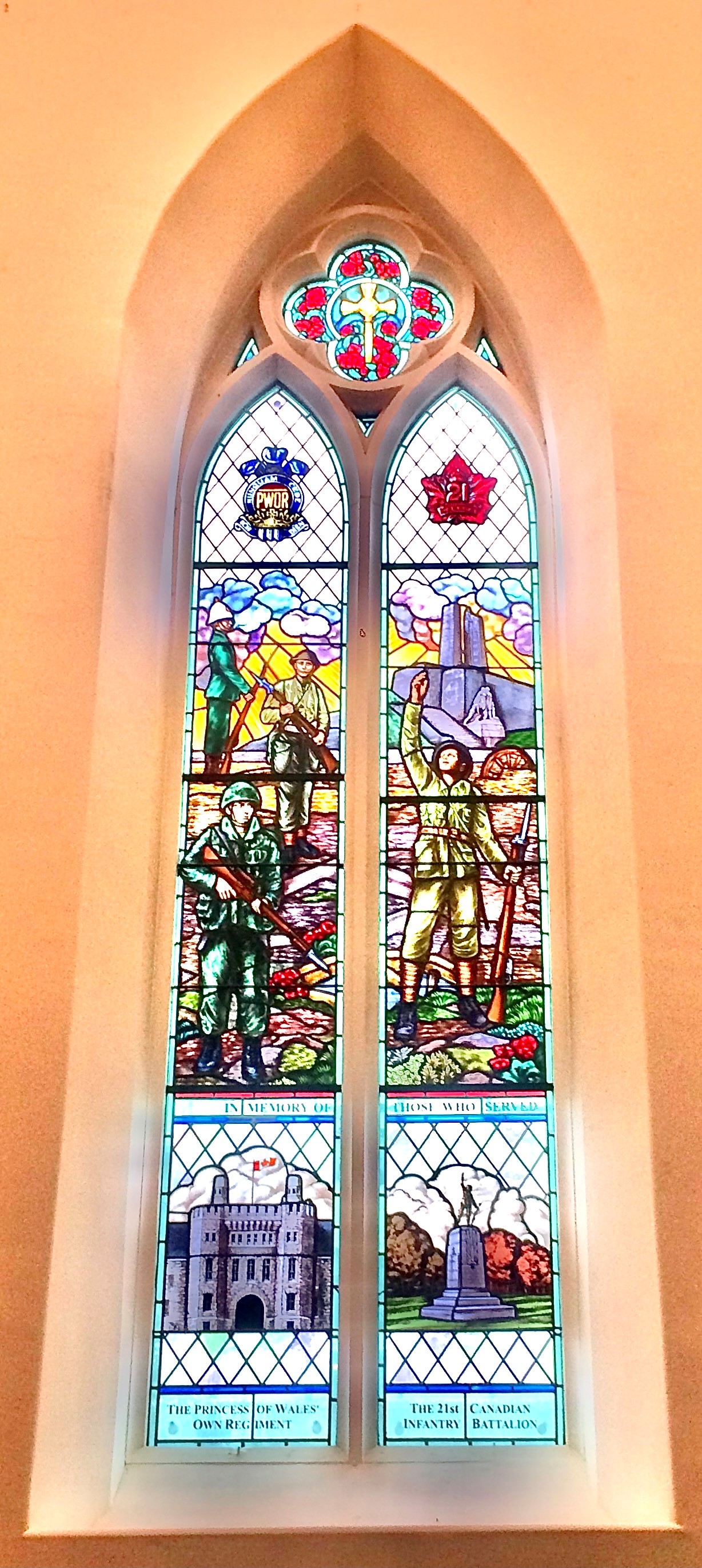
The Memorial Stained Glass Window commemorates those who served in the 21st Canadian Infantry Battalion, Canadian Expeditionary Force, and in the Princess of Wales' Own Regiment. The window was dedicated on 13 May 2007 and depicts: a cross, Princess of Wales' Own Regiment cap badge; 21st Canadian Infantry Battalion cap badge; Canadian National Vimy Memorial; soldiers from the War of 1812, South African War, Great War, and Second World War; Kingston Armoury; and the 21st Battalion Memorial in City Park.
The Princess of Wales’ Own Regiment has served Kingston since 1863 and was a major contributor of people and resources to the aid, defense and interests of Canada in major and minor historical events during the late 1800s and throughout the 1900s.
St. Paul's Anglican Church opened for worship on St. Paul’s Day 1847 and was more or less a Garrison church in the early days, as many of the troops of the Garrison used to attend Sunday afternoon services arranged by Reverend J. Bartlett, chaplain to the Forces. The church’s connection to the military continues to this day, as it is the Regimental Chapel to the Princess of Wales’ Own Regiment.
Just 11 days after the 1st Canadian Division sailed for overseas, the Honourable Sam Hughes, Minister of Militia and Defence, authorized the formation of a second division. On 19 October 1914, his youngest brother, Lieutenant Colonel William St. Pierre Hughes, commanding the 14th Regiment, Princess of Wales' Own Rifles in Kingston, was ordered to raise the 21st Battalion to be part of the 4th Brigade. On 3 November 1914, the battalion was formed in Kingston from 15 eastern Ontario militia regiments, along with 93 men from the Royal Canadian Horse Artillery. The Battalion was in existence for four years, six months, and 22 days, during which just over 5,000 served in its ranks. They earned 18 battle honours and over 300 personal decorations at a cost of over 800 killed and many more wounded.