
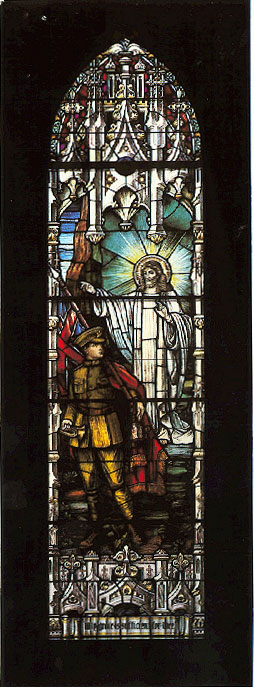
The Soldier's Window is dedicated to the 17 members of St. John's United Church congregation who died in the First World War. The stained glass window, manufactured in 1919 by Luxfer Prism Co. Ltd. of Toronto, was erected by the congregation of St. John's United Church. The Unveiling Service and Dedication took place July 25, 1920. The cover of the church bulletin that sunny Sunday read: "Unveiling of the Memorial Window erected in loving memory of OUR HEROES who fell in the Great War... Greater love hath no man than this, that a man lay down his life for his friends. " John 15:13. The sermon Life and Sacrifice was delivered by Capt. the Rev. J.W. Magwood, the dedicatory prayer by Capt. the Rev. W.B. Caswell. The choir anthem, There is a Green Hill Far Away, was followed by a solo by Mrs. W.T. Merry entitled, God Shall Wipe Away All Tears from Their Eyes. The Ladies' Octet sang Abide With Me. Of the ten stained glass windows in the church, The Soldier's Window is the most unusual. Instead of the conventional Biblical scene, it depicts a contemporary man in what is otherwise a religious setting. The Canadian soldier with the maple leaves on his collar and cap, bears no visible military rank or insignia, emphasizing his Everyman quality. He carries only a bugle or small trumpet and a flag, which appears to be the Canadian Red Ensign, precursor of the present day Maple Leaf. The bars of the Union Jack in the flag's upper right-hand corner form a red cross which he appears to carry over his right shoulder, just as his Savior behind him bore a similar burden. The soldier's stance is reluctant, pulling away from his ultimate fate. The promise of salvation is echoed in the scriptural reference at the bottom of the window, 2 Corinthians 12:9 My grace is sufficient for thee. The choice of colours in the window is also symbolic. Gold, red, blue and white are predominant. As sun streams through the window, the soldier's khaki uniform is transformed into a burnished, verdigrised gold, re-echoed in the bugle, the flag's fringe, and Christ's halo. Gold represents something of great value and purity. Red, of course, symbolizes the blood of life, sacrifice, loyalty, and our communion with God. It appears in the flag, which is draped around the soldier and within the flag, in the red cross of St. George, patron saint of England. Blue is visible in the sky above the soldier, but not above Christ, suggesting He is otherworldly, and in the top right-hand corner of the flag, part of the cross of St. Andrew, a white x-shaped cross on a blue background. Blue, the ancient colour of purity, also symbolizes great courage and endurance. White, the ancient colour of mourning, enrobes Christ and also represents purity and innocence. Below the window are two plaques commemorating those members of the church who died in the First and Second World Wars. The cost of the window in 1919 was $210. Today, its replacement value would exceed $10,000.
St. John's United Church Soldier's Window
Oakville, Ontario
Notice:
The National Inventory of Canadian Military Memorials is a public, crowd-sourced registry that helps Canadians learn about memorials in their communities. Inclusion in the Inventory does not imply VAC ownership or authority. Responsibility for the care, management, and any changes to a memorial rests with its owning or governing organization.
Inscription
MY GRACE IS SUFFICIENT FOR THEE
Street View
Location
St. John's United Church Soldier's Window
262 Randall Street
Oakville
Ontario
St. John's United Church Soldier's Window
262 Randall Street
Oakville
Ontario
GPS Coordinates
Lat. 43.4475962
Long. -79.6688442
Lat. 43.4475962
Long. -79.6688442