
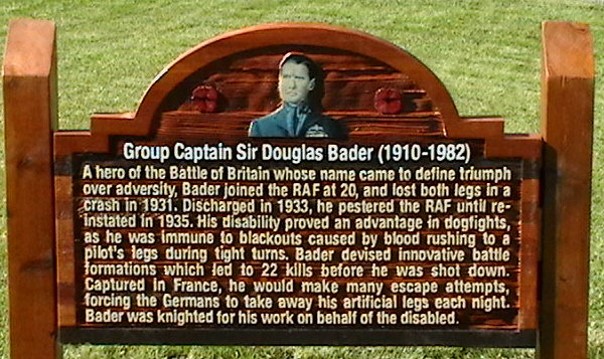
Bader Crescent is named in honour of Group Captain Sir Douglas Bader. It is located in Montgomery Place, an area developed in 1946 to house returning Second World War Veterans and their families. Most streets and parks in the area are named for prominent military members, famous battles, and military units.
Bader, a hero of the Battle of Britain whose name came to define triumph over adversity, joined the Royal Air Force at age 20, and lost both legs in a crash in 1931. Discharged in 1933, he pestered the Royal Air Force until re-instated in 1935. His disability proved an advantage in dogfights, as he was immune to blackouts caused by blood rushing to a pilot’s legs during tight turns. Bader devised innovative battle formations which led to 22 kills before he was shot down. Captured in France, he would make many escape attempts, forcing the Germans to take away his artificial legs each night. Bader was knighted for his work on behalf of the disabled.
After flying operations over Dunkirk, he was posted to command No. 242 squadron as Squadron Leader at the end of June 1940; a Hurricane unit based at Coltishall, mainly made up of Canadians who had suffered high losses in the Battle of France and had low morale. Despite initial resistance to their new commanding officer, the pilots were soon won over by Bader’s strong personality and perseverance, especially in cutting through red tape to make the squadron operational again. Upon the formation of No. 12 Group Royal Air Force, No. 242 squadron was assigned to the Group while based at Royal Air Force Duxford.
Bader was a champion for his men, long after the war. Bader was subsequently successful in convincing the city of Calgary to name a street after his young wingman. In October of 1969, a roadway leading to the Calgary Airport became McKnight Boulevard. Bader was also instrumental in having another street in Calgary named for his old friend and devoted aircraft fitter from the Battle of Britain—Corporal Noel Holland Barlow. When Bader first visited Calgary in 1955, he was met at the airport by Barlow.
In 2004, the Montgomery Place Community Association embarked on a project to explain the choice of names for Montgomery Place streets. The research and writing were undertaken by Kevin Gooding who was the Finance Director at the time, with help from President Jim Earle.
The signs were produced at Abe’s Sign Design Group of Saskatoon, with owner Gerry Tunicliffe giving the Association his whole-hearted support. Gerry even offered the Cassino Avenue sign free-of-charge, since his father had fought at the Battle of Monte Cassino. With interest and dedication, Gerry was also a great help to Kevin tracking down photos for the signs.
On September 22, 2007, Kevin, Jim and Vice-President Dave Price, along with Secretary Larry Rempel, Communications Director Gary Berg and resident Don Janzen, rented an auger and then dug, filled, tamped and installed the first 16 signs. Three more signs were installed later.